


Share This Article
You’ve probably never met Glen Silver and he’s probably never met you. But chances are he has, at some point, smelled your garbage.
“It’s like nothing else in the world,” Silver says of the odor from the Seneca Meadows Landfill, located more than three miles from his home in Waterloo, N.Y. “Sickly sweet. Acrid. Stomach churning, depending on what the mix of the day is. It’s almost like you’re smelling chemicals from a dry-cleaning establishment or what benzene smells like. It doesn’t smell like something you should be breathing.”
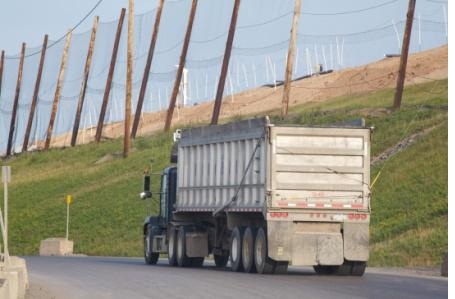
It isn’t just the stink that bothers Silver and other members of the group Concerned Citizens of Seneca County, which has battled against the landfill for six years. They are also troubled by the height of the growing mound at the landfill, which at 275 feet is the tallest manmade structure for miles, and the truck traffic that hauls an average of 5,500 tons of trash to the landfill daily.
“There’s a lot happening here around what I think of as an assault on this area of New York,” Silver says.
New York City’s Department of Sanitation collects more than 12,600 tons of material from households and institutions every day. Only about 16 percent of it gets recycled. Almost all the rest heads to one of five landfills in New York or 24 other facilities spread around Connecticut, Kentucky, New Jersey, Ohio, Pennsylvania, South Carolina and Virginia. The top recipient in 2014, Atlantic Waste landfill in Waverly, Va., accepted 794,000 tons of New York City refuse last year.
The road trip our garbage takes is not a cheap one. The Department of Sanitation currently has contracts for municipal solid-waste export worth $8.2 billion with 13 companies. The city’s fiscal 2016 executive budget calls for $368 million to be spent on waste disposal next year alone.
At the Earth Day unveiling of the his OneNYC strategy Mayor de Blasio committed New York City to a “zero waste to landfills” goal by 2030, touching off debate about what his pledge really entailed and how the city could possibly achieve it. The city will face tough choices to reach the mayor’s goal, including whether to wind down shipments to landfills by increasing its use of plants that incinerate trash to generate energy.
Even without action by the de Blasio administration, however, the landfill landscape is changing because of work by residents and regulators at a few of the sites New York City dumps on.
Timing out at Tullytown?
Dave Hamilton has lived in Florence, N.J., since the 1960s and has smelled garbage since 1988 when the Tullytown Landfill opened just across the Delaware River.
Tullytown was the 11th biggest recipient of New York City trash last year. Nearby is the GROWS North landfill, which accepted 521,000 tons of New York waste in 2014, second only to the Waverly site in volume received from DSNY. Both Tullytown and GROWS North are operated by Waste Management, whose current contracts with New York City are worth $3.8 billion.
Both those landfills sit in Pennsylvania but on New Jersey’s doorstep, and that’s created tensions for years. Waste Management pays host fees to municipalities in the Keystone State—2014 budget documents indicate the firm would provide $3.7 million of Tullytown’s $5.7 million in revenue—but it’s the Garden State that’s downwind. “It’s been a constant problem ever since they put the landfill in,” Hamilton says. “Predominantly, the wind blows west to east so when there are odor problems, they blow right to Florence. This thing is just massive.”
In 1998, Waste Management settled a lawsuit with Florence residents, agreeing to pay $3.1 million in damages and take steps to reduce odors. But the stink has persisted, Florence residents say. “Last summer, three or four days out of seven it was really just undesirable to be outside on our property. We couldn’t use our yards. It was like sitting next to a trash can,” Hamilton recalls. When Florence residents would complain via a Waste Management hotline, he says, they’d be told, “‘We got a bad load in. We’ll turn on our misters and deal with it.'”
Last fall, Pennsylvania Department of Environmental Protection inspectors crossed the Delaware to conduct “multiple odor inspections” and determined that “the location, type, frequency, duration and intensity of the odors detected constitute a public nuisance,” according to a notice of violation issued to Waste Management in October. The notice concluded that the company’s odor-control practices were “inadequate.”
A spokeswoman for the Pennsylvania agency told City Limits earlier this month that Waste Management had taken steps to address the NOV, including reducing daily tonnage accepted at Tullytown, using more soil to cover up the garbage and installing additional misters to dampen down the stink. No fines were assessed for the violation.
But for Waste Management, the timing of the regulatory action was inopportune—coming just a few months before Pennsylvania considered whether to renew or revoke the permit that allows the company to bury trash at Tullytown. On Thursday, PADEP announced that it would shut down the landfill in two years’ time. Citing “public concerns regarding ongoing odor, noise, bird and aesthetic nuisances” the department said Waste Management could be subject to enforcement in the meantime if it doesn’t get control of the smell.
“We are thankful that the Pennsylvania Department of Environmental Protection has renewed our permit and has allowed us to complete the construction of Tullytown Landfill,” Waste Management said in a statement. “We remain fully committed to minimizing and controlling potential off-site impacts. We will continue our daily quality assurance patrols and maintain our relationships with nearby communities to assure that we are doing everything we can to be a good neighbor.”
Hamilton views the decision as a victory for Florence. Had the DEP shut Tullytown down immediately, Waste Management might have had strong grounds for mounting an appeal that, win or lose, would have kept the landfill open for far longer than two years as the legal battle played out.
Even after Tullytown closes, landfills will continue to affect the area. Waste Management is applying for a permit to start a new landfill at the site of an old steel factory next to the GROWS-North facility. The breezes off that site will affect residents outside of Florence, Hamilton says, but he sympathizes. “Those are cute little towns. They’re going to experience what we’ve been experiencing the last 26 years,” he says. And they don’t even know it’s coming.”
To burn or not to burn
Some of New York City’s garbage journeys about an hour southwest along the Delaware River from Tullytown to Chester, Pa., and a plant operated by Covanta Energy, which burns trash to generate power. The Chester site and three other Covanta facilities—in Hempstead, N.Y., Rahway, N.J. and Newark—accepted a total of 500,000 tons of New York garbage last year. More could be on the way: Under a 20-year, $2.8 billion contract now in place, Covanta agreed to take up to 800,000 tons from DSNY. The firm is upgrading another plant in Niagara Falls, N.Y. to deal with some of that volume.
Covanta dubs itself the world’s largest operator of “energy-from-waste” plants. The U.S. Environmental Protection Agency (EPA) calls the process used at Chester and elsewhere “energy production from waste.” But Mike Ewall, a veteran environmental justice advocate in the Chester area, contends that language is misleading. “It’s important to understand that ‘waste-to-energy’ is not an accurate term,” he says. “Incinerators are still incinerators even if they produce electricity.”
No one disputes that plants like Covanta’s employ massive boilers to burn garbage and use the resulting heat to turn water into steam that drives turbines to generate electricity. The argument is over whether “waste-to-energy” plants adequately capture enough of the pollutants that are produced by trash-burning or continue to release dangerous toxins into the air the same way old-fashioned incinerators did.
“The emissions control systems that we have in place” are what distinguishes the Chester plant from old-fashioned incinerators, according to Covanta director of communications James Regan. “It’s not an open burning system. We have sophisticated filtering systems that scrub acid gasses and bag houses that get particulate matter.” Regan says the Chester plan emits dioxins at a level 92 percent below what is allowed in Pennsylvania while generating up to 80 megawatts of power.
There appears little question that waste-burning plants generate less pollution than they used to. Since regulatory changes in 1990, the 86 energy-producing incinerators around the country have emitted levels of mercury, cadmium, lead and particulate matter 95 percent lower than before, according to the EPA. The issue is whether those reductions have eliminated the toxic potential of burning trash. Ewall believes the Chester plant is a threat to the health of people in the area, citing what he says are higher-than-average asthma hospitalization rates in the area. He’s also concerned that many waste-to-energy incinerators monitor their own emissions or pay another private company to do so with regulators looking only at results.
The Chester facility has been fined 11 times for a total of $330,000 in administrative orders under the Clean Air Act over the last five years, according to an EPA database. In 2010, Covanta settled a lawsuit by environmental justice advocates in Newark over the operation of its plant there and agreed to install more sophisticated pollution prevention equipment. It promised to upgrade that plant again in 2012, before it inked the current long-term deal with the city of New York. In 2011, it paid a $400,000 fine to the state of Connecticut after the company detected excessive dioxin emissions at its Wallingford facility.

This sidebar is part of a series about the challenge New York City faces in reducing the environmental and economic costs of its municipal waste. Click here to read more.
It’s unclear whether plants like Covanta’s will play a bigger role in handling New York’s garbage down the road given de Blasio’s “zero waste to landfills” pledge.
“We’re going to constantly drive down the amount of waste we create through composting, through better recycling. We’re going to constantly drive that down to the point that nothing goes from New York City to a landfill in the future,” the mayor said on April 22. “It will be a hard effort. It’s going to take a lot of resources. It’s going to take a lot of public education. It’s going to take a lot of community organizing. But this is the way of the future if we’re going to save our earth.”
The administration hasn’t explained whether de Blasio’s pledge, which focused on landfills, means more burning of trash for energy. Some environmental advocates argue against a literal adoption of “zero waste” precisely because it implies that garbage will be incinerated, which they oppose. They note that incineration can’t eliminate all need for landfills: According to the EPA, about 10 percent of the volume of the garbage that waste-to-energy plants burn remains as ash, which then must be disposed of—usually in landfills.
“There is no such thing as ‘zero waste to landfill,'” Ewall says. A true zero-waste policy “means to neither bury nor burn waste. Incineration is what needs to come off the table first.”
Regan, however, argues that landfills are the far greater health threat. Energy producing trash incinerators are easier for regulators to monitor and can install pollution controls, if the owners are willing to pay for them.
“As opposed to the alternative of trucking waste to landfills as far as South Carolina, we are far superior to landfills, in our view,” he argues. “Landfills generate methane gas with 30 times more potency than carbon dioxide for global warming and have hundreds of uncontrolled emissions.” And sometimes landfills burn trash, too, but in an uncontrolled manner: An underground fire burned for years at a landfill in Bridgeton, Mo.
‘It’s a Wonderful’ landfill
Like Tullytown, GROWS, Waverly and the Covanta plants, Seneca Meadows accepts trash from sources besides New York City. The Seneca site is located in a rich vein of Americana: Seneca Falls (population 9,040), where the facility is located, is believed by many to have been the model for the fictional Bedford Falls in the Jimmy Stewart classic “It’s a Wonderful Life,” and next-door Waterloo (population 5,182) boasts of being the site of the nation’s very first Memorial Day Parade.
Waterloo mayor Ted Young says there are pros and cons to living so close to a landfill. “It’s close by enough for our residents and local municipalities in the county to dispose of their waste—garbage and trees and other stuff that they take out there,” Young says. “The downside is that it’s a huge mountain that gives off an odor every once in a while that has an effect on village residents and town residents who happen to be in the windfall.”
The benefits of Seneca Meadows are more quantifiable in Seneca Falls, where more than half the funding for the town’s $5.4 million budget comes from landfill host fees. Waterloo and other nearby towns see the truck traffic and smell the trash but don’t see any of that money, Young says.
Yet Silver acknowledges that there’s hardly a groundswell of opposition to the landfill in the area. He attributes that to the small population—Seneca County’s territory is about as large as New York City, but the entire county’s population is no larger than the headcount of the NYPD—and prevailing conservative mindset. “It’s not a sexy enough issue to be on people’s radar screens,” he says. Concerned Citizens of Seneca County is pursuing a challenge to the permits Seneca Meadows uses to operate the landfill. “To my mind, landfills are the scourge of the earth,” he says. A landfill “is a polluter of air, land and water at the same time.” Seneca Meadows didn’t return a call for comment.
A 2011 assessment by the New York State Department of Environmental Conservation indicated that Seneca Meadows still had 28 million tons of capacity under its permit, enough for about 14 years of operation. Altogether, DEC estimated that the 27 active landfills in the state had room to bury 220 million more tons of garbage, enough to keep the bulldozers working for 29 years unless cities like New York find a different way to deal with their trash than burying or burning it in someone else’s backyard.
5 Comments
EnergyJustice
Thanks for covering these sides of the story, Jarrett! So much to add, though…
* The “waste-to-energy” term… to see why it’s inaccurate, see: https://www.energyjustice.net/incineration/waste-to-energy
* Incinerators still require landfills for their toxic ash. For every 100 tons burned, you get 30 tons of ash (the 10% figure is by volume, but disposal is done by tonnage). This makes the landfills more toxic, threatening groundwater, after the incinerator makes the air far more toxic than a landfill ever could on its own.
* The Chester, PA incinerator (“Covanta Delaware Valley”) is lacking the “sophisticated filtering systems” that most incinerators have. It’s totally missing any controls for nitrogen oxides (NOx) that cause asthma, which is why that incinerator is one of the largest sources of NOx in the region. Most incinerators have these, plus carbon injection to limit mercury and dioxin pollution. The Chester incinerator doesn’t, even though it’s the nation’s largest and in a dense, urban black community. Even EPA inspectors questioned this (but did nothing about it). See https://www.ejnet.org/chester/pollutioncontrol.html and https://www.ejnet.org/chester/covantapollution.html Of all 80-some trash incinerators in the nation, the Chester plant is #1 in particulate matter, #3 in sulfur dioxide pollution, #6 in mercury and #7 in NOx, according to the latest national data from EPA (National Emissions Inventory, 2011).
* The article says that methane gas is 30 times more potent than carbon dioxide. It’s actually 34 times more, if you still look at it over a 100 year time-frame, but the latest science looking at it over a (more appropriate) 20-year time frame, shows that it’s 86 times as bad as CO2. See https://www.energyjustice.net/naturalgas#GWP That’s why we need to digest trash before landfilling it (and skip the incinerator altogether), to minimize global warming pollution. Incinerators are 2.5 times as bad as coal plants for global warming, according to EPA’s eGRID data — looking at it in tons of CO2 per megawatthours generated. Conventional landfills are even worse because of the methane, but not if you digest things first, to get the methane out in an enclosed situation where it’s possible to capture it all. This also avoids having gassy, stinky landfills. Here’s what a real zero waste system looks like: http://www.energyjustice.net/zerowaste/
Unfortunately, the 20-30 year contract to burn trash in Chester and Niagara Falls has provisions that make it costly for NYC to back out of it, essentially locking in the worst possible option for what to do with the waste. NYC could at least have required that Covanta bring it to plants that have modern pollution controls installed! This injustice needs to be addressed. Poisoning Chester, PA residents for 20-30 more years is unacceptable. Black lives matter.
Roberta G. Zuckerman
Plans are that the garbage from the East 91st Street Marine Transfer Station in NYC will ultimately be sent to Chester Pennsylvania so what is being accomplished by building this WHITE ELEPHANT?
James Hack
A well written and concise article about NYC’s waste problem. I wish more focus was on how inefficient and wasteful DSNY is with its long-term waste disposal contracts. The DSNY has a budget of over $1 billion per year and does not charge for its service. Their budget comes from the general fund. The only way to get people to recycle and reduce waste is to actually charge for disposal. But the DSNY response is always that NYC is unique from other cities because it’s made up of high rise buildings and you can’t determine who is throwing out what. That’s nonsense because the DSNY should just charge the whole building for the waste it generates and leave it up to the building on how to divide the bill among residents. Sadly, there is very little traction to move this initiative forward.
DLH
You are right – NYC is drowning in the garbage we all create and the only way to stem the tide is through price incentives. Most cities charge for garbage collection and disposal directly – often as a utility. Residents and businesses in these cities can see exactly what they pay – and the cities are able to offer cost savings or increases if the amount of waste set out for collection is changed. NYC pays for waste management out of a huge general tax fund – so NYers have no way to know what they pay for garbage processing – and they have no way to change how much they pay by reducing, reusing and recycling more waste.
DSNY and City Hall have avoided facing our waste problems directly by coming up with costly, elaborate and outdated schemes to move garbage around differently – and send it far away to distant, poor cities for incineration and landfilling. One of these schemes (E91 MTS) will triple what we pay for garbage processing without addressing the real issue – the huge amount of waste we generate. It’s time for NYC to face the problem and develop real solutions – make it easier to reduce, reuse and recycle – and develop a price incentive plan to change behavior.
Laura
People of Staten Island dealt with this for years and years , and no one really cared. The amount of people who lived near the dump with cancer is outrageous; people with no history of cancer, no attributing lifestyle choices other than the dump and no one cared because it was Staten Island.