


Share This Article
Mayor Mamdani and the City Council reached a deal late Monday to expand city-subsidized rental assistance as part of a larger budget agreement. Thousands of new households will be eligible for vouchers under the expansion, but the scope is far smaller than lawmakers originally intended.
This is a developing story and will be updated.
Thousands of new households will become eligible for city housing vouchers if lawmakers pass a budget deal Tuesday. The agreement expands eligibility for city-subsidized rental assistance to some people living in rent stabilized housing and to a wider subset of those living in homeless shelters.
The expanded aid will be administered under a new program run by the Department of Housing Preservation and Development, officials said.
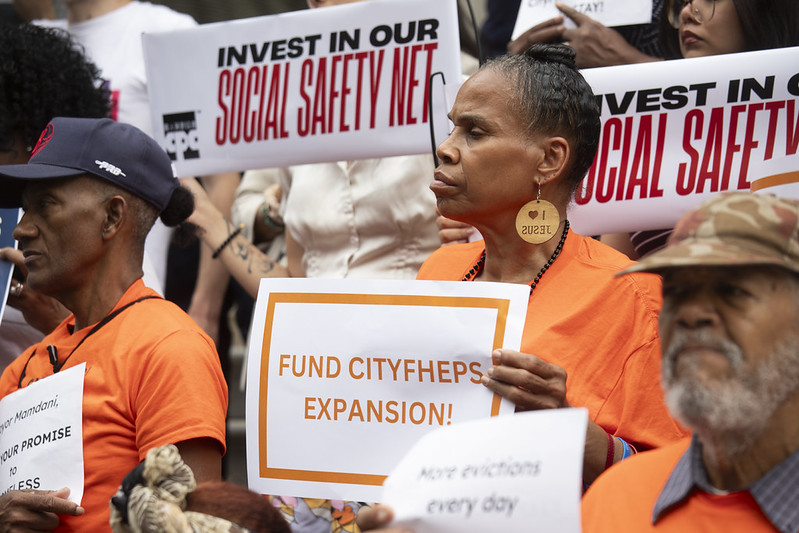
Funding for the city’s existing voucher program, called CityFHEPS, became a sticking point for negotiations between Mayor Zohran Mamdani and the City Council late last week. With a budget due by midnight Tuesday, lawmakers took talks down to the wire, agreeing on a $175 million voucher expansion late Monday night.
Though the program is far smaller than a previous expansion passed by the City Council, the deal settles a lawsuit between the Council and the mayor and creates a new voucher program that will serve tens of thousands of New Yorkers.
The City Council and City Hall provided differing estimates for how many people that will be, exactly. A spokesperson for the mayor said they expect the new vouchers will serve approximately 5,600 households, or 14,000 people, while the Council estimated it could cover 9,600 households, or 30,000 individuals.*
“Every New Yorker deserves a safe, affordable home, and this agreement will help more families avoid eviction and homelessness,” said Speaker Julie Menin in a statement. “Our historic announcement includes the administration dropping their lawsuit against the Council and a new bill which addresses some of the fiscal concerns.”
The mayor and speaker will shake hands on the spending plan Tuesday morning.
The CityFHEPS program currently serves New Yorkers moving out of Department of Homeless Services (DHS) shelters. Nearly 70,000 households use the program, and around 15,000 left city shelters for permanent housing using the subsidy last fiscal year, a record high. With the vouchers, tenants pay 30 percent of their income in rent while the city pays the rest.
Here’s what the agreement means for the ongoing political battle and which New Yorkers may be newly eligible for vouchers.

The City Council will drop its lawsuit against the Mamdani administration
Back in 2023, the City Council passed a package of laws that expanded eligibility for CityFHEPS housing vouchers to people outside the shelter system facing eviction, and households with slightly higher incomes. It also dropped work requirements for the program.
But former Mayor Eric Adams never implemented those laws, saying the expansion was too expensive and would increase competition for existing voucher holders, who sometimes struggle to find apartments where they can use their subsidies. The Council sued. During his campaign for mayor, Mamdani pledged to drop the lawsuit and implement the expansion.
Then, faced with a significant budget deficit, he backtracked, appealing the lawsuit and vowing to work on a solution that put CityFHEPS on “firm financial footing.”
Even before considering expansion, budget groups were sounding the alarm over the price tag on the program, which grew five-fold between 2021 and 2025, to over a billion dollars. Comptroller Mark Levine estimated that fully implementing the expansion could cost between $6 and $20 billion over the next five years.
But after progressive lawmakers said they wouldn’t vote for a budget unless more CityFHEPS vouchers were included, Speaker Menin pulled out of a budget handshake Friday, insisting on more funding for vouchers.
The deal reached Monday night will see the Council drop its lawsuit against the administration, in exchange for an expansion of the program to the tune of $175 million in this year’s budget, and a baseline of $125 million beginning in fiscal year 2028.
The sum is considerably less than some in the Council had hoped. Legislators aimed for as much as $300 million or $500 million in recent negotiations.
The agreement creates a new voucher program, run by a different agency
The budget isn’t the only piece of Council business that needs to wrap up before midnight Tuesday.
The new vouchers, while part of the campaign to expand access to CityFHEPS, will actually be part of a new rental assistance program that lawmakers will need to pass before they advance a budget.
The legislation will essentially replace the contested 2023 laws with a new voucher initiative that will expand access to part of the population that would have been covered by those earlier bills.
The program will be implemented by the city’s housing agency, HPD, instead of the Department of Social Services, which runs CityFHEPS. HPD administers the federal housing voucher program Section 8, as well as the state’s Housing Access Voucher Program, in New York City.
Sources said that the new program is being administered by a separate agency in part to avoid complications with New York’s social services law, which was an issue in the legal case.
“We are expanding access to housing vouchers responsibly, delivering relief to tens of thousands of New Yorkers, and putting the City on a stronger path away from costly shelter reliance and toward permanent homes,” said Councilmember Pierina Sanchez, who led on some of the negotiations, in a statement.
The agreement allows some rent-stabilized tenants facing eviction to use vouchers
As part of the agreement, some households facing eviction in rent stabilized units will be eligible to receive a voucher if they meet income requirements.
For those facing eviction, the income eligibility for the new program would rise to that of the original Council expansion—up from around $55,000 for a family of three currently (200 percent of the federal poverty line), to around $76,000 for a family of three (50 percent of the area median income).
These vouchers would have no work requirements.
But by limiting the expansion to just rent-stabilized units, which have lower rents, the city will save on costs per voucher while also shrinking the total number of eligible households.
People in different agency shelters will be able to use the new vouchers
Currently, only people living in shelters run by the Department of Homeless Services are eligible for CityFHEPS vouchers.
But thousands of people live in homeless shelters run by other city agencies, as City Limits reported. In April, 10,536 thousand people lived in shelters run by the Human Resources Administration, the Department of Youth and Community Development, HPD, the Mayor’s Office of Criminal Justice, and NYC Emergency Management.
Families and single adults living in these shelters would be eligible for the new vouchers as well, with the same income limits as rent stabilized tenants and without work requirements.
The existing CityFHEPS program in DHS shelters stays the same
The 2023 expansion also significantly expanded eligibility for vouchers for people within shelter. Currently, shelter residents are subject to work requirements, and can’t make more than 200 percent of the federal poverty level in order to qualify.
Under the new expansion program, those rules for CityFHEPS will stay in place for DHS shelter residents, sources say.
The existing CityFHEPS program saw its budget cut by half a billion dollars in Mayor Mamdani’s executive budget, savings the administration says will come from program reforms and efficiencies.
A previous analysis by the shelter provider Women In Need estimated that increasing the income limit to 50 percent of AMI would have made 894 households eligible. The elimination of work requirements for people in DHS shelter would have made over 12,000 households newly eligible.
Despite the expansion, they will remain ineligible for CityFHEPS. Households living in DHS shelters who make above the income limit for CityFHEPS, but less than 50 percent of the area median income, may be eligible for the new program, a Council source said Tuesday.
Households making under 200 percent of the federal poverty level who are not currently eligible for CityFHEPS because they do not meet work requirements will also be eligible.
The new program will have a capped number of vouchers based on its appropriation in the budget, unlike its sibling, CityFHEPS, where eligible households in shelter are given pre-clearance to search for an apartment.
*After original publication, City Limits updated the number of households expected to be covered by the voucher expansion based on additional information from the Council and City Hall.
To reach the reporter behind this story, contact [email protected]. To reach the editor, contact [email protected]
Want to republish this story? Find City Limits’ reprint policy here.