


Share This Article
A new rental assistance program launching this week will help some low income households afford rent. But its reach is far smaller than advocates hoped, and isn’t keeping up with the need, they say.
It was a long wait for a small program.
New York State’s Housing Access Voucher Program (HAVP) is up and running, after lawmakers and advocates who fought for years to get it included in the state’s budget finally succeeded last year.
The city’s Department of Housing Preservation and Development (HPD) started accepting applications for the $50 million statewide program on Sunday. With a housing voucher, households typically spend 30 percent of their income on rent and the government pays the landlord the rest.
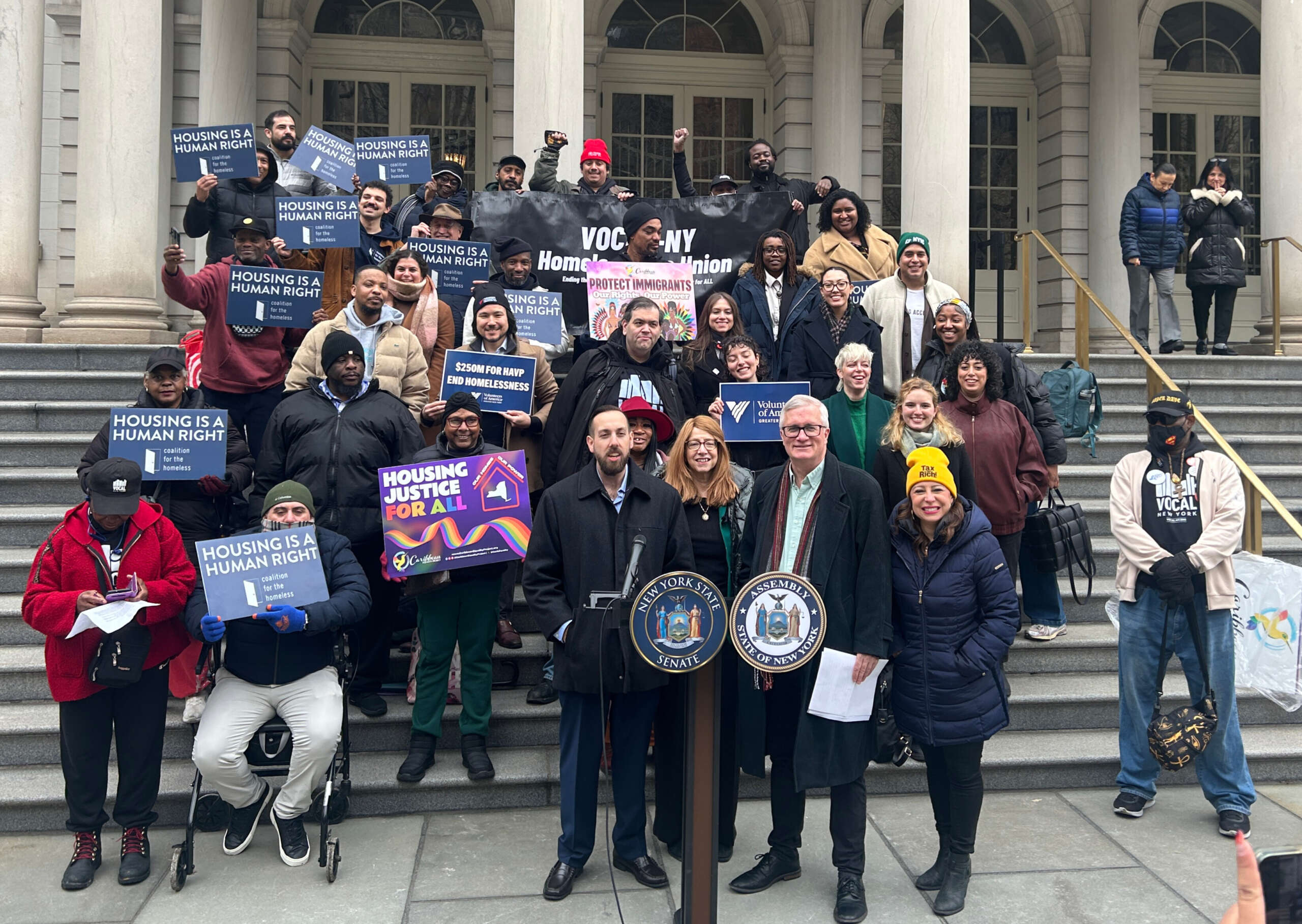
Lawmakers and advocates, rallying outside City Hall on Friday morning, celebrated the launch of the program and also called on Gov. Kathy Hochul to fund it this year at $250 million, five times the current amount.
“This is both a huge victory, getting vouchers into people’s hands for the first time is an incredible win,” said Chris Mann, assistant vice president of policy and advocacy at Women In Need, the city’s largest provider of shelter for families with children. “But the crisis means we need much more.”
In a sign of just how expensive housing remains, a $32.5 million allocation for New York City will create between just 900 to 1,100 vouchers, HPD expects. After using 10 percent of the budget for program administration, each voucher will cost the city roughly $2,500 a month on average.
HPD said the actual number of vouchers would fluctuate based on the household size, income, and other factors of applicants.
The rest of HAVP’s $50 million a year budget will flow to other jurisdictions in New York State, where community partners are already signing up households. The program is funded through 2030.
As federal assistance for housing has plateaued, lawmakers in Albany called on the state to step in. “The city has CityFHEPS. The feds have Section 8. What does the state have?” asked Assemblymember Linda Rosenthal Friday morning. “The state has $50 million for a pilot for this year, and that’s just not enough.”
The pilot program was undoubtedly a policy win for housing advocates. But it looks small compared to the over 60,000 households using the city’s housing voucher program, CityFHEPS, and the federal Section 8 voucher program which serves 123,000 households in New York City.
“Every bit does help,” said Emily Osgood, associate commissioner for Housing Opportunity and Placement Services at HPD.
Osgood said that people living in shelters who want to apply to HAVP should talk to a housing specialist at their shelter.
Eligibility for the program is roughly the same as the federal Section 8 program. Households must make less than 50 percent of the area median income ($72,900 for a family of three). But unlike other rental assistance programs, HAVP is open to applicants regardless of their immigration status.
The size of New York City’s own CityFHEPS program has quintupled in as many years, with a current budget of $1.25 billion. The City Council passed a law in 2022 to expand program eligibility to people with higher incomes and not just people in shelter. But Mayor Mamdani is holding off on that expansion because of its cost.
“Really, rental assistance shouldn’t be a municipal responsibility,” outgoing Social Services Commissioner Molly Park told City Limits earlier this week. “While the city shouldn’t have to be in the place of stepping up and solving for rental assistance, without it, we would be in a far worse off position.”
Osgood said that the program rollout is prioritizing people living in shelters. The first vouchers are being offered to eligible individuals in HPD’s Emergency Housing Services program, which provides shelter to people displaced by severe housing issues that require tenants to vacate, like a fire. After that, they will accept applications from other government partners like DHS shelters.
Osgood said they are training HPD staff on eligibility and the application process and will train more agency partners soon.
With so few vouchers available, it’s unclear how far they will get. HPD said there would not be a formal waitlist like there is for Section 8, since government partners apply on tenants’ behalf, rather than tenants themselves.
But demand for vouchers is surely high. When the Section 8 voucher waitlist re-opened last year for the first time in 15 years, 400,000 people signed up for just 200,000 slots on the waitlist.
Advocates called for a program that could meet the size of the need. “Let’s be real—when someone has nowhere to go, this is not a personal failure. When a family is sleeping in a car, that is not a personal failure. That is a policy failure, that is a system failure. We need an expansion of the Housing Choice Voucher Program,” said Tiffany Jade Munroe, the trans justice manager for the Caribbean Equality Project.
The public launch of the program comes just one day after a New York State Appeals Court struck down a state law that prohibits discrimination based on “source of income,” like using a housing voucher to rent an apartment. The protections, advocates say, help people with federal vouchers access more housing options.
Lawmakers said that they do not believe the ruling will affect state and city programs, and will wait and see if it invites other challenges to local laws protecting voucher holders—or stands up on appeal.
“I think it’s an unfortunate ruling,” said State Sen. Brian Kavanagh, who sponsored the legislation to create HAVP. “But I don’t know whether it is likely to spread beyond this and I assume it’ll go to the court of appeals.”
To reach the reporter behind this story, contact [email protected]. To reach the editor, contact [email protected]
Want to republish this story? Find City Limits’ reprint policy here.
1 Comment