


Share This Article
Nearly 40 percent of homeless families with children are placed in shelters outside the borough of their child’s school, forcing long commutes, early mornings, and strained community ties.
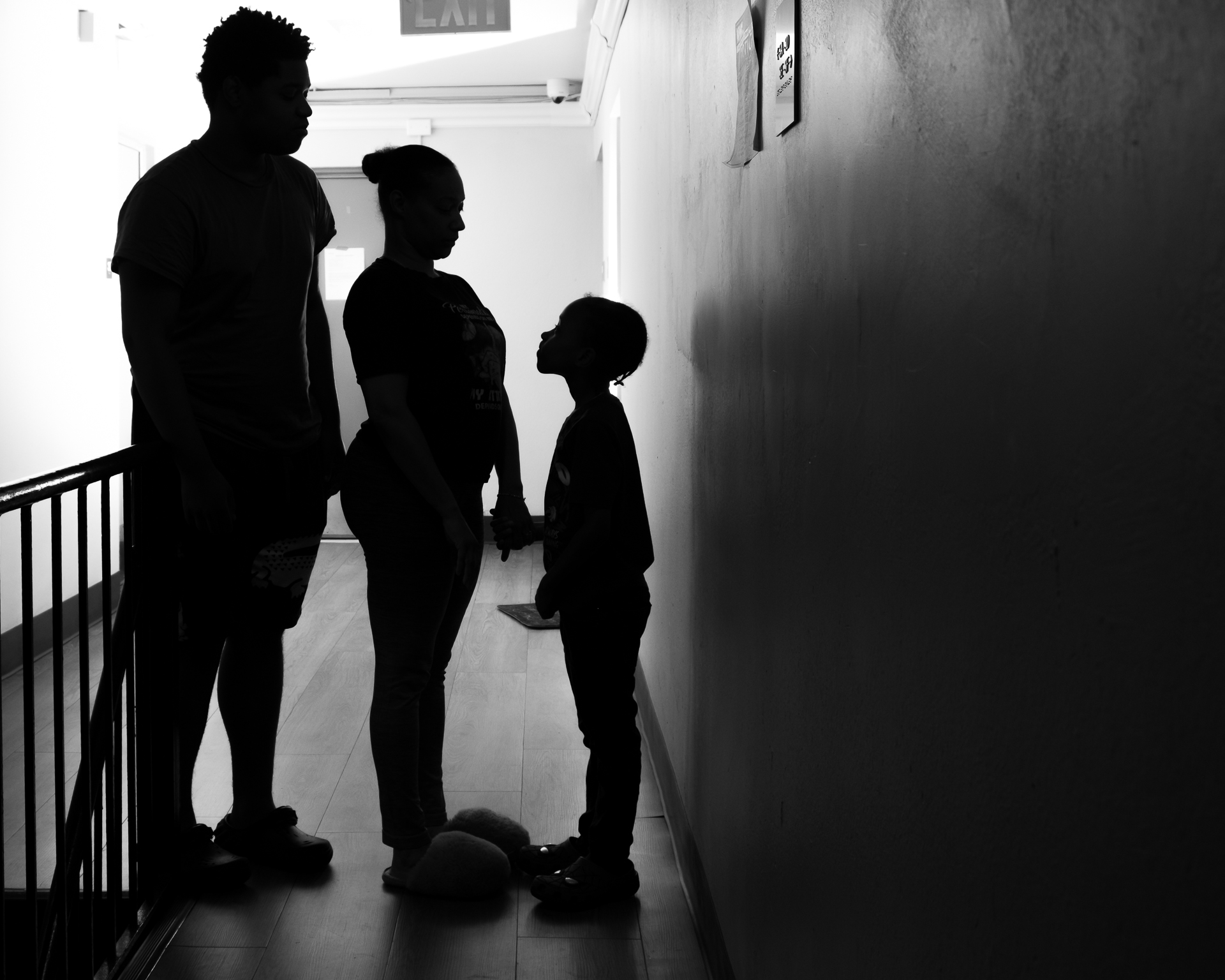
Back to school should mean school supplies, new outfits, and reunions with friends.
For Nyasia Neal, 43, and her sons Nyeem, 16, and Royal, 6, it has meant early mornings and hours spent commuting.
Neal and her sons were doubling up in an apartment in Brownsville, Brooklyn, with Neal’s mother, who had a Section 8 housing voucher. But when her mother needed to move to Long Island, they had nowhere else to go—they weren’t on the Section 8 lease.
So they went to the city’s homeless intake center for families in the Bronx, where they were assigned a shelter on Staten Island on Aug. 9.
The trouble is, Nyeem and Royal’s schools—and Neal’s work—are all in Brooklyn.
The family is one of thousands in New York City’s shelter system who were placed in a shelter outside the borough of their kids’ school this year. Over 14,481 families with children entered Department of Homeless Services (DHS) shelters from July 2025 through the end of June, and nearly two out of every five families got an initial shelter placement in a different borough, according to the most recent Mayor’s Management Report.
“They’re disrupting our pattern because we’ve been out here all their lives in Brooklyn. It was real, real disruptive at this point, and [my kids] are asking me, when are we moving?” said Neal.
The stress and the commute is affecting her family’s health and her kids’ education, she added.
Neal and her sons wake up as early as 5 a.m. for the journey: first to drop off Nyeem at his high school in Bedford-Stuyvesant, then to Royal’s elementary school in Canarsie, and finally, to Neal’s own work as an assistant manager at a center for people with developmental disabilities in East Flatbush.
Placing students in shelters near their home is a priority for the Department of Homeless Services, but has been a persistent challenge, with the number of students placed in their school’s borough hovering at around 60 percent for the past five years. The city’s stated goal is 85 percent.
The agency must comply with the city’s “right to shelter” mandate, where every person who requests a bed at a shelter must get one. With limited beds available on any given night, placements become a puzzle where family preferences can sometimes come second to logistical constraints.
“We recognize that quality education is not a privilege but a right for every child in New York City, and we work diligently to minimize disruptions that can negatively impact a child’s education,” a spokesperson for the Department of Social Services (DSS) said in a statement to City Limits.
“We continue to prioritize equitable shelter siting, so every community contains the necessary resources to support New Yorkers in need and keep families near their anchors of life, including their children’s school.”
Homeless New Yorkers and shelter operators say that out-of-borough placements exacerbate the health and learning consequences of homelessness.
“You can look back and say, ‘Oh, we’re pretty much in line with what other administrations have done,’ but what we’re saying is that’s not good enough for for kids, and this is a great opportunity for the Mamdani administration to say, ‘We’re really going to prioritize children’s education,'” said Chris Mann, vice president of policy and strategy at Women in Need, which operates shelters for families.
Last fiscal year, 81 percent of kids living in shelters long term eventually ended up going to a school in the same borough, according to the report—but that could come after a transfer to another shelter or a transfer to another school, which can be disruptive.
“In my experience, it’s not because DHS has moved 20 percent of families to new shelters by the end of the month. My guess is that it’s because 20 percent of families have decided to enroll their kids in the local school by the shelter,” said Jennifer Pringle, project director at Advocates for Children.
The Department of Education and DSS also work together on bussing and transportation if families want to remain in their existing schools, but it takes time to set up. And the city’s school bus network is notorious for delays and inefficiencies.
“If we had a school bus system that could reroute a kid within a couple days, shelter placements far from kids’ schools wouldn’t be such an issue. But the reality is that if everything works correctly… you’re looking at a minimum of a month to get bussing rerouted,” said Pringle.
Neal considered transferring the kids to schools on Staten Island, “but that still wouldn’t work, because who’s gonna watch the 6-year-old?” said Neal. “I still have to get to Brooklyn because my job is still here.”
DSS said that they do try to proactively reach out to families in shelters with longer commutes to offer them placements closer to their child’s school, when available.
Education disruptions
For now, Neal has been able to borrow a friend’s car, which saves the family a tremendous amount of time, cutting their commute by 40 percent. But she has to give it back at the end of the month.
The car—borrowed from her grandmother’s neighbor who is spending time in Florida—is a luxury many homeless families don’t have; and even so, tolls and high gas prices stretch them thin.
“I’m just taking it day by day because it’s a lot now, so I don’t want to over-stress myself. I try to plan ahead, but it’s not much I can do,” said Neal. “I’m just on shaky ground.”
Before they had the car, the family would walk 15 minutes from their shelter to the Staten Island Ferry, then take the 4 train from Bowling Green to Fulton, transfer to the Brooklyn-bound A, and get off at the Utica Avenue stop, near Nyeem’s high school. Then back on the A train to Broadway Junction, a transfer to the L, and the B15 bus to Rockaway Avenue to drop off Royal. Then Neal would either walk 25 minutes to work, or get back on the B15 bus, and then the B46, concluding a two-and-a-half hour journey each morning.
The early mornings take a toll on families like Neal’s, research shows. Students living in shelters are far more likely to be chronically absent from school. Their grades and learning suffer.

Neal’s kids are tired, and the oldest is falling behind in his classes. “I am just worried that this right here—with this commute—he’s not getting the proper rest. It’s gonna affect him; he won’t be able to graduate on time,” said Neal.
The number of school age children experiencing homelessness is on the rise. As many as one in seven experienced homelessness last school year, according to a report from Advocates for Children, with 65,000 living in shelters. Two out of every three students in shelter were chronically absent, the organization found.
Shelter facilities for families with children offer support and educational programming, DSS said, and work closely with community organizations to offer family-specific needs, like help with special education requirements and transportation options.
Far from school, loved ones, and community
Moving shelters and schools also disrupts community and support. The family still tries to come to Brooklyn on the weekends (Neal works in the borough on Saturdays), and they spend time at Neal’s grandmother’s house, where Royal likes to walk his great-grandmother’s dog, Cooper.
“They don’t have time to have that family bond like they used to because we’re over there, and it’s like we can’t stay here because we gotta get back,” said Neal. They used to see their cousins every day, but now it’s a couple times a month. “They’re losing their connection.”
Neal’s oldest, Nyeem, has asthma—and his cardiologist and pulmonologist are in Brooklyn too.
The average stay for someone in New York City’s shelters lasts about one year. The majority of heads of households in shelters are Black.
Neal is hoping that she can secure a transfer to a shelter in Brooklyn, and apply for a rental assistance voucher, called CityFHEPS, to find a permanent home.
Requesting an education-related shelter transfer is another administrative process—and Neal hit an early roadblock. While she was placed in a shelter the same day she went to the intake center, Neal said that she was initially deemed ineligible, forcing her to reapply and muddling her transfer request.
The eligibility process for shelter—where “investigators” research a family’s housing history to ensure they don’t have another place to stay—means some families must reapply multiple times, which can prolong shelter stays by an average of 40 days, City Limits reported earlier this year.
“I’m just so much in limbo. I’m trying to find a pathway, but I don’t know how this is gonna work,” Neal said “The kids being on hold, trying to do the transfer, it was kind of confusing.”
Long journey ahead
Advocates for the homeless say that’s one area where DHS can improve: cleaning up the intake process and making transfer requests for families more readily available.
For families placed in shelters outside their home borough, Pringle suggested the city automatically reevaluate placements after one or two weeks if they’re far from home—something DHS says that it does, when possible.
“They really try hard to accommodate those types of requests if there’s an appropriate unit available, and they act on it really quickly, which is fantastic,” said Pringle.
While DSS says they’re proactive in making those adjustments, Pringle said many families don’t know their transfer rights, and sometimes it takes an advocacy group to help them. “There’s not a systemic approach,” she said.
Mann also suggested technology could play a role, making it easier to see open beds at shelters around the city and optimize placements that meet family preferences as well as shelter capacity needs.
“Trying to get it right on the first try is going to significantly reduce the educational disruptions for kids,” said Mann.
There’s also the always-controversial question of where shelters should be sited. On one hand, advocates say, every neighborhood should have shelter resources for those who need them—part of the city’s “fair share” mandate.
But evictions and homelessness are not evenly distributed throughout the city. When families get placed in shelter further away and then move their kids to the local school, it could concentrate homeless students in a few districts—where as many as one in four students experience homelessness—taxing both schools and families. Local opposition to new shelter sites can also add another hurdle.
DSS hopes that having shelters in a diverse set of neighborhoods will help them meet their legal mandate, and give them more placement options.
“We have now sited a shelter in every Council district and continue to work to site and open additional family shelters where they are most needed,” the agency said in a statement.
Schools also have some resources to help. On the campaign trail, Mayor Zohran Mamdani called attention to the Every Child and Family is Known program, which dedicates school-based staff to build trust and relationships with students in shelter. The program has been shown to increase academic performance and reduce traumatic transfers.
“But if the kids aren’t making it to the schools, those resources aren’t reaching the kids that need them the most,” said Mann.
For the time being, Neal is praying she can use the borrowed car a little longer, or that her transfer request will come through. She then hopes to secure a CityFHEPS voucher and find a permanent home in Brooklyn.
But the road ahead is long. It takes 236 days to find a place with a city housing voucher and move in, according to the most recent data from DHS. And voucher holders typically can’t access all the city’s neighborhoods, due to high rents and discrimination from some landlords; nearly half of city voucher holders rent in the Bronx. That could mean more shelter transfers, more school transfers, and more disruption before the family can get back on its feet.
“My kids—they don’t complain,” said Neal. “But they are starting to complain like, ‘When is the transfer coming? Why are we still here? How long is it going to take?'”
She doesn’t have the answers.
To reach the reporter behind this story, contact [email protected]. To reach the editor, contact [email protected]
Want to republish this story? Find City Limits’ reprint policy here.