


Share This Article
A new plan promises to build lower-income units up front. Gov. Hochul is on board, and the state’s approval process is starting—though the full public costs remain unknown.
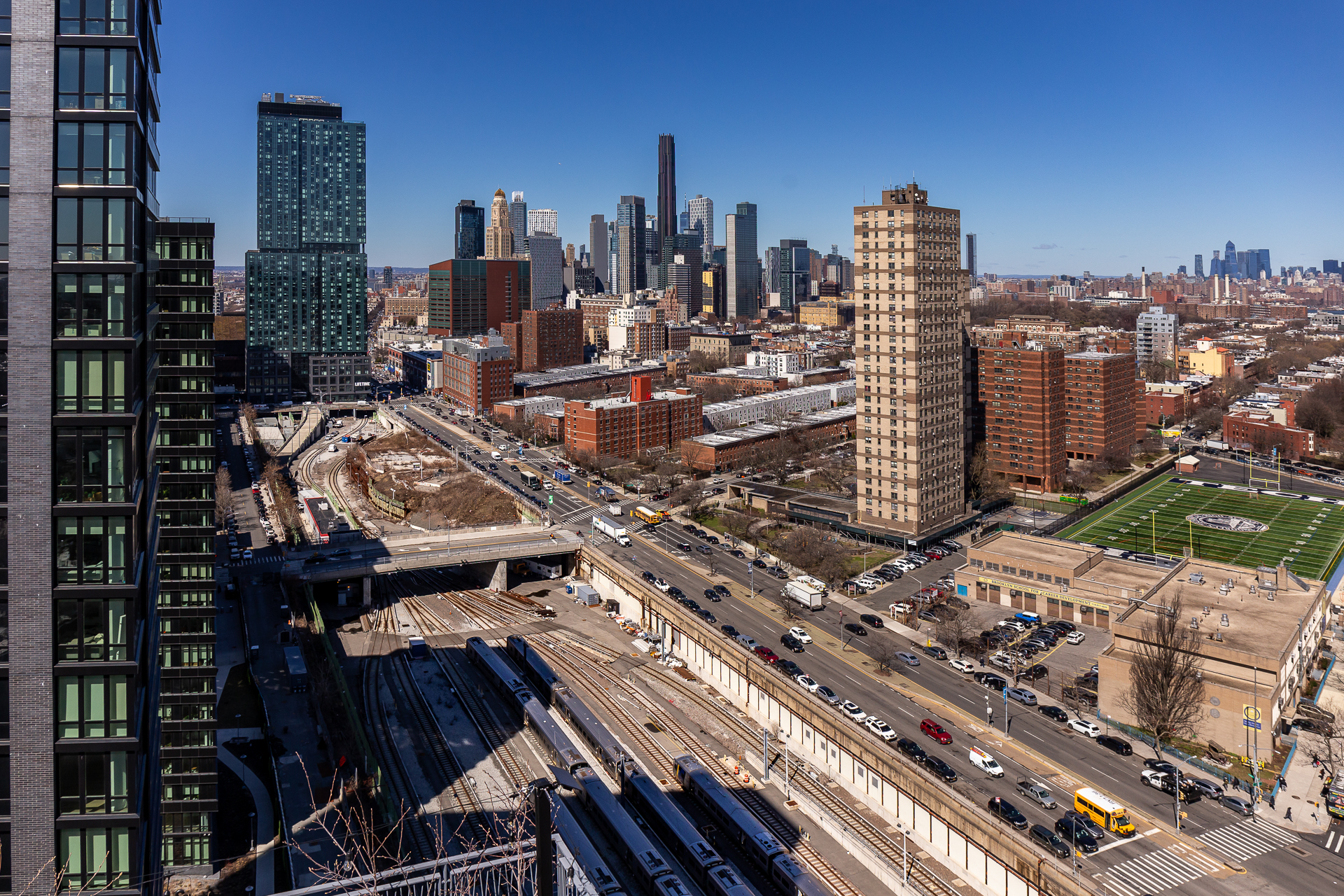
Last October, Empire State Development (ESD) agreed to accept just $12 million in penalties for the 876 missing affordable housing units, of 2,250 promised, in Brooklyn’s long-stalled Atlantic Yards (aka Pacific Park) megaproject.
The penalties, if enforced per a 2014 agreement, now exceed $21 million a year, and could reach $143 million if the state opted to collect on them, according to local elected officials. But ESD explained that it wanted to encourage progress with a new development team—and, later, also said it feared a lawsuit from previous developer Greenland USA.
New developers Cirrus Workforce Housing, funded in part by construction labor unions, and LCOR have since proposed a more “feasible” project, with taller, bulkier towers averaging heights of 564 feet, sited to allow faster construction and more contiguous open space.
Well, at least if the state grants 1.6 million square feet of new bulk, the volume of Manhattan’s One Vanderbilt office tower, plus at least $700 million to build a platform for vertical development over a two-block railyard stretching east from the Barclays Center, in addition to other, unspecified, subsidies.
The controversial project—which was first announced more than two decades ago, and is now on its third development team after delays fueled by lawsuits and a recession—has seen about half the 6,430 approved apartments built. Under the latest plan, that would grow to 8,812, with 2,382 additional units.
That leaves 5,600 left to build in seven towers, over a relatively small portion of the 22-acre site, just east of Downtown Brooklyn.
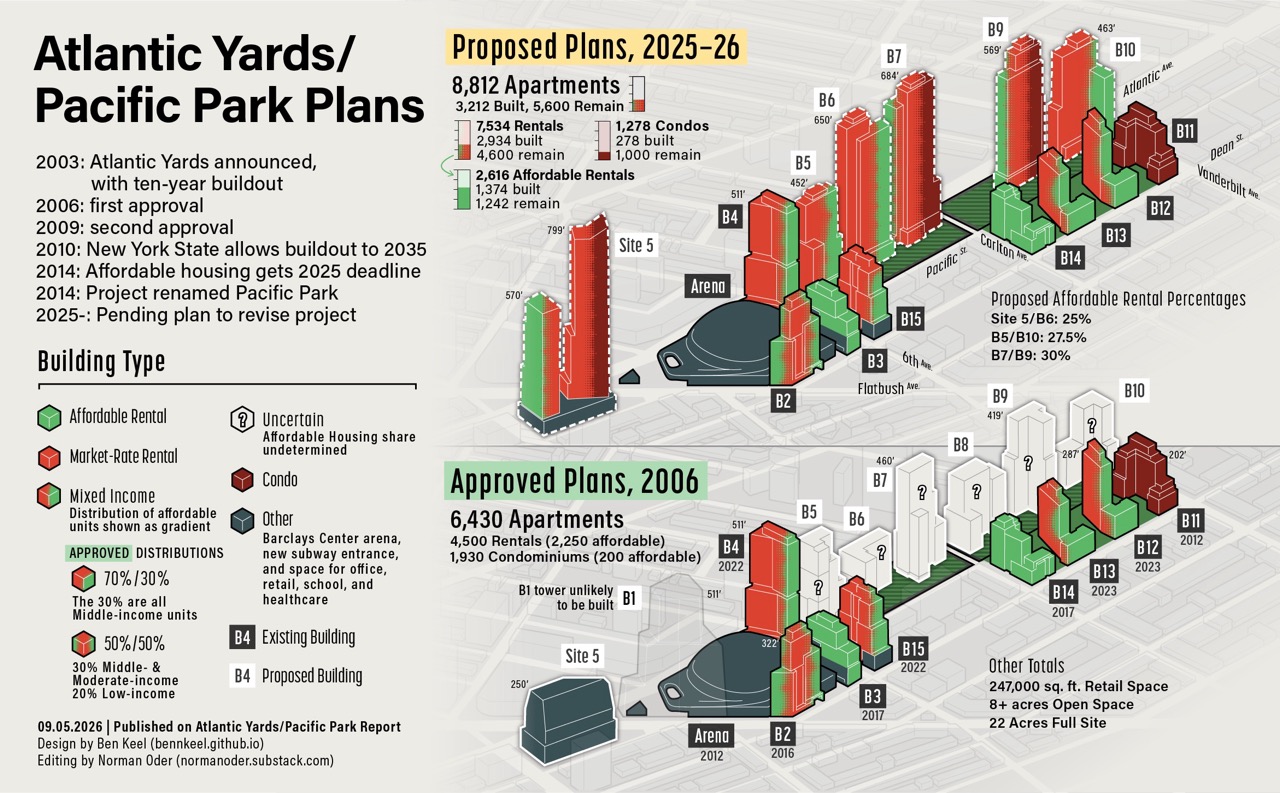
The railyard parcel would support five large towers, plus a “signature” open space created by eliminating one previously planned tower at the former B8 site. No platform, however, is needed for a separate parcel known as Site 5, across Flatbush Avenue from the arena, long home to the big-box stores P.C. Richard and the now-closed Modell’s, which temporarily serves as the Brooklyn Basketball Training Center.
When Cirrus and LCOR disclosed a refined plan on June 29, Gov. Kathy Hochul declared, “Atlantic Yards is one of New York’s most significant unfinished affordable housing developments, and we are finally moving it toward completion.”
(She controls ESD, the state economic development authority, which can approve projects without the input and potential roadblocks required by the city’s land-use process.)

Contrary to Hochul’s claim, Atlantic Yards would be less affordable, as a percentage of units, than previously approved. The coalition BrooklynSpeaks, which in 2014 had negotiated the 2025 affordable housing deadline, said the proposed configuration, with just 366 additional affordable units, and the gentle penalties—given the state’s failure to enforce the $2,000 a month in damages for unbuilt affordable units—are “unacceptable and shocking given the depth of the affordability crisis.”
“As such, an announced $700 million in State funding for the project’s rail yard platforms amounts to a subsidy for market rate and luxury housing,” said the coalition, which includes several neighborhood groups and has the ear of local elected officials.
Despite questions about affordability, density, subsidies, and accountability, the developers’ lobbying effort, via the firm Bolton-St. Johns, has borne fruit at a time when both YIMBY sentiments have increased and Atlantic Yards activism has diminished.
“Mayor Mamdani has been clear: we must build much more housing to create an affordable city,” the Mayor’s Office said in a June 30 statement. “It’s encouraging to see a path forward for Atlantic Yards, a project that has the potential to deliver thousands of new homes, including affordable homes, alongside good-paying jobs for New Yorkers.”
In August, ESD launched the required environmental review process, which is supposed to disclose impacts for potential mitigation, but typically culminates in a rubber-stamp vote by ESD’s board, which answers to the governor. Here’s ESD’s Atlantic Yards site.
The agency will hold a public hearing on the Draft Scope for an Environmental Impact Statement (EIS) on Thursday night at 6 p.m. While its virtual format can involve a broader geographic audience, it’s also likely to limit the potential alliances and debates that an in-person hearing would bring.
With the environmental review expected to conclude by the end of 2027, construction could restart in 2028.
Changing plans
Atlantic Yards, announced in 2003 by developer Forest City Ratner, was approved in 2006 (and re-approved in 2009) for an arena and 16 towers, with the market-rate housing expected to subsidize the costs of building the railyard platform. The Barclays Center opened in 2012. Eight towers have since been built, all on terra firma. Of 2,250 promised affordable units, the 1,374 built have been skewed toward middle-income households.
The project’s increased size, the new developers contend, reflects today’s context, given the now-taller, bulkier towers in nearby Downtown Brooklyn, and the need for financial viability.
They say the first towers to be built, which rely significantly on solid ground rather than the platform, could open as early as 2031, and include 500 low-income affordable units among 2,000 total rentals, plus 400 condos.
Still, that new tranche of 366 affordable units would represent a 16.3 percent increase over the original promise of 2,250 units, and only 15.4 percent of the additional 2,382 apartments requested. Meanwhile, there’d be 48.2 percent more market-rate units.
Nonetheless, Cirrus Managing Principal Joseph McDonnell, speaking in an online “Town Hall” on July 13, asserted they’d deliver “40 percent more affordability than originally contemplated,” adding that “1,200 income-restricted units is approximately 40 percent more.”
That calculation apparently equates “originally contemplated” with the missing 876 units. To build 40 percent more than the 2,250 units approved, they’d have to add 900 apartments, not 366. (Asked if it agreed with the developer’s math, ESD didn’t answer, instead pointing to general statistics.)
Accountability questions
The project’s Memorandum of Understanding (MOU) indicates relatively gentle penalties for two years of extensions—$500,000 the first year, $1 million the second, directed to the city’s affordable housing trust fund—on the first five buildings, allowing completion by 2039. It offers no new accountability structures, leaving discretion to ESD, which refrained from enforcing the previous affordable housing deadline.
It does include provisions to ensure the developers build not merely on the least complicated sites. For example, they must start construction on the first block of the railyard platform before getting a temporary certificate of occupancy (TCO) for condominium units at Site 5, and must get a TCO for affordable units at that parcel first. Also, they can’t profit by selling development sites on each railyard block until work on that block’s platform has started.
ESD, which oversees/shepherds the project, has conducted a public engagement campaign seemingly aimed at ratifying and refining the new developers’ plans. After receiving pushback from affordable housing advocates, Cirrus and LCOR lowered the ceiling for affordability from 130 percent of Area Median Income (AMI) to 120 percent (a four-person household earning up to $203,520 a year, for example, could qualify for those units were they available this year, compared to a max of $220,480 under the higher threshold). They also promised that 30 percent of future apartments would be family-sized two- and three-bedrooms.
Still, while Atlantic Yards was originally supposed to contain 35 percent affordable units—with half the rentals below-market—the new total would be nearly 30 percent.
“It would be helpful to understand how that change happened, considering this project has always been 35 percent affordable,” said Michelle de la Uz of the Fifth Avenue Committee, an affordable housing nonprofit, at the June 29 meeting of the advisory Atlantic Yards Community Development Corporation (AYCDC), when the refined plans were revealed.
de la Uz, who helped negotiate the 2025 affordable housing deadline on behalf of BrooklynSpeaks, didn’t get a direct answer. Two weeks later, at the Town Hall, Cirrus’s McDonnell offered an indirect response. “This is not a perfect plan,” he said, “because Atlantic Yards is not a perfect site, and there’s been a lot of work done around those trade-offs.”
At the July 13 Town Hall, Gib Veconi, another leader of BrooklynSpeaks, contrasted the proposed Atlantic Yards affordability—averaging 75 percent of AMI for the remaining apartments—with the recent city rezonings that would deliver 25 percent affordable units at an average of 60 percent of AMI ($101,760 a year for a family of four).
(That said, the 75 percent proposal is well below the average AMI originally approved for Atlantic Yards and even further below the average AMI delivered by the project so far, though it can’t make up for dramatic increases in AMI, which also outpace local incomes.)
Veconi questioned why ESD accepted the affordability levels, contrasting the state process with the more transparent city land-use process.
ESD’s Joel Kolkmann, senior vice president of real estate and planning, said the initial three towers at Site 5 and B6 would be built on solid ground, where construction is easier, and conform to the configuration enabled by the 485-x tax break.
The other buildings, which rely on the platform, would be more complicated and costly, he said, warranting the higher rents. At a Sept. 14 meeting of the Atlantic Yards CDC, Directors Ron Shiffman and Veconi, noting the board’s responsibility to oversee project commitments, moved to ask ESD to share a financial analysis of the project, given changes in affordability and significant expected subsidies.
However, fellow directors, most appointed by the governor, rejected the motion.
“We have to get this done, perfectly or imperfectly,” said Chair Daniel Kummer, citing a “premium” on completing the project.
Subsidies and deadlines
If all goes well, McDonnell has said, the project—five towers over the railyard, plus a giant two-tower building at Site 5, catercorner to the arena—could be completed by 2040. In July, the new developers and ESD signed their own non-binding MOU, which suggests a somewhat longer leash.
While the agreement sets deadlines of 2032 to complete the first block of the platform and 2037 for the three towers there (plus two at Site 5), it also contemplates those two years of extensions, followed by potential default or further discretionary extensions.
It sets 2040 as the deadline to complete the towers and platform on the second block, at least if a funding agreement is executed, but that would be just one year after the first block’s potential extension to 2039. (It offers the same two years of extensions, plus discretionary ones.) The document also extends the deadline to 2042 for that second block if no funding agreement is executed, potentially portending another project reboot.
The MOU revealed that the state—while already granting $175 million to platform the first railyard block, and expecting to deliver another $175 million toward an estimated total cost of $400 to $500 million—has no plan yet to fund the platform over the second block.
At a Sept. 14 Atlantic Yards CDC meeting, ESD’s Arden Sokolow, executive vice president of real estate and planning, said they estimated a similar subsidy, $350 million, for the second block, toward a total subsidy of $700 million. “It’s very far in the future,” she said, seemingly putting it off for future administrations.
Asked if the $400 million overall cost estimate for the second block seems low, given the larger area and more limited precursor work than the first platform block, plus inflation, ESD said that “there are many one-off costs which are incurred during the beginning of the project and which serve the project overall. Due to this, the all-in forward costs of each platform are not necessarily linear with respect to size.”
Density questions
While Site 5 was approved in 2006 for a 250-foot, 439,050-square-foot building, the project developers since 2015 have sought to move the bulk of the unbuilt flagship tower (B1, aka “Miss Brooklyn”), once slated to loom over the arena, across Flatbush Avenue to create a two-tower complex.
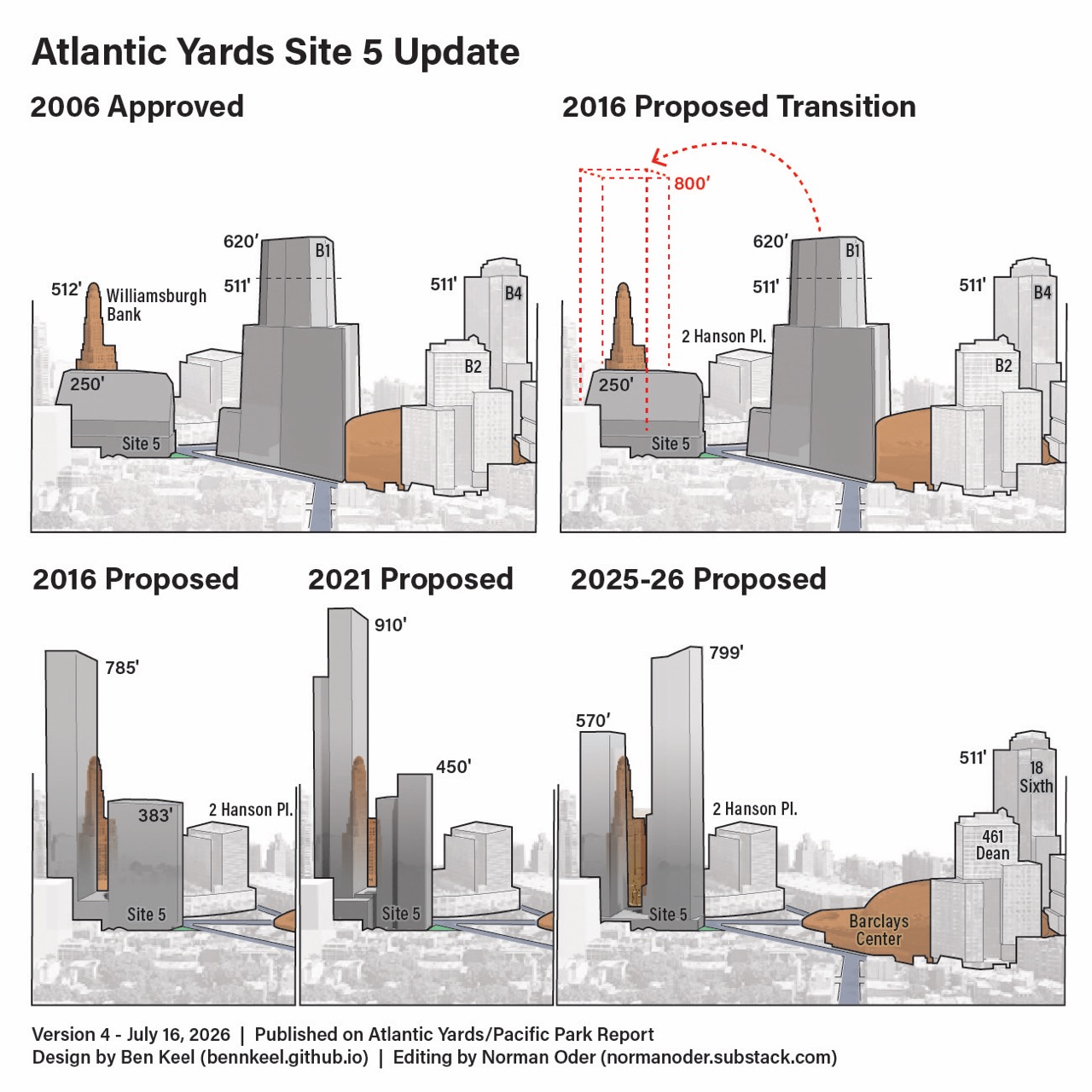
The new developers now plan 1,403 apartments—or slightly fewer, if a hotel is included—on a site little more than an acre, with no room for a public open space, and 1.45 million gross square feet of development in towers 799 feet and 570 feet tall. That’s an almost unprecedented level of density for Brooklyn.
“How are you going to consider,” asked resident Colin Sullivan at the Town Hall, “both the comfort level of the residents that are in a building that’s going to have 1,400 units, as well as the residents who live nearby, with a massive structure towering over their community?”
LCOR’s Co-Chief Investment Officer and Principal Anthony Tortora responded that, given the need for housing, “there are a lot of reasons to push density to Site 5,” given the wide bordering avenues and the advantage of building on solid ground. (The southern end borders narrow, low-rise Pacific Street.)
At Atlantic Yards CDC meetings, Director Shiffman, a longtime advocacy planner and academic, has questioned the location’s suitability for families, warning about the lack of open space and challenges faced by pedestrians.
Along with Site 5, the developers also would start on the B6 tower, taking advantage of a piece of terra firma jutting below Atlantic Avenue, while also working on the adjacent section of the platform.
The additional bulk, noted Brooklyn Speaks, would rank Atlantic Yards among the world’s “densest residential developments.” Asked about comparable projects, averaging more than 400 apartments per acre, LCOR’s Tortora diverted to cite the changing context. He argued that the 22-acre project’s overall Floor Area Ratio, including open space, was less than that of individual buildings in Downtown Brooklyn—not quite a direct comparison.
Viability questions
Historically, Atlantic Yards’ record includes overoptimistic developers promising projects they couldn’t build, though ESD-commissioned reports, from the consultant KPMG asserted the plans were viable.
Recently, ESD has hired the consultant BJH Advisors to assess the new developers’ plan. No assessment has been made public.
Asked at a public meeting about the project’s viability, McDonnell responded indirectly, saying it was “infinitely more financially viable because of the time and money that [predecessor developer] Greenland already put into the ground.”
He’s also called Greenland USA “the largest subsidy provider” to the development, having invested $950 million. (That total’s fuzzy; McDonnell didn’t respond to a query about details.)
Moreover, since his statement, the combination of free bulk and the potential $700-plus million in direct subsidies—as well as other support—suggests that the public would provide considerably more.
Cirrus and LCOR, McDonnell said, had planned to “make the project as a whole more resilient.”
“When you’re building an individual building on a solid ground site, it is unlikely that it will go through a recession. Something the length of Atlantic Yards will” —his emphasis —”almost assuredly go through a recession, unless we are all very lucky.”
“We have thought about ways to make sure that it’s financially viable,” he said, so “individual buildings can move forward as the world may change and evolve over time.” He didn’t elaborate.
Evolving plans
The developers’ plan, as presented in June, evolved from the one revealed last November at a public workshop organized by ESD. Rather than build six towers over the railyard averaging 350 feet, they proposed five taller towers, eliminating one tower, known as B8, which was said to help create an additional acre of open space—on top of the eight acres approved—and avoid complicated construction.
They’ve hired respected firms as consultants, including KPF (Kohn Pedersen Fox) as the master plan architect and Michael Van Valkenburgh Associates to revise the open space. Their alliance with construction unions means predictable labor costs.
Their open space revisions, which draw in part on changes by previous developer Greenland, generated praise, given earlier designs that suggested private courtyards. Still, the residential population growth would outpace the increase in open space.
The developers also expect 1.6 million more buildable square feet without having to pay the Metropolitan Transportation Authority for additional development rights. (Forest City had to bid to build over the three-block railyard, used to store and service Long Island Rail Road trains. One of the three blocks is now used for about half the arena, plus the B4 tower at 18 Sixth Ave.)
A draft Community Engagement Report, based on responses from in-person attendees and an online survey, unsurprisingly disclosed that housing affordability was their top priority.
Less predictably, it suggested that most respondents—339 in a 593-person survey—preferred affordable housing “particularly for moderate and middle incomes.” The median annual income of those who took part in the survey and disclosed their incomes was $135,256.
BrooklynSpeaks noted that “moderate and middle income levels make up only about 7 percent” of the city’s 1 million-plus rent-burdened households, arguing that the project should serve “the much larger population of low- and very low-income households struggling to pay their rent.”
Only a small fraction of survey respondents reported earning less than $50,000, or identified themselves as Black. The feared—and since realized—displacement of Black residents in the neighborhoods around Atlantic Yards fueled the 2014 agreement that set the 2025 affordable housing deadline.
“One thing that we heard very strongly was a need for affordability, [and] not in the 2040s, right?” said Cirrus’s McDonnell at a public meeting. “Find a way to do it faster. The project was delayed as it is.”
He said 75 percent of the apartments would be allocated to low- and very low-income households (currently, that would range from $40,710 to $108,560 a year for a two-person family). By 2031, a two-person “low-income” household at 80 percent of AMI might earn over $140,000.
Of the 925 future low-income units, only 216 (23.4 percent) would be very low income (defined as 50 percent of AMI or below), where the need is greatest. “We are missing the boat” on affordability, Assemblymember Jo Anne Simon said at the Town Hall.
While 25 percent of affordable units would go to moderate-income households earning between 81 percent and 120 percent of AMI, rents for moderate-income units now exceed those for middle-income ones from just a few years ago.
On June 29, the developers finally released more details, with dimensions for each tower and helicopter-level illustrations. The tallest tower over the railyard, B7, would be 684 feet, and the towers over the railyard would now average 564 feet.
Cirrus/LCOR acknowledged that the increase in open space would be only a half-acre, partly because of redesigned tower podiums aimed at mitigating wind. The limited increase provoked scorn from BrooklynSpeaks, which noted that the taller towers had been promoted as delivering more open space.
While new state documents suggest the new increment of 5.6 acres might yield a total of only 8.3 acres, Empire State Development, when queried, said building designs were being refined and that the total would exceed the 8 acres initially approved.
Arena company gain
Not building the approved B1 flagship tower would make the arena plaza, currently sponsored by Ticketmaster, permanent. Because the plaza serves as both a safety valve for crowds and a canvas for advertising and promotion, it’s enormously valuable to Barclays Center operator Brooklyn Sports & Entertainment (BSE).
The current and previous companies operating the arena and owning the Brooklyn Nets have already reaped enormous financial gains, given the dramatic rise in franchise values.
At one session, a resident asked if BSE, in exchange for gaining that permanent plaza, could be required to fund a unit to monitor quality-of-life violations caused by arena impacts.
ESD’s Kolkmann was noncommittal: “You know, BSE, obviously, is an important part of this project and an important stakeholder, and we look forward to discussing how their role in the project can continue to evolve.”
To reach the editor, contact [email protected]
Want to republish this story? Find City Limits’ reprint policy here.