


Share This Article
“A new analysis highlights how a surge of Amazon and other e-commerce delivery vehicles have clogged our streets, polluted our air, and made us less safe. Most importantly, the analysis reveals the direct connections between worker exploitation, quality of life, and the environment.”

From snowstorms, to scaffolding, to groups of side-by-side tourists, New Yorkers are well-attuned to the many obstacles of navigating the city. And while Amazon might make getting your deliveries feel frictionless, it makes getting around New York City anything but.
A new analysis highlights how a surge of Amazon and other e-commerce delivery vehicles have clogged our streets, polluted our air, and made us less safe. Most importantly, the analysis reveals the direct connections between worker exploitation, quality of life, and the environment.
Amazon increases its dominance in the marketplace by becoming more convenient than competing retailers—meaning more deliveries at faster speeds. A key way they achieve this is by imposing aggressive delivery quotas on their workers. The predictable effect is that last mile delivery workers face injury rates three times higher than the national average for all employees.
In New York City, over 85 percent of all reported injuries were severe enough to make workers unable to work in the same role—or at all—for two months on average. The worsening climate crisis compounds these safety hazards. This summer’s record-breaking El Nino forced workers to deliver through flash floods and extreme heat. During the summer’s first heat wave, a 26-year-old Amazon delivery driver with a delivery route of 222 packages said “I don’t havenwords to describe how horrible it is.”
But because Amazon relies on an evasive subcontracting model, workers and community members cannot hold this massively profitable corporation responsible for its abuses. Delivery workers sit at the epicenter of this harm, but the impacts extend outward from there. To get even closer to consumers, last mile warehouses are now located closer to urban population centers.
In New York City, these sprawling facilities have clustered in neighborhoods like Red Hook, Hunts Point, East New York and other communities already overburdened by traffic and industrial pollution. To maximize delivery volumes, they operate 24/7, bringing thousands of diesel-spewing truck trips per day that impose an enormous toll on the lungs of both workers and nearby residents. Researchers at the Environmental Defense Fund estimate this pollution drives an estimated 10,200 new childhood asthma cases every year just in New York City.
The impacts of these mega-warehouses then travel out through our streets. The surge of delivery vans has slowed down buses and made cyclists and pedestrians less safe. In just four years, Amazon delivery vehicles alone were ticketed 3,602 times for blocking bus lanes and transit routes, 2,162 times for speeding in a school zone, and roughly 1,200 times for blocking bike lanes and crosswalks. In neighborhoods where last-mile facilities have opened, truck-related crashes have increased by 146 percent.
Reining in these harms requires a comprehensive approach. State leaders must finally regulate
warehouses, requiring them to ratchet down their emissions including by shifting their operations off of diesel to non-polluting options like electric vehicles. There is already a bill to do this at the state level that has passed the Senate three times, but must still pass the Assembly.
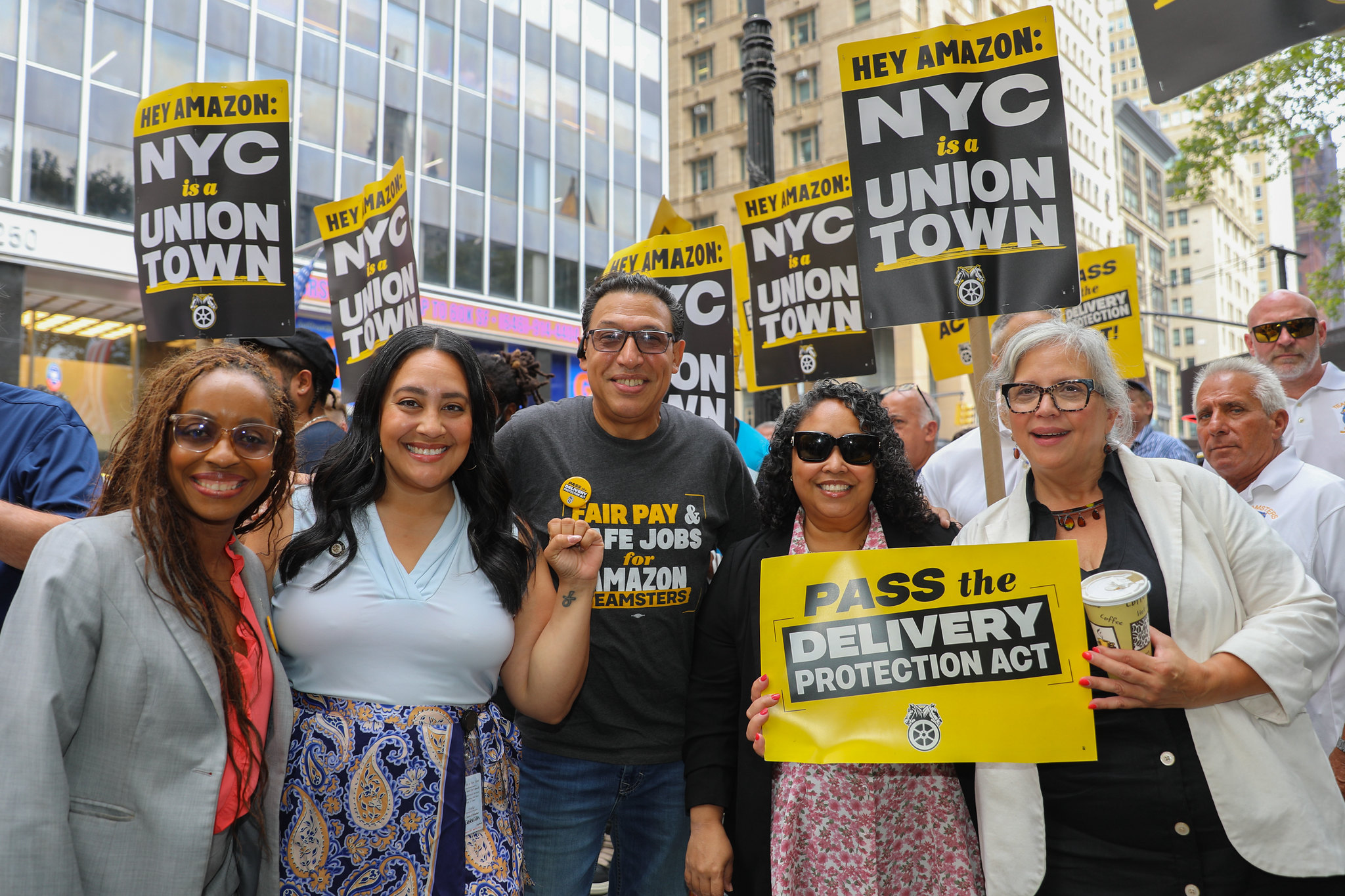
The city has also introduced a companion bill that must be adopted. But as long as Amazon can continue to rely on precarious subcontractor arrangements, there is little that either the city or delivery workers can do to demand better working conditions that all New Yorkers depend on for safe, sustainable mobility. That is why the most immediate step the City Council must take is to pass the Delivery Protection Act, a bill that would not only improve safety standards, but ensure that Amazon—one of the most profitable companies in history—is responsible for the conditions of the delivery workers it depends on.
Whether we seek to strengthen labor protections or increase environmental protections, industry will always argue that safeguards hurt business, and therefore workers and communities must simply accept exploitation and pollution. In both cases, policymakers should not be misled.
Despite their threats of re-location, e-commerce warehouses depend on proximity to dense consumer markets like New York City. Leaders in the City Council have leverage to demand adoption of more responsible and sustainable operations, and massive corporations like Amazon certainly have the resources to comply. It’s time to demand Amazon be a better New York neighbor.
Sasan Saadat is a senior research and policy analyst at Earthjustice.