


Share This Article
A NYCHA residents’ association is among the plaintiffs challenging the federal rule, which advocates say could force thousands of families to separate or lose their housing assistance.
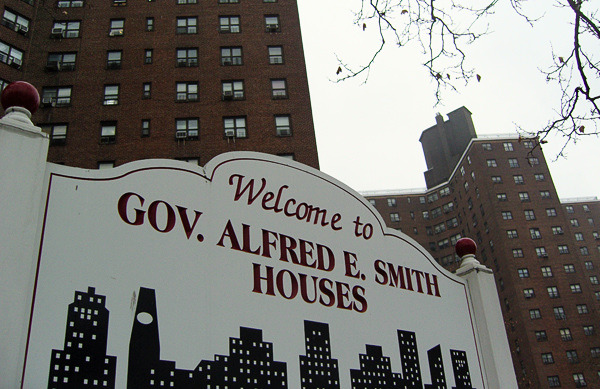
A coalition of public housing residents and immigrant advocates filed a federal class action lawsuit Thursday challenging a Trump administration rule that could force thousands of families with mixed immigration status to choose between staying together and keeping their federally subsidized homes.
The lawsuit, filed Thursday in U.S. District Court in Massachusetts, seeks to block a new U.S. Department of Housing and Urban Development (HUD) rule scheduled to take effect Dec. 14. The plaintiffs argue that the regulation violates federal housing law and constitutional protections.
Plaintiffs include the Alfred E. Smith Houses Resident Association, representing tenants at a New York City Housing Authority (NYCHA) development in Lower Manhattan. According to the complaint, 16 of the development’s 1,876 households have mixed immigration statuses and could face displacement under the rule.
The legal challenge follows HUD’s announcement of the final regulation on Nov. 10, which would require members of households that receive federal housing assistance through programs like Section 8 and Section 9 to verify their U.S. citizenship or eligible immigration status.
Under existing law, mixed status households can receive reduced federal rental assistance based on the number of eligible family members. Those who do not qualify for subsidies can still live with eligible relatives, including children who are U.S. citizens.
The new rule would end the longstanding arrangement allowing mixed status families to receive prorated assistance indefinitely, potentially forcing households to separate or give up their rental aid. As City Limits previously reported, approximately 2,500 New York households could be affected by the changes.
Among those challenging the rule is a Honduran woman identified in the complaint as Jane Doe #2, who has lived in the United States since 2009. She resides in New York City with her husband, a lawful permanent resident, and their three U.S. born daughters.
The family has lived in a federally subsidized Section 8 apartment for nine years. Although the woman has been authorized to live and work in the country since receiving U nonimmigrant status in 2022, it does not qualify her for federal housing assistance under the law cited in the complaint.
According to the lawsuit, the family cannot afford market rate housing in New York City. The plaintiffs argue that the rule could force the woman to leave the apartment or cause the entire family to lose their home.
The lawsuit also challenges new documentation requirements that would apply to recipients of federal housing assistance, not just mixed status households. The plaintiffs argue that the requirements could disrupt benefits for eligible tenants, particularly elderly and disabled residents who may have difficulty obtaining the necessary records.
Nationwide, roughly 80,000 people, including approximately 36,000 eligible children, could face displacement under the regulation, according to estimates cited in the complaint.
In a statement provided to City Limits, HUD Secretary Scott Turner defended the change saying it fully implements the Housing and Community Development Act of 1980.
“This rule guarantees ONLY AMERICAN citizens and certain eligible noncitizens will reside in HUD funded housing,” Turner said.
He added that the change represents a reallocation of up to $218 million in housing assistance to eligible Americans currently on waiting lists.
The plaintiffs dispute HUD’s interpretation of federal law, arguing that Congress explicitly authorized reduced subsidies for mixed status households. They are seeking a court order declaring the rule unlawful and preventing its implementation next month.
Housing lawyers who spoke to City Limits earlier this week urged households potentially impacted by the change to stay put.
“People need to know that until it goes into effect, nothing has changed,” said Lucy Newman, the supervising attorney of Legal Aid Society’s public housing unit. “They should not move, or evict out of fear.”
Here’s what else happened this week in housing—
ICYMI, from City Limits:
- For the first time, NYCHA is using a federal program called Section 32 to repair 91 single-family to four-family houses—opening a path for public housing residents to buy their homes.
- A career training program for the city’s public housing residents is getting $1 million from an unusual source: Kalshi, the prediction market company recently sued by New York State for allegedly operating as an illegal and unlicensed gambling platform.
- All but one building in a portfolio of properties that recently went to foreclosure auction failed to receive any bids, raising alarm about the health of the city’s rent-stabilized housing. Tenants, and the mayor’s office, hope to steer the buildings to a buyer they say will work to preserve them.
ICYMI, from other local newsrooms:
- The city is suing a landlord for evading fines and failing to make building repairs under a local fraud law, what City Hall described as a novel tactic to hold bad property owners accountable, according to Gothamist.
- Astoria residents are opposing proposals for three new apartment buildings on Steinway Street, the Queens Eagle reports.
- The city is billing 7,500 households under the new pied-à-terre tax on expensive second homes, what officials say will raise $500 million, according to The City Reporter.
- The Mamdani administration shuttered its last remaining migrant shelter in the Bronx this week, potentially stymying a a subpoena from the Trump administration demanding the city disclose the names of undocumented immigrants with criminal records who lived there, the New York Times reports.
To reach the reporter behind this story, contact [email protected]. To reach the editor, contact [email protected]
Want to republish this story? Find City Limits’ reprint policy here.