


Share This Article
“New Yorkers deserve policy that responds to the urgency of diesel exhaust clouding neighborhoods and matches the bold action of similar successful policies across the country.”

Earlier this month, New York City and the tri-state area choked as thick smoke from more than 100 Canadian wildfires pushed the Air Quality Index (AQI) into the unhealthy range, prompting experts to urge people to stay indoors and wear a KN95 mask when outside. While wildfire smoke is a visible reminder of the dangers of polluted air, harmful emissions also come from everyday sources much closer to home.
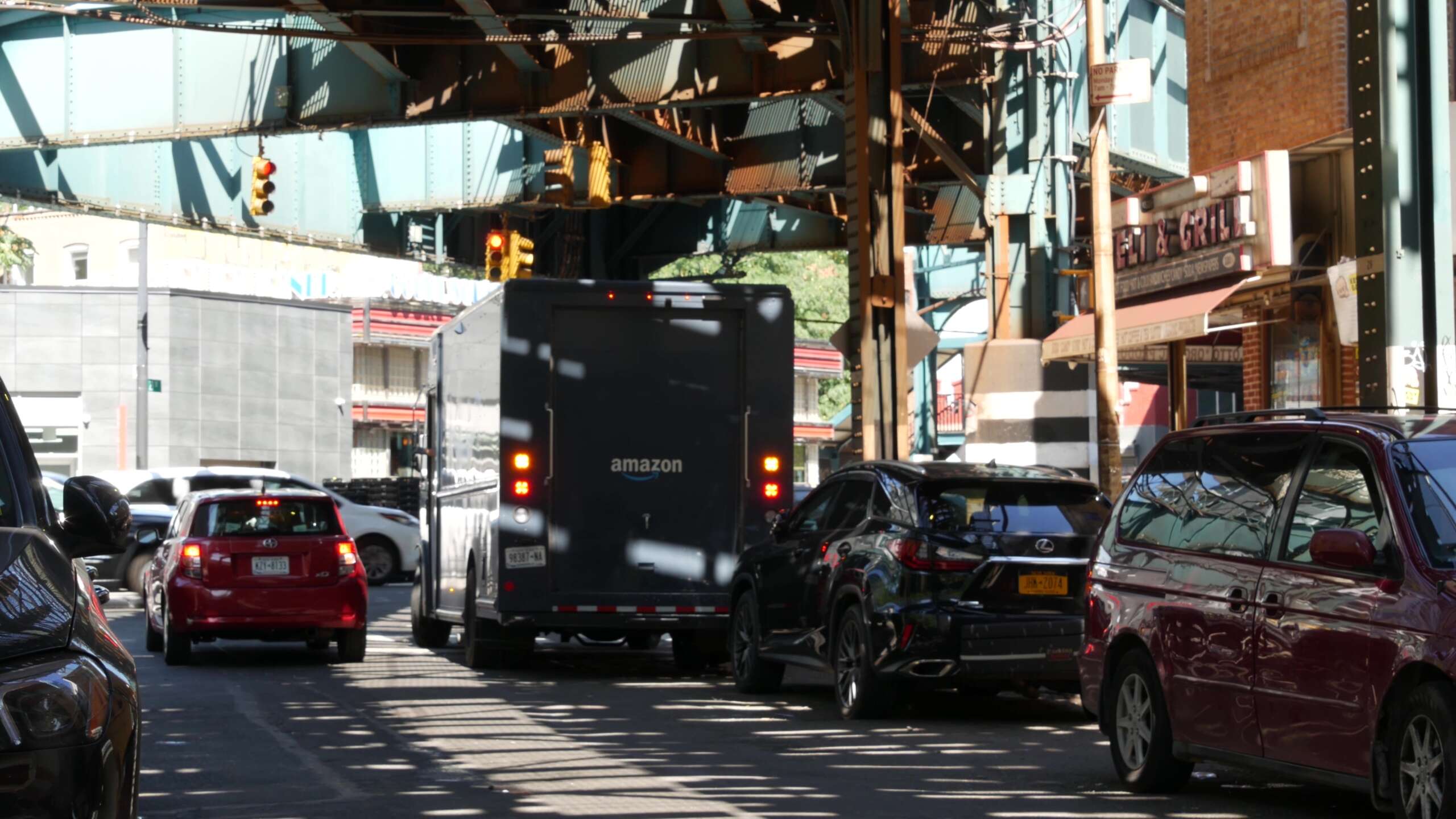
The rapid growth of online shopping, highlighted by Amazon’s recent record-breaking $26.4 billion Prime Day sales, has fueled an expanding network of mega warehouses and delivery trucks that swarm residential neighborhoods with diesel truck smoke. The exhaust contributes to dangerous air pollution linked to asthma, heart disease, and other serious health problems, while making our communities hotter and noisier. Packages may arrive within days, but the adverse health impacts of the pollution generated by these deliveries can affect families and neighborhoods for years to come.
Since 2019, online shopping has grown exponentially. While it offers us convenience and unprecedented choices, it has led to the unregulated rise of mega e-commerce warehouses and delivery truck traffic in neighborhoods across New York. This has quietly and rapidly reshaped neighborhoods across New York State. And for low-income and communities of color, who live in places where land is cheaper and antiquated regulations allow these facilities to be sited without any public review, the environmental and public health costs have been especially damaging.
With more frequent air quality advisories due to wildfire smoke, diesel pollution only poses a greater threat to vulnerable communities. Fine particle pollution from wildfire smoke can cause shortness of breath, coughing, dizziness or fatigue and aggravate heart and lung diseases and other chronic health issues—much like the smoke coming out of tailpipes.
Local communities’ health and wellbeing is at risk, but there’s an opportunity for Gov. Kathy Hochul and our state legislators to take common-sense action in the upcoming legislative session. To protect our neighborhoods, modernize our economy, and create healthy, livable communities statewide, our elected leaders must pass the Clean Deliveries Act. New Yorkers deserve policy that responds to the urgency of diesel exhaust clouding neighborhoods and matches the bold action of similar successful policies across the country.
As opposed to traditional warehouses, a single e-commerce warehouse is almost the size of 15 football fields, and can generate hundreds or thousands of daily truck trips. A majority of these trucks are diesel-fueled, releasing toxic fine particulate matter (PM2.5) and other pollutants into the air we breathe. The pollution from these trucks causes asthma, heart disease, and even early death. This is a public health crisis.
Communities near these facilities are overburdened with air pollution. In New York neighborhoods like Hunts Point, Red Hook, and around Newtown Creek, new e-commerce warehouses have emerged like unwanted backyard weeds in recent years. These corporations are leaving air pollution in their wake and compounding existing environmental and public health issues.
In Hunts Point and Longwood, asthma emergency department visit rates among children under the age of 18 are significantly higher than the citywide rate. In Red Hook, levels of PM2.5 are higher than the boroughwide and citywide averages. Around the Newtown Creek area, an area long burdened by industrial pollution, new mega-warehouses and trucking activity add yet another layer of environmental stress.
We did not create this e-commerce boom, but we are the ones paying for it.
The Clean Deliveries Act offers a smart and flexible solution to address unchecked warehouse pollution. The bill would establish a statewide warehouse indirect source review in which the New York State Department of Environmental Conservation (DEC) would analyze the state’s largest warehouses and identify the emissions standards necessary for each warehouse, including factors like proximity to schools, parks, or population centers.
Warehouse operators would work with the DEC to craft plans to reduce pollution, choosing from a menu of options to achieve these targets. New York City is also considering implementing its own policy to reduce pollution from mega-warehouses.
As New York works to meet its climate mandates and protect public health, we cannot allow one of the wealthiest corporations to proceed without oversight. Convenience should not come at the expense of our lives, nor the well-being of our communities. It’s time to pass the Clean Deliveries Act—for the sake of all New Yorkers.
Willis Elkins is the executive director of the Newtown Creek Alliance, a community-based organization dedicated to restoring, revealing, and revitalizing Newtown Creek.
Tevina Willis is the Senior Manager of Community Organizing at Red Hook Initiative, a community-based nonprofit focused on youth development, community building, and community hiring to strengthen the future of Red Hook, Brooklyn.
Dariella Rodriguez is director of community development at THE POINT CDC, a community development corporation dedicated to youth development and the cultural and economic revitalization of the Hunts Point section of the South Bronx.