


Share This Article
“Neighborhood businesses may want these spaces, but too often landlords keep storefronts vacant rather than lower rents to a level small businesses can actually afford,” said Irene Tung, senior director of program and policy at the Action Lab.
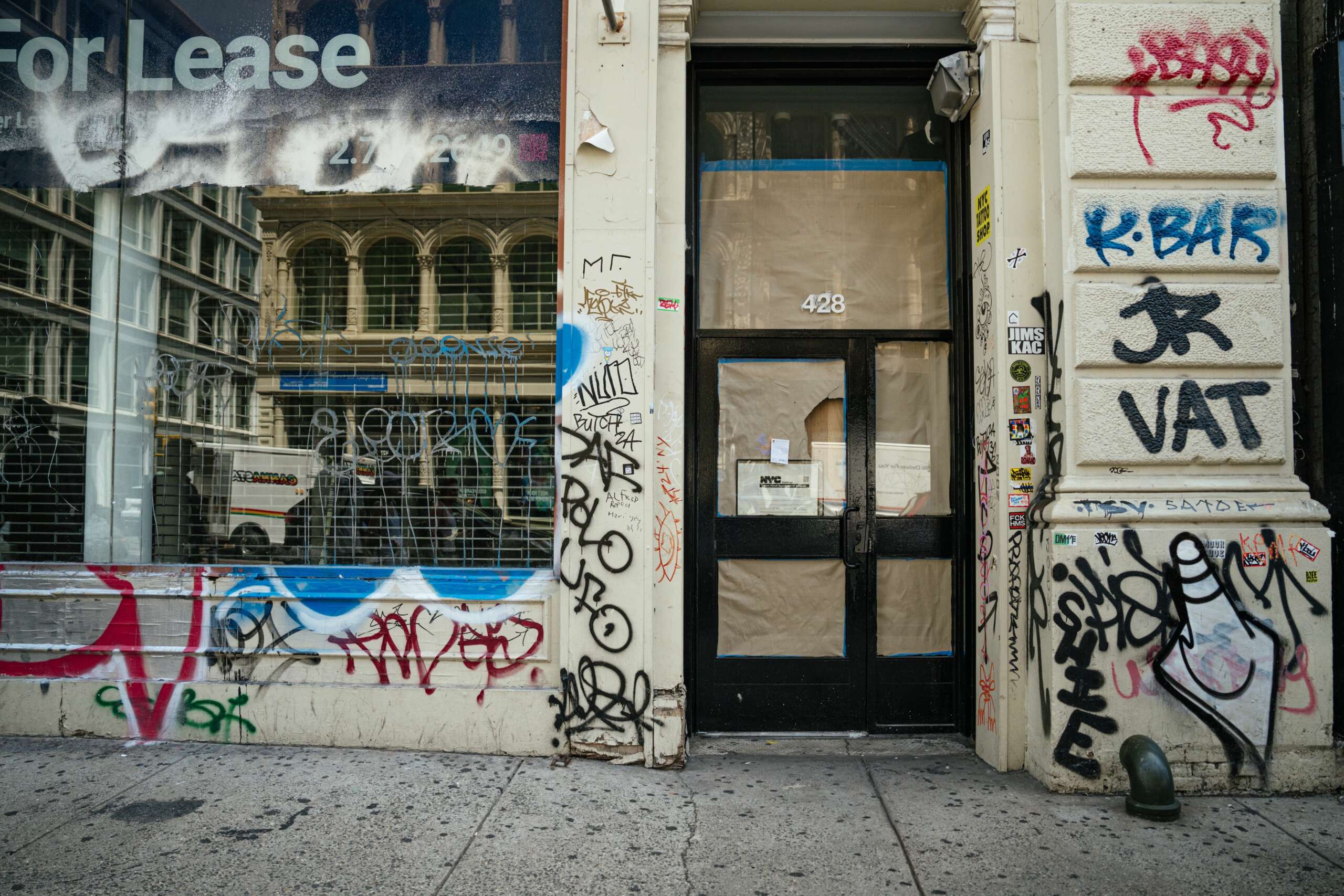
From 2020 to 2024, the number of vacant storefronts across New York City rose by nearly 30 percent. But during the same period, rents for commercial spaces declined by just 6.5 percent, according to a new report—what its authors say indicates a willingness, on the part of at least some property owners, to let storefronts sit empty for months rather than lower their price.
“The data show that in many areas of New York City, high rents and high vacancy often go hand in hand,” Irene Tung, senior director of program and policy at the Action Lab, said in a statement about the findings, which the group published alongside Small Business United and Main Street Alliance.
The report builds on numbers published by the city comptroller’s office in June, which counted approximately 15,700 empty storefronts across the city, putting the commercial vacancy rate at 11 percent (“healthy retail corridors,” the report says, should have no more than 5 percent of its storefronts empty). In many city neighborhoods, the comptroller found, up to 90 percent of vacant shops had been that way for at least nine months.
“Neighborhood businesses may want these spaces, but too often landlords keep storefronts vacant rather than lower rents to a level small businesses can actually afford,” Tung said. “That isn’t an inevitable outcome, it’s the result of policy choices.”
The solution, the report’s authors say: regulating the city’s commercial rents. They’re specifically calling for passage of the Small Business Rent Stabilization Act, a bill proposed in the state legislature to establish a Commercial Rent Guidelines Board that would vote each year on rent adjustments for commercial spaces, just as the Rent Guidelines Board does annually for the city’s rent-stabilized residential apartments.
The legislation would also create lease renewal rights for commercial tenants, defaulting to a 10-year lease in most circumstances.
“It would make it easier for tenants to renew their leases, so that fewer storefronts would become vacant in the first place, and and in turn would create greater predictability both for small businesses and for landlords,” said State Sen. Julia Salazar, who sponsored the bill in the Senate.
Rent is the number one worry for some small business owners like Kit Keys, a member of the Small Business United coalition and owner of Yant Studios, a tattoo parlor and art gallery with locations in Long Island City and Chelsea.
“Everyone is afraid of having a problem with the landlord because there is no protection,” she said, after disagreeing with her previous landlord in Forest Hills on the rent. “To be honest I’m afraid to sign any lease, any new lease.”
In Ridgewood, Emil Bovbjerg, also an SBU coalition member, said that landlords were asking for rents that were more than retail tenants could bear.
“There’s beginning to be a divide between what the reality we’re seeing on the street and rent that is actually affordable… and what is realistic in [the landlord’s] view, the appraiser’s view, a lender’s view, to get in rent each month,” said Bovbjerg, who owns a coffee shop and cocktail bar called Dada Bar on Myrtle Avenue.
Neighborhoods with the greatest number of empty storefronts include several in Manhattan, including areas with some of the highest commercial rent prices. For example, State Senate District 28—which spans the Upper East Side, Midtown/Midtown East, Gramercy and Murray Hill—has a nearly 18 percent store vacancy rate, according to the report. Commercial rents there average around $20 per square foot, compared to a citywide average of $8.55.
“I think one of the most significant findings for me is the positive relationship between high rents and high vacancy rates,” said State Assemblymember Emily Gallagher, who co-sponsored the Small Business Rent Stabilization Act with Salazar.

“Oftentimes there’s a narrative about the market responding to the vacancy rates, but it really does seem that landlords continue holding out for the premium-paying tenants,” she said. “There’s some kind of business calculation here that is making people choose to keep a vacant storefront rather than to try to get it occupied.”
Regulating the city’s commercial rents isn’t a new idea. For decades, lawmakers at both the city and state level have debated the possibility, though past proposals faced significant opposition from real estate groups and building owners.
“Before government meddles this deeply in private contracts and takes the easy path to solve this problem—blame the landlords—it should first understand why,” Jan Lee, who owns a small mixed-use building in Chinatown and serves on the board of Small Property Owners of New York (SPONY), told City Limits in a statement.
Lee called the current bill a “blanket” approach that “treats every neighborhood, every storefront, and every landlord-tenant relationship as though the problem is exactly the same.”
“Every block in New York City is different,” Lee said. “On Canal Street, legitimate brick-and-mortar businesses compete with counterfeit goods sold directly outside their doors. Elsewhere, vacancies may be driven by a persistent encampment, public-safety problems, years of construction, poor transit access, or a street that floods every time it rains.”
Ann Korchak, SPONY’s board president, said limiting how much owners can raise the rent makes it harder for them to maintain their properties amid rising operating costs. A similar debate is playing out over the city’s residential rent stabilized buildings, where many owners say the regulations are fueling distress.
“Commercial rent control will harm small owners and their residential tenants,” Korchak said in a statement. “Elected officials should be considering concrete solutions, such as tax relief for both small property owners and the small businesses we rent to.”
Gallagher says their bill was crafted with some of those concerns in mind. Like the residential Rent Guidelines Board, the Commercial RGB the legislation would establish would be required to examine owners’ operating costs and take those into account when voting on annual rent adjustments.
“The goal is not to create a rent freeze,” the lawmaker said. “The goal is to just create a stable business economy where business owners and workers can calculate for the future and can actually build their business in a way that is appropriate.”
Supporters point to the many benefits of a thriving small business sector, which accounts for roughly a quarter, or a million, of the city’s jobs. Vacant storefronts can have other cascading effects on a neighborhood, they argue, including safety concerns from having fewer “eyes on the ground” as well as diminished foot traffic that impacts neighboring retailers.
Stable commercial corridors “certainly benefit landlords,” Salazar said. “They also benefit tenants, workers, and neighborhoods that are part of this ecosystem that landlords benefit from and are a part of.”
“The truth is that when local businesses close, everyone feels the impact,” she added. “Workers lose jobs, residents can lose essential services, and commercial corridors become less vibrant, and then local economies suffer.”
To reach the editor, contact [email protected]
Want to republish this story? Find City Limits’ reprint policy here.
3 Comments
Acme
They don’t necessarily need rent regulation. The market economy says vacant storefronts are overpriced. Meanwhile, the owners prefer zero income to a true market rate rent, which would be lower than what they’re asking. These vacant storefronts are a drag on the community and an eyesore. The solution is to use Eminent Domain to seize these vacant properties and let the City rent them out for the true market price. Evidently, the owners don’t need the money so it should be fine with them, right? In any case, given the alternative of having their property lost to Eminent Domain, they’d probably adjust the rent down until somebody took it.
David
There has been previous discussion in Council about banning the practice of commercial mortgages containing clauses that forbid landlords from lowering retail rents during the term of their mortgage (an attempt to preserve the status quo under which the mortgage credit risk was underwritten). Can you do a follow up on whether this is still a live issue?
Jeanmarie Evelly
Interesting, thanks for flagging! Will see what we can find out.