


Share This Article
“It’s not a how-to guide, but hopefully by the end of it, people will walk away feeling like they know what they’re up against, and they’re ready to keep fighting,” said housing activist Sam Stein, who spoke to City Limits about his new book, out Tuesday.
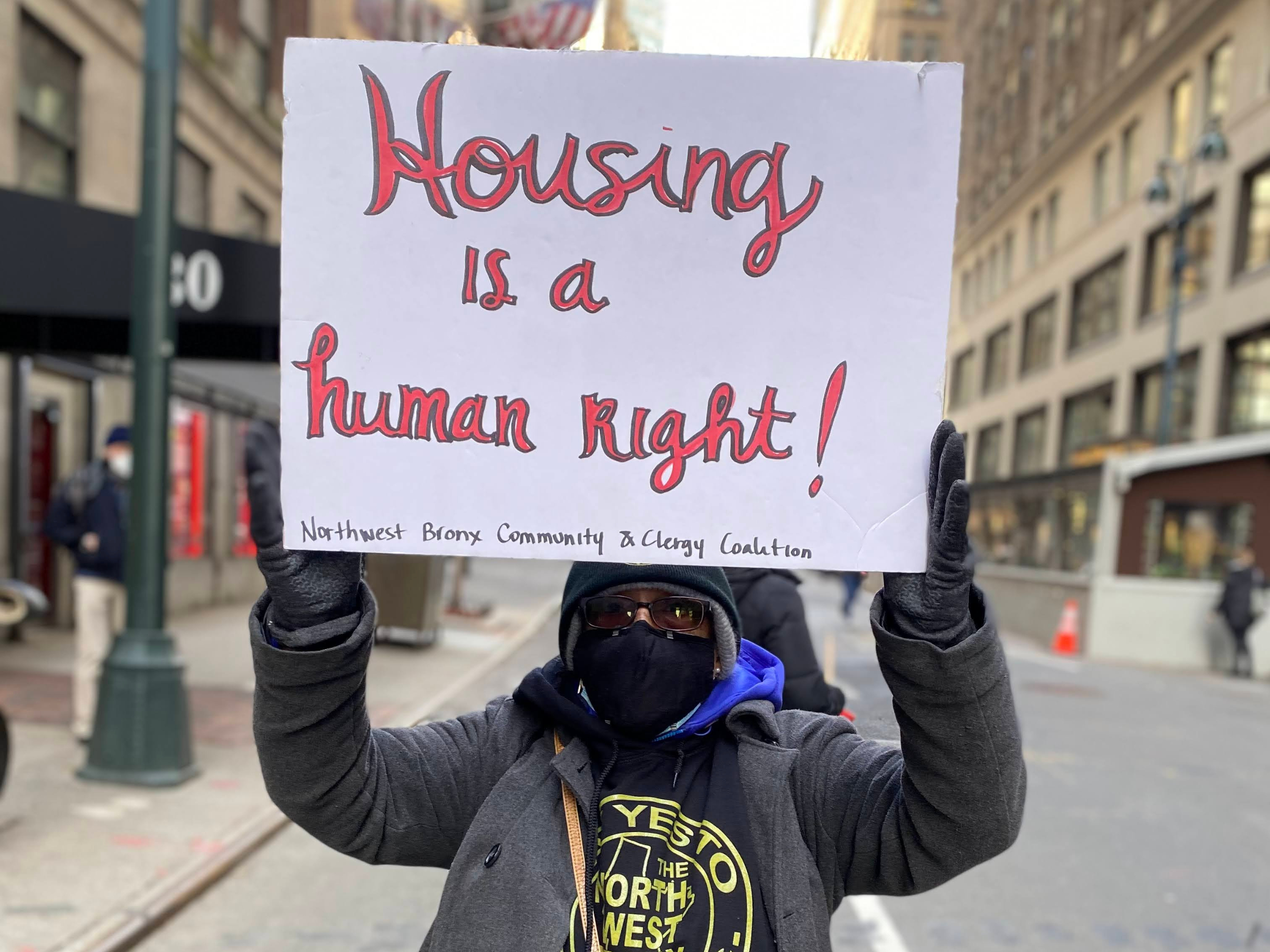
“Fight, fight, fight! Housing is a human right!”
Through the decades, the chant has been shouted—on the steps of City Hall, outside the offices of city agencies, or on the stoops of dilapidated apartment buildings—by New Yorkers fighting for housing justice.
The refrain is a promise and a paradox, argues Samuel Stein, a tenant organizer and researcher, in his new book, “A Right to Housing?”
Stein, a longtime tenant organizer and researcher at the Community Service Society,* examines the potential of a right to housing and pitfalls in getting there.
“It’s a tough sell, but what I’m trying to make the case for is that we have to understand all these obstacles and barriers and limitations and contradictions, and that we not stop fighting for universal housing, affordable housing, a right to housing,” said Stein, whose previous book, “Capital City: Gentrification and the Real Estate State,” examined the influence of real estate interests on urban governance.
“It’s impossible to change something if you don’t understand what it is,” he added. “But it can also be paralyzing to realize just how much we’re up against.”
In an interview with City Limits, Stein discusses his new book—on sale Sept. 8—the policy solutions that would create a right to housing in New York City, and the political movement it would take to achieve it.
This interview has been edited and condensed for clarity.
Jump to:
- Organizing as religious practice
- Barriers to housing as a human right
- Shifting the balance of real estate power
- How Mayor Mamdani has done on housing so far
- Has the administration gone full-YIMBY?
- What happens when activists start working in government?
- How to build on the “right to shelter” and solve homelessness
- Building a housing movement that includes homeless New Yorkers
- Fighting for vouchers, rent stabilization, and social housing
- Controversial NYCHA privatization fights
- Fighting when it feels hopeless
You frame the book as a question: a right to housing? You express both optimism and pessimism, and you use this housing organizers’ chant, “fight, fight fight, housing as a human right,” as a way to examine if we can actually fulfill that promise. Why did you frame the book this way, and after writing the book, do you feel any closer to an answer to that question?
All of us who are doing this work are caught in the space between what we say and what we’re living, and I thought that that was a productive confusion to start from and end with. There’s this chant that we hear all the time: “fight, fight, fight! Housing is a human right.” Every single tenant rally, every homelessness rally, social housing, public housing—that’s that’s the go-to. And the thing that always catches me up is the “is” part. That if housing is a human right, what do we mean by that?
It’s very different than to say, as a rent-stabilized tenant, I have a right to a lease renewal, where if I’m denied that lease renewal, there’s something I can do about it. Whereas if I find myself homeless, I have a right to shelter, but I don’t exactly have a way to access this rhetorical right to housing. So I start there, but then I want to take seriously all the reasons why that hasn’t already happened. These aren’t original ideas, and so there must be something more than just “we’re not trying hard enough.”
So if the question is: am I closer to the answer at the end of this than at the beginning? I think no. That when you ask an existential question and you actually try to answer it, you only end up with more questions in the end.
You draw some repeated connection between your political commitments and your religious practice. With this idea of hoping and trying to achieve housing as a human right, what role does that faith play for you? And do you need some sort of faith to be an effective housing organizer?
You need something, and the specific form of Judaism that I practice works for me. Other people have hope, and in the sense that they think that we’re going to win or they believe it’s possible that we’re going to win. I found that as things got worse and worse in this world, I felt less and less hope, and yet I didn’t change any of my behavior, even as that implicit assumption that we would eventually win and that things would eventually change dramatically faded away.
So that’s where faith comes in for me. It’s an orientation to the work, and it’s an orientation to the world, where you have to just keep doing it, partly because maybe you have faith in the unknown. It’s faith that I couldn’t possibly know whether or not we’ll win, and therefore I have a commitment to trying. But it’s also faith in the sense of a lineage, people have been fighting for housing rights in one form or another for centuries, and you can’t just stop because you’re frustrated that we seem to have hit several walls.
My practice of Judaism is similarly situated, where it’s actually not that I believe in God, let alone that specific God. It’s that I am who I am, and I’m not going to be the one to give up on thousands of years of tradition in this way. And that by doing Judaism, I actually find the meaning. So the meaning doesn’t come first, and then it takes you to the religion. Doing the religious practice puts me in a different place of mind than I could be otherwise, and it’s almost the same with politics. It’s only actually by doing politics that I come to realize what any of this means and why it’s important.
What are some of the biggest barriers to achieving “housing is a human right?”
We’ve got the federalism problem in that we’re a city that’s controlled by a state that’s controlled by a federal government. We can elect a mayor who is committed to the idea of housing as a human right, but doesn’t necessarily have the power to do anything much about it, or not all that would be expected of somebody who wanted to make housing a human right, it’s just not in their legal powers.
One of the key ones that I think the Mamdani administration has been very candid about is the budget, where they entered with a budget deficit. They can’t control any taxes but the very blunt measure of the overall property tax. They can’t even do a more progressive property tax, where some people’s property taxes go up more than others. It’s just a rate that they can adjust, and so they’re dependent on the state and the federal government to provide the money. If the powers that be at those levels aren’t really interested in playing ball, then we’re stuck.
But I think even more profoundly, this property tax question means that to get the money that we would need to guarantee housing, we would need housing to be profitable enough that it would be taxed at a high enough rate to bring in the revenue to support it. So New York City’s budget comes in its largest block from our property taxes. If we decommodified all the housing, which I think you would have to do to have a fully realized right to housing, we would lose all that money. We would have to replace it with something else, and it’s not impossible to think of what that something else could be. But that’s a really, really, really big obstacle to anything happening immediately or locally.
In your previous work, “Capital City,” you described this phenomenon of real estate interests making themselves intractable forces in urban governance, seizing upon a kind of a vacuum of power in recent decades. Do you feel like much has changed since you wrote that?
Yeah, there’s structural shifts that are really hard to change quickly, and then there’s power dynamics that change surprisingly fast. And I think that we’ve seen both things play out in the last seven years since that book came out.
The structural side, things are not changing that much. Yeah, real estate still has tremendous power in New York City, and a lot of it is implicit and structural. It’s because they are the tax base. It’s because they are a lot of the power players. They are the financial backers of a lot of political campaigns, etc.
But I think we’ve seen real advances in the tenant movement over those years, including immediately after the book came out with the 2019 rent laws, in ways that really challenged some of the assumptions, implicit or explicit, in that first book. For example, the relationship between new high end development and existing housing is really changed when you have all the loopholes in the rent laws closed up, and especially when you pass good cause eviction a few years later. Those things were not facts of life when I was writing the book or when it was published, and then suddenly they were.
So it’s not that this entire situation is immutable, but I do think that we have to understand the structural power of real estate in order to even think about challenging it. And sometimes there’s a bit of wish casting it away so that we can fast forward to the fun part, but it doesn’t actually work that way.
Now because we have a democratic socialist mayor in office, let’s talk about the current state of the political economy around housing. There’s one problem that you identify in the book that speaks to some of it:
“This is a structural problem of the capitalist state. Its leaders and planners must ensure healthy profits for real estate in order to sustain a fiscal base and maintain elite support, while also addressing affordability to maintain popular legitimacy.”
This does strike me as one of the big challenges that a socialist mayor would face in office. And there’s some issues where we’ve seen him tack to center a little bit; others where he’s stayed more on the left. How would you kind of evaluate how he’s done on that pretty wicked problem?
The most important thing is to recognize that it’s impossible, first. You don’t want to judge somebody on how well they perform an impossible task, or else you’re setting yourself up for disappointment.
Getting into the specifics, though, we’ve seen the Mamdani administration show a real commitment to improving tenants’ rights at the building and portfolio level when it comes to empowering tenant unions, officially recognizing tenant unions, creating structures for tenants to speak directly to government or to organize and get action from government. We saw just the other day the announcement of a fast-tracked 7A process for tenants to sue landlords to bring in alternative management. All this is really good and really important. I think we’re going to see the rollout of “Fix the City” soon, which is going to step all these things up significantly for a targeted pool of buildings.
But there’s limits to how much they can do. Part of that is budget, that all of these interventions cost quite a bit of money that they don’t necessarily have, and so they’re going to probably target the worst buildings, the worst portfolios, the most overleveraged, the ones where the landlord really has the least set of legitimate excuses, which will be very important both symbolically and directly for the tenants. But that’s going to leave a lot of tenants in buildings that are not great, but not bad enough to justify alternative ownership.
So that’s one set of issues, and then the other set of issues is they’re very clear that they want to see more real estate growth, and that they want to see not just 100 percent affordable housing. They want to see fully market rate housing, mixed inclusionary style housing. That will be, I think, welcomed by some folks and opposed by others, and probably most controversial when it happens on public land. Just something the Adams administration already started to do.
But it goes against the standard practice of 100 percent affordable [housing] on public land that New York has been doing for at least the last decade, so that seems to me a notable bifurcated push. One is to go harder on the worst landlords, and the other is make life a little bit easier for the developers.
That brings me pretty squarely to the “yes in my backyard”–the “YIMBY” question. The Mandami administration has embraced some of those policies, and you express some skepticism about YIMBYism, but also acknowledge the idea that a supply constrained market gives a certain amount of leverage and power to landlords. I’m wondering, where do you come down on this question about the YIMBY movement and how it kind of squares with the movement that you’re talking about—housing as a human right?
Mostly, I try to move us away from that framing because I think it’s not terribly productive. It certainly caught on in the popular imagination, but I think we do ourselves a disservice when we imagine that loosening zoning and other regulatory frameworks will unleash a torrent of new development, which will then filter out into genuine affordable housing for all. Only the extremists of the YIMBY camp actually make that final argument. But that is the implicit scenario, and where I go with it in the book is to say exclusionary zoning sucks, so forget about that as any kind of a liberatory pathway.
I think we should not get hung up on the solution to the housing crisis that we’re facing, either being the private supply, like expanding or contracting the private supply of housing, and instead move toward the realm of tenants’ rights and social housing, not as a replacement for new housing construction, but as an irreplaceable component of an overall housing system.

The book is as much about policy as about as it is about a movement, and many of your contemporaries, some of whom were mentioned in the book, are now working in government for the Zohran Mamdani administration, most notably in the mayor’s office for tenants and some of the initiatives that you talked about with “Fix the City.“
Reflecting on their first few months in office, I talked to Deputy Mayor for Housing Leila Bozorg, and she told me that they’re going to both stand up with tenants and work with real estate. Can you do both and achieve a right to housing? As someone who’s in a housing movement and then is trying to work within a system to achieve some of those goals, how should you act in government?
It is a strange feeling to have activists go into city government alongside long standing government veterans, and that’s been the sort of Mamdani admin M.O. To bring in both new faces familiar to those from the tenant movement, the labor movement, the environmental movement, the transit movement, alongside people who really know how things work. It’s a smart pairing because there’s often a problem where the outsiders with the best ideas have no idea how to implement them. The insiders who know how the implementation works can’t imagine anything outside of the norm, and so it’s potentially fruitful to bring those two together.
But then there’s the realities of flying the plane as you’re building it, or governing while you’re trying to change the fundamental nature of government, and that’s how you end up with, “We’re going to protect tenants and landlords together,” or “We’re going to stand with the movement and the real estate industry at the same time.”
They don’t really have much of a choice but to do both. In part because you can’t leave behind the movement that brought you into office and the motivating forces that make this work meaningful to you as a municipal worker. But you also need that tax revenue flowing, and you also need new homes for people to move into, and you don’t yet have the capacity to do public development at the scale that the private sector can, and so you find ways to do it.
And I think the admin is trying to say, “this is not a conflict, this is not a contradiction.” They’re saying, in Mamdani-esque language, “for far too long, we’ve been led to believe that these two things are separate. You can either have tenants’ rights, or you can have new housing development, and we’re showing that you can do both.”
Maybe, we’ll see. I think that there are concrete places where the rubber hits the road, where we’re going to figure out exactly how this works. What about neighborhoods that have some housing right now that might be torn down to build more housing than was there before? What if the housing that’s there right now is relatively cheap, and the housing that’s going to be built is relatively expensive, but there’s going to be much more of it?
It’s one thing to say we’re going to look at vacant public land and we’re going to build more affordable housing there, of course, or even to say we’re going to take public land that has something on it and we’re going to build housing plus the thing it already has on it, like some of the library plans—not all that controversial.
But once you talk about removing existing housing to build more housing, or removing things that people have other beloved attachments to, like a health clinic in Harlem, you start getting legitimate claims on both sides in ways that having a commitment to both tenants’ rights and more housing simultaneously doesn’t easily resolve.
One of the places that I’ve noticed the rubber meeting the road is homelessness. There are people in the housing movement that were very critical of the mayor for backtracking on some of his promises around vouchers that are the primary way to get folks that are currently living in shelters, which is over 100,000 people every night, into permanent housing. Those vouchers also have a lot of problems where you can’t live in the neighborhoods that you might expect. They’re really hard to administer, and there’s eligibility requirements. They ended up coming to a compromise, but it falls far short of what some folks had hoped for. There’s also questions of the Mandani administration’s work on homeless encampment sweeps. How do we get from right to shelter to a right to housing, given all these constraints that you’ve been talking about?
It’s hard to do locally. Part of this entire story is the story of the federal government f**king up over and over again for decades, first slashing the budget at [the Department of Housing and Urban Development (HUD)], ending the commitment to building more public housing, creating a Section 8 program but never fully funding it. More recently, cutting off emergency housing vouchers years early, just affront after affront after affront.
And so it ends up landing on local governments to make up for the federal government in ways they can’t. They can’t because they don’t have nearly the resources of the federal government, and because they can’t budget deficit the way that the federal government can and does.
There’s something that one of my dissertation advisors, Ruth Wilson Gilmore, and her husband Craig Gilmore wrote a few years ago that stuck with me, that said that neoliberalism is like a scissor attacking cities. It’s simultaneously federal disinvestment and local responsibility, and so localities are more and more charged with fixing things that they have less and less resources to fix, and it sucks.
So how do we move from the right to shelter to a right to housing? We have done it for a subset of the homeless population, which is homeless veterans. We have essentially instituted a functional “housing first” program for military vets who find themselves homeless. We put them in housing, and then we figure out whatever other supports people need. We don’t make them wait in shelter and then find their way to the private market. We don’t make them go from the streets into the shelters into the private market. We have a parallel system set up.
Other countries, other cities have a much more expansive “housing first” program. I read about Finland as maybe the most successful, the most famous current example, where they basically got rid of all forms of [homelessness] except the kind of overcrowding and staying with friends and family in a precarious kind of way that is a form of homelessness, but doesn’t always show up in official statistics. Everything else has been almost entirely removed. They put people in apartments, and then work with them to get them into a permanent place to live, to get them whatever medical resources, therapy, addiction counseling, whatever else they need. But they don’t make the housing dependent on that.
If there’s a stigma against tenants, the stigma against homeless people is magnitudes more virulent. How does the housing movement bring homeless people into it?
It’s been a challenge. I’ve been in and I’ve heard about meetings where tenants and homeless New Yorkers are meeting together, and one says something that the other finds extremely offensive or dismissive or hurtful. So there’s that kind of interpersonal misunderstanding even among tenants and homeless people, let alone bringing in homeowners to the question.
A coalition like Housing Justice for All has been trying to do this, to make its priorities relevant to both keeping tenants in their homes, creating alternative housing models, and ending chronic homelessness. You saw Housing Justice for All fighting for HAVP and Good Cause in the same legislative sessions, for example, and making the case with good cause that this is not just a tenant protection; it’s also a homelessness prevention policy. And then making the case with HAVP that this is a way of getting people out of chronic homelessness, but also a way of keeping tenants housed.
So thinking of policies as equally relevant to both populations, and then building solidarities between them. The Coalition for the Homeless has also been really good on this for years. They’ve been strong supporters supporters of rent stabilization, and you might think of that as being a tenant issue and not a homeless issue, but they make the case that having the stability of a guaranteed lease renewal and a slowly rising rent keeps people housed, and having rent stabilization be as broad as possible keeps the cost of rental assistance from skyrocketing, and therefore makes it a more sustainable program and one that can help more people with the same number of dollars. And so, the more we can do to make homelessness and tenants’ rights and social housing all a part of the same movement, the same conversation, the same policy platform, the same vision, the better.
There’s a bunch of proposed legislation that you name check in the book at the local, state, and federal levels. The three biggest policies you focus on are vouchers, rent regulation, and social housing. What should people be fighting for if we’re going to achieve a right to housing?
All of the above. I think it can be tempting to pick one and stick with it, and sometimes our jobs require us to. Sometimes the limitations of just how much time we have require us to sort of pick a lane and stick to it, but I try to make the case that one of those things without the other doesn’t really work. That we can have a perfect vision of social housing where rent is capped at the cost of operating, but the cost of operating is going to be a lot more than a lot of people can afford in this city, and so we’re going to need rental assistance to cover that gap.
In order to even have a grounds on which to fight, tenants need the stability of stabilization. And maybe our future vision is a fully social housing vision, in which case rent means something entirely different than what it is right now. But as long as we still have anybody paying rent we’re going to need as strong and as universal a rent stabilization program as possible. Like I said before, rental assistance works a lot better with widespread rent stabilization.
Vouchers, rent regulation, and social housing conversions are all things that there are existing tools for. You talk about new social housing being particularly elusive. I think that’s something that is very attractive to a lot of folks on the left. The mayor has a big affordable housing platform, but by your definition, the 200,000 affordable homes don’t really meet the social housing definition. What’s what’s missing from making that happen?
We need institutions, and we need those institutions to have funding. So we have NYCHA, we have also the Preservation Trust, both of those could be building new housing. You don’t have a lot of public housing authorities around the country building new public housing, but you do have some, both acquiring but also building new project-based Section 8 housing and operating it through their public housing authority under municipal control. NYCHA doesn’t do that probably because they’re so underwater with the public housing that they have right now. But legally, they could.
There has been a push for a statewide bill called the Social Housing Development Authority that would create a new public authority solely tasked with building various forms of social housing. It could be building the next generation of Mitchell-Lama cooperatives. It could be building a new model of public housing. It could be partnering with community land trusts. It could be doing a whole lot of things.
We also have other institutions that don’t build social housing, but could, and I think we can point to the history of the Urban Development Corporation in New York State, which sponsored a lot of the Mitchell-Lama construction in the late 60s, early 70s, and it still exists.
There’s talk of doing pilot projects in various places. There’s a state-owned site in Brooklyn in Phara Souffrant Forrest’s district where there’s been a bunch of visioning sessions of what could be done there. I know Assemblymember Sarahana Shrestha is interested in getting a social housing pilot project up in the Kingston area, and we can look at those pilots and be like, “Eh, it’s one project. What’s that going to do?”
But if you can do it successfully, you can show that it can be done, and you can inspire more organizing to do it more. So I think those kinds of pilots can be incredibly important, and just reminding New Yorkers that this sort of a thing, which we talk about as part of our housing heritage, is not easy, but totally possible to do again.
One of the missing pieces there as well is the preservation of existing social housing. Project-Based Section 8 conversions in NYCHA are super controversial, even though they do unlock new funding to be able to do some of that preservation. I’m wondering if you see that as a step towards social housing, or is it a compromise?
It’s a compromise that is being largely forced by the federal government for generations. This is what the federal government has wanted to see happen, and it’s pushing public housing authorities to pursue Section 8 conversion. It’s wild to me that HUD, the federal government, will pay so much more money in monthly rent once you’ve brought in private management for the exact same unit that it will with public management.
This is not how Section 9 was set up to operate, but it’s also not really how public housing works elsewhere. There are international models with private management of public housing—that’s not actually all that rare—but it is weird to have these dual systems with drastically different funding levels for exactly the same apartment.
Ultimately, that’s going to be what needs to change. It’s possible that somebody like AOC [Alexandria Ocasio-Cortez] is going to run for president, and that she’s going to put refunding public housing back on the table. Certainly, that’s not anything that anyone expects the Trump administration to do under this or the next Congress, and so you’ve got these immediate moral questions of okay, well, there’s more money on the table for public housing if we bring in private management, but a lot of tenants oppose it.
I think the the Mamdani administration is trying to get people to see a well functioning RAD/PACT conversion as social housing, in that the land is still owned by the public, they they don’t have the same tenant council structure as before, but the new management has to meet with them, and they bring in more resources. So it’s creating a more equal housing system, essentially, [in] not subjecting Section 9 residents to the worst conditions. But I think that it’s still a very tough pill for a lot of people to swallow: that a model that was championed by Fiorello LaGuardia, the mayor’s hero, is going to see its end anytime soon.
The book is full of dualities. You say that “the electoral endgame remains elusive to me,” but also that right now you’re experiencing “the greatest degree of political optimism I’ve had in years.”
This returns to the question of faith that we talked about before—that politics is a practice, and it needs to be done, and it needs to be continued, and you can practice it in the same way that you would a religious faith. You can do it whether you’re hopeful, and if you are—wonderful. And if you’re hopeless, you can actually still keep doing it, and be surprised when good things happen.
My gambit in the book is that a lot of people are actually feeling these dualities, but that we don’t have a way to express them. And the experiment is: what if we put all this on the table? What if we put our biggest dreams and our greatest fears on equal footing, and try to live with them both?
It’s not a how-to guide, but hopefully by the end of it, people will walk away feeling like they know what they’re up against, and they’re ready to keep fighting.
*Community Service Society is among City Limits’ funders.
To reach the reporter behind this story, contact [email protected]. To reach the editor, contact [email protected]. Want to republish this story? Find City Limits’ reprint policy here.
1 Comment