


Share This Article
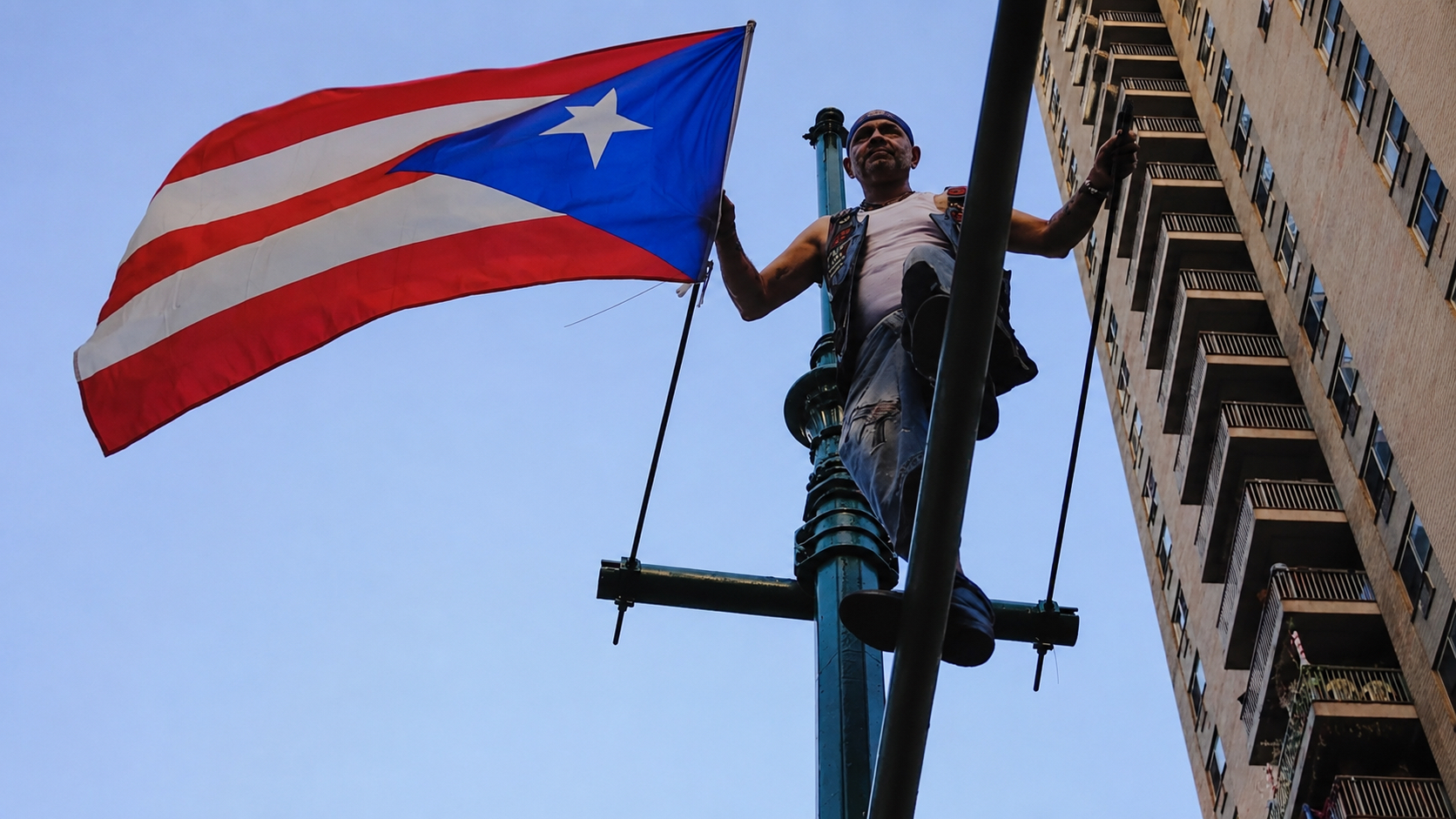
New York City-based filmmaker Taylor Hosking begins her debut documentary, “West Side Familia,” with a simple question: Why is the Puerto Rican flag unfurled and flown from a light pole on the Upper West Side each June? The film will premiere in September at the New York Latino Film Festival.
Lea la versión en español aquí.
Amid the city’s constant transformation, some rituals get buried.
New York City-based filmmaker Taylor Hosking begins her debut documentary, “West Side Familia,” with a simple question: Why is the Puerto Rican flag unfurled and flown from a light pole on the Upper West Side each June?
The annual tradition has been carried out by “Chino Familia,”* a member of La West Side Familia, a Puerto Rican-led biker gang and community activist group. The documentary reconstructs his story dating back to the 1970s alongside the history of the neighborhood and its changes.
It sheds light on the Black and Puerto Rican community that existed—and still fights for visibility—on the Upper West Side, and how its cultural and political influence helped shape the city.
Each year, the simple act of raising the flag tells a story of New York’s Latino history, and opens the door to conversations about housing, gentrification and memory in an ever-changing city.
City Limits caught up with Hosking, who grew up in the neighborhood, to talk about the film, which is set to premiere in New York City at the New York Latino Film Festival on Sept. 16 at 7:15 p.m. at Regal Union Square.
This conversation has been edited for length and clarity.
City Limits: The documentary opens—and this is not going to be a spoiler because the trailer also shows it—with the Puerto Rican flag being raised in the Upper West Side. What lies behind the act of flying the Puerto Rican flag?
Hosking: For some people, the Puerto Rican flag marks the start of summer, regardless of whether you’re Puerto Rican or not. For some people, it’s a time of year when they get to be the most loud and proud. And it’s like an important annual reunion that reminds people of what it means to be Nuyorican.
I actually saw the flag out my childhood apartment window. But I never thought to wonder: who puts it there; how it gets there. I guess partly because it looked so official every year. But once I saw who puts it there, I was like: Oh no, this is a story! It was interesting that I had already had this relationship with this symbol of the community before I even started the film.
It just became such a great window into the depths of what it means to people to hang that flag…because for a lot of the people in the story, that means Puerto Rican independence, Puerto Rican liberation. For other people, it means the love that they share for their neighbors and their community. For others, it means the neighborhood is kind of moving on without them.
In the past, about two weeks after the flag is put up, someone in the neighborhood—probably one of the new neighbors—usually does something, like calling 311 to have it taken down, saying it’s blocking a traffic light and giving different excuses. But ever since we started filming this movie, the flag has been able to stay up all year.
Maybe because people are starting to understand that it’s more than just a little nuisance and that it does mean something to people. Maybe they’ve seen some of the trailers and news coverage or just some of the cameras out there with them as well. But I don’t think it’s a coincidence that now we’re finally starting to tell this story. People are finally starting to let the flag stay.
CL: New York is known as the constantly changing city that is always on the move, and never sleeps. And I feel like part of the documentary is about change. How can we honor the transformation of a neighborhood in a place like New York City?
Hosking: Having annual traditions—and maybe they could be even more frequent than annual. For example, the Central Park rumba community meets every weekend during the summer… It is such a touchstone to be able to have the world constantly change all around you, but have this one thing that’s always going to be pretty similar or a continuation of itself. That’s intergenerational and very community-based.
The more people start to understand those decades-long traditions, and to learn that those involved are intergenerational community leaders, then it’ll be easier to stay connected to a more sustaining spirit of the city and the spirit of their own heritage and where they’re from.
CL: How would you characterize what happened on the Upper West Side?
Hosking: There is a gentrification that’s happened in the sense that the neighborhood was remodeled, some neighborhoods were completely leveled during urban renewal, and rebuilt with new buildings, so there was that kind of filling in of the city.
But beyond that, the Upper West Side also has this mix of longtime residents in rent-controlled or Mitchell-Lama apartments and newer, wealthier arrivals. So you have a mixture of some longtime residents that have been here for decades—like me living in the apartment I grew up in.
It’s also become quite a wealthy neighborhood too. So there’s now a really drastic contrast between the wealthier people and the newcomers, and the long-time folks.
CL: What do you hope the neighborhood’s more affluent residents take away from the film?
Hosking: It might sound corny, but don’t judge a book by its cover in the sense that you know the main characters of this story are people who—at one point in time—started a gang in their neighborhood to look out for the local community, while wearing these hard-edged leather vests.
They’re an outlaw crew, and they’re very much from that time: the Young Lords and the Black Panthers. So they almost look from another time, and they bring that energy into the here and now. No matter who they’re talking to.
But at the same time, what they really stand for is the same thing that I’m sure the person who might be calling the police because of a group of loiterers stands for, in the sense that they both want a safe neighborhood. They both want to feel respected and comfortable when they’re walking down the streets. My hope is that this film shows people they can be allies with anyone sharing the same love for their local community.
When you see movies like “The Warriors”—which portrays a world of gangs in New York and was even shot in this neighborhood—it’s interesting to see how the locals reacted. Some of the guys tried to stop the shooting because they were like, “Who are these Hollywood folks trying to portray our stories?”
For a while, TV shows and movies portrayed the Puerto Rican community in New York in a hyper-Hollywood filter, [like] West Side Story. After that, it was basically everything and anything you saw on TV—Seinfeld, Curb Your Enthusiasm, or The Marvelous Mrs. Maisel—having to do with this area was pretty white, either preppy or pretty Jewish. Which is fine, but…there was nothing of the [Puerto Rican] community…that was also present in culture.
CL: We see a lot of movies set in the city, but not documentaries. How hard was it to fund this project?
Hosking: It was really difficult to get this project funded. We got a grant from the City of New York Mayor’s Office, which was administered by the NYC Women’s Fund, and then we got another grant through Latino Public Broadcasting. That was kind of their last round of grants before the Trump era, when cuts came in. And ever since Trump took office, we haven’t gotten any other grants. We have been lucky to find some executive producers and individuals who were able to donate in a way.
But there’s definitely a need for more resources to help marginalized communities in the city share their stories. I know the mayor’s office is involved in a lot of things, but I think it’s still hard to figure out how to get resources and funding into projects that deserve it. I think the city itself could help with that, as well as facilitating more pipelines.
We’re still working on closing the budget gap, but we’re making progress. We’re showing the film and getting some of the money back from these screenings and other sources.
CL: What’s the best way to find out when and where New Yorkers can see “West Side Familia?”
Hosking: Our New York City premiere will be at the New York Latino Film Festival. After that, we’ll have more screenings in the fall, winter, and into next year, including one on PBS. The best way to stay updated is to follow @westsidefamiliafilm on Instagram. We’ll post screenings, community events, and more there.
*This story was updated to correct the name of the subject of the film, who goes by Chino Familia. City Limits regrets the error.
To reach the reporter behind this story, contact [email protected]. To reach the editor, contact [email protected]
Want to republish this story? Find City Limits’ reprint policy here.