


Share This Article
“The goal shouldn’t be to freeze this industry in place. It should be to accelerate the transition already underway—more walkers, more e-bikes, more waterfront freight, more operators building career ladders from the ground up.”
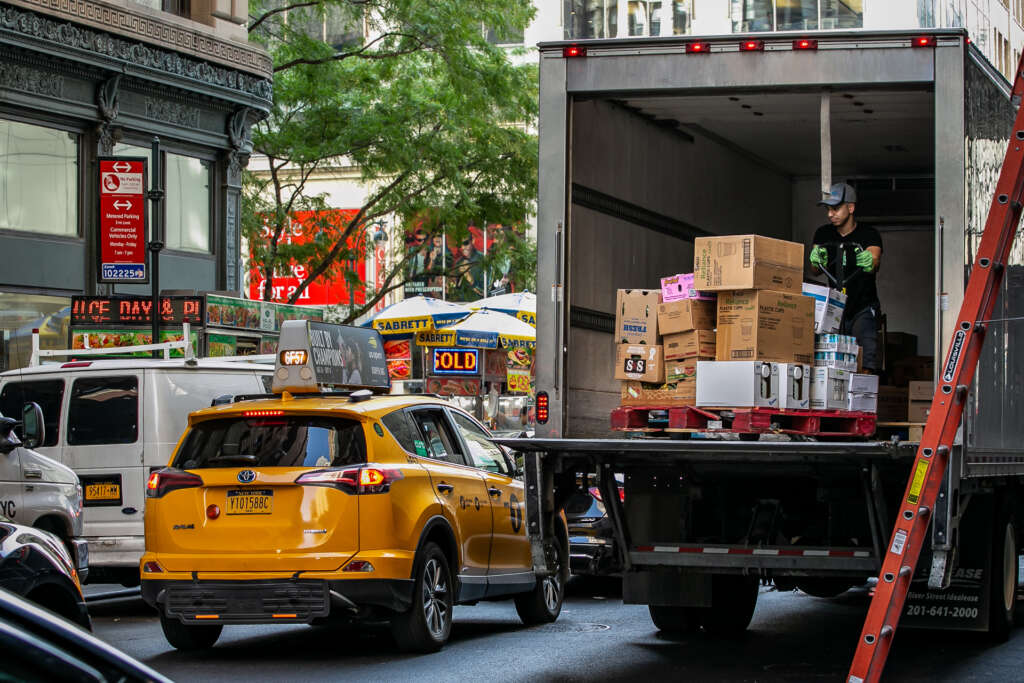

New York City has set ambitious targets to cut transportation emissions and reduce street congestion. Freight is one of the hardest pieces of that puzzle. And yet, in neighborhoods across this city, a quieter transition is already underway—one that deserves far more attention than it’s getting in the current policy debate.
I’ve worked in logistics for over 40 years. In 2014, I helped launch one of the earliest Delivery Service Partner operations in the country. What I’ve learned is that last-mile delivery, the final step that gets packages, groceries, and essentials to people’s doors, doesn’t have to mean more trucks on neighborhood streets.
It can mean something very different.
I’m a member of the Urban Freight Lab, a public-private research collaborative at the University of Washington that brings together businesses and government agencies to study how urban logistics can reduce its carbon footprint. The work isn’t abstract—it shows up in real programs, in real neighborhoods.
Our operation in Upper Manhattan runs roughly 100 workers daily, covering the corridor from 125th Street through Washington Heights and up to 220th Street. Large trucks bring freight from New Jersey into the city, but once goods arrive, the final mile is completed almost entirely by foot couriers, e-quads, and e-bikes. Hundreds of them. The trucks don’t idle in front of buildings. They don’t circle blocks. The last leg is human-scale, built for dense urban neighborhoods, and specifically designed to reduce carbon.
We’ve also been exploring what freight looks like when you think beyond streets entirely. Through Blue Highways initiatives, we’ve worked on using New York’s waterfront to move goods, reducing truck miles and congestion by leveraging water routes the city already has. First implemented summer 2025 for freight onto Governors Island and again in December 2025, we ran deliveries out of the Fulton Street Fish Market using all-electric, lithium-ion equipment designed to operate in bike lanes. A collaboration that includes Empire Clean Cities, Fulpra E-Mobility equipment, Barretto Bay Strategies, U.S. Coastal Service, Freight Matters and Net Zero Logistics will continue to pave new paths for Blue Highways.
In Boston, in partnership with the city’s Transportation Department and the Urban Freight Lab, our company completed an 18-month pilot using electric cargo bikes for neighborhood deliveries. The results showed nearly 6,000 miles traveled by e-cargo bike and an estimated reduction of over 2,300 kilograms of carbon emissions by replacing conventional vehicle trips with right-sized electric alternatives.
The workforce dimension matters too. In our operation, almost every dispatcher, supervisor, and manager started as a foot courier or bike rider. The model that reduces carbon also creates career pathways for workers in the communities it serves.
That full picture matters as the City Council considers Intro 0518-2026, a bill that would restructure how last-mile delivery businesses operate, including the relationships between large delivery companies and the independent, locally owned operators running programs like ours.
If the bill moves forward without careful calibration, it will impact the bottom line for operators—that will mean less innovation towards carbon reduction, and businesses setting up outside city limits—forcing bigger trucks to travel longer distances. Companies experimenting with walker programs, cargo bikes, and waterfront freight don’t restructure easily or quickly. Disruption to how they function would slow investment in exactly the kinds of programs already demonstrating results in cities like New York and Boston.
New York has real climate targets. Transportation remains among the city’s largest sources of emissions. The last-mile sector is part of that challenge, but it can also be part of the solution.
The goal shouldn’t be to freeze this industry in place. It should be to accelerate the transition already underway—more walkers, more e-bikes, more waterfront freight, more operators building career ladders from the ground up.
Across New York, the transition to cleaner freight is already happening—often quietly, block by block, bike by bike, delivery by delivery. With thoughtful policy, that quiet shift could become one of the city’s most effective tools for cutting congestion and reducing emissions.
Mark Chiusano is the owner of Net Zero Logistics.