


Share This Article
Residents at NYCHA’s Redfern Houses say the state is dragging its feet on whether to allow the nearby Inwood Materials Terminal, which crushes leftover construction debris, to keep operating. Officials just extended the deadline for their decision by more than three months.
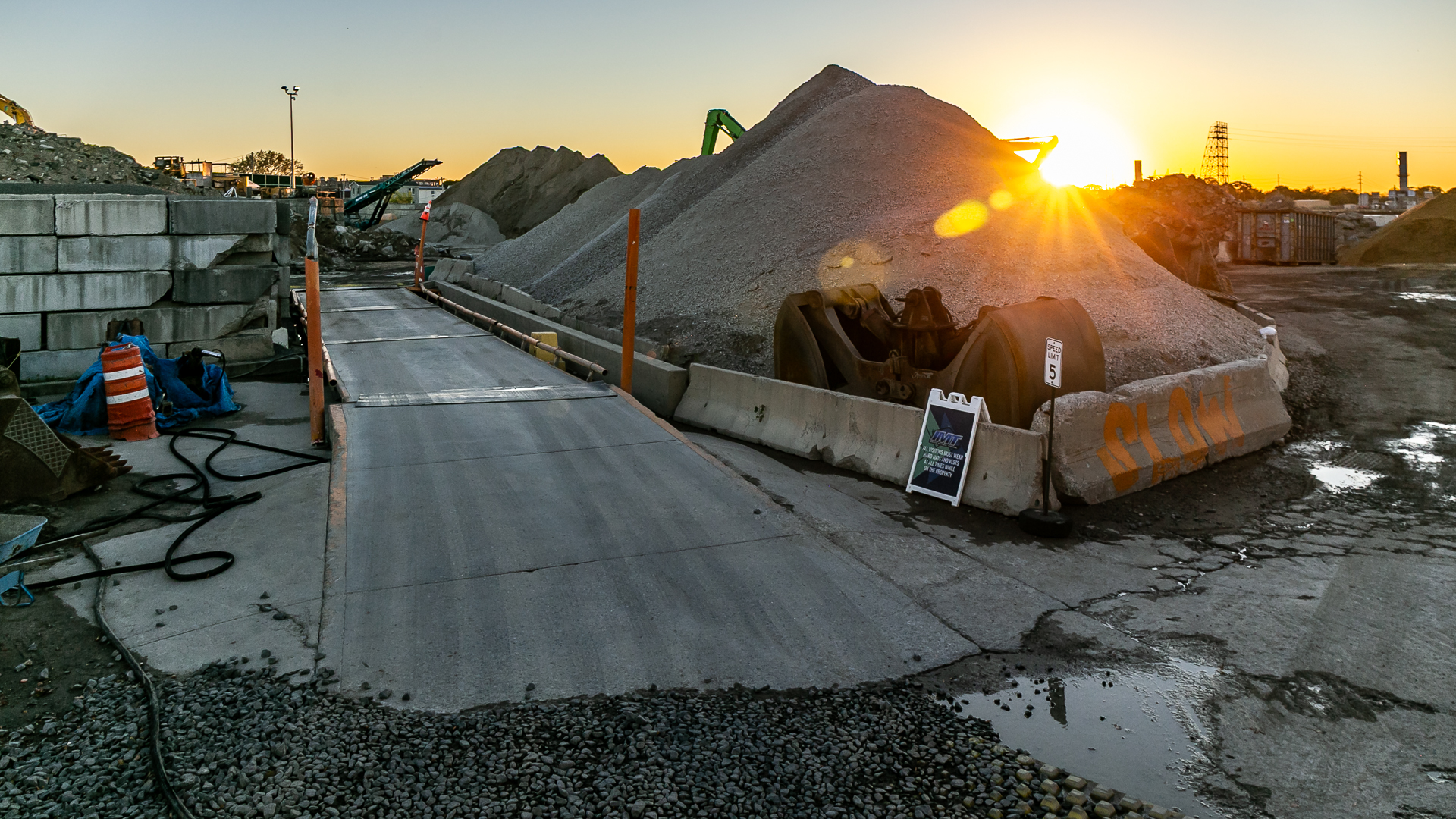
Public housing residents of Redfern Houses in Far Rockaway, Queens, say they’ve long documented the dust from an industrial waste site, which sits roughly 150 feet away, gathering inside in their homes, and covering playgrounds and cars.
“All the dirt blows over here, comes in through our windows and covers surfaces in our apartments,” said Kimberly Comes, who’s lived at Redfern Houses for about 36 years.
“It feels like we don’t matter,” Comes said.
Managed by the Haugland Group, Inwood Materials Terminal crushes construction and demolition leftovers, like concrete, asphalt, brick and rock, into recycled material.
It’s been operating near Jamaica Bay, at the tip of Inwood in on the border of Nassau County and Queens, since 2015, taking over the site of an oil terminal that had operated there for decades prior.

In 2023, the state adopted stricter laws governing solid waste management sites, requiring companies like IMT to submit applications for additional permits, which the state Department of Environmental Conservation (DEC) can approve or deny. The new laws also require DEC to consider the impact of pollution on surrounding communities in its permitting decisions.
But neighbors at nearby Redfern Houses, a New York City Housing Authority (NYCHA) development home to over 1,400 residents, say both IMT and the state agency have been dragging their feet on the re-evaluation process—noting that IMT has been submitting incomplete applications for over three years.
The company submitted its first complete application in August, which the DEC accepted public comments on this fall. Now the agency has extended its decision deadline by more than three months—to Jan. 30, 2027, according to an announcement earlier this month—to allow for a more thorough review of the feedback it received.
Now, residents are calling on DEC to hold a public hearing for community members to share how the site affects them, saying the state agency hasn’t yet met with residents directly to hear their concerns.
In public comments, residents are also calling on the DEC to deny the application, or strengthen requirements for IMT to protect the neighborhood from dust it releases.
Incomplete applications and delayed deadlines
Damon Gilbert, a staff attorney with New York Lawyers for the Public Interest (NYLPI) working with community members, described the DEC’s extension as another delay from the agency.
“There was an Oct. 28 deadline for them to make a decision on the permit application, and that deadline came and went,” Gilbert said. Still, he said, the extension “underscores the extent of community concern” over the project.
But as residents await a decision, the site is still crushing debris—and filling their homes with dust.
Gilbert explained that “it’s not unusual for companies like IMT to continue operations without proper permitting, because they’re usually given a grace period to transition onto the new track,” adding that the company’s earlier, incomplete application submissions allowed them to drag the process out.
Until now, IMT has “essentially been applying and getting denied over and over again, while operating under a general registration that is no longer what those types of facilities require,” Gilbert explained.
IMT’s applications, Gilbert said, were “incomplete in a number of ways, including how they are analyzing their impacts on the community, dust emissions, as well as the state’s Environmental Justice Siting Law, which requires that the state can’t make any actions that would add further harm to an identified disadvantaged community for environmental justice purposes.”
Redfern Houses is in one of those identified communities.
Public comments submitted to the DEC describe industrial activity at the site “six days a week, beginning early in the morning and regularly extending into overnight hours.”
“For residents, IMT’s operations have tangible consequences,” one read.
“The wind and the dust don’t care if we’re an impoverished community,” said Comes, who also serves as the president of the resident council at Redfern Houses. “Our health is just as important, especially if we’re poor.”
She said she’s been cleaning dirt that covers surfaces of her bathtubs, windows and car several times a week for years.
“I get the dirt every morning,” Comes said. “I can feel the grit on the bottom of the tub.”
Commenters also point to a community-led survey of about 436 nearby residents, which documents their experiences “rinsing layers of dirt from bathtubs before bathing, and repeatedly cleaning household surfaces and vehicles, only to find them coated again the next morning.”
Of the residents who responded to the survey, about 86 percent identified as Black or African American, and 46 percent identified as having a disability.
Public comments also argue that IMT’s existing burden report doesn’t determine how much pollution in the surrounding community is caused by dust from its operations, which include crushing, screening and stockpiling materials.
Additionally, community comments argue that the company’s proposed harm mitigation methods—which include extending walls and 15-foot limitations on open-air 24-hour stockpiles—are inadequate.
A spokesperson for IMT told City Limits that “while we meet all DEC operational regulations, we also continue to take community concerns seriously.”
“We continue to collaborate on further improvements with community leaders and residents on items such as additional dust controls through filtration fencing, additional water cannons and sprinklers, and enhanced cleaning,” the spokesperson added.
But Comes said that’s not enough.
“I would hope that they dome the place, or they move to where there are no people,” she said.
But IMT’s current waterfront location allows the facility to transport shipments of waste materials, like concrete and rock, on the water—which helps reduce traffic and congestion on local roads.
“Through barge transportation, the facility takes thousands of trucks off local and regional roads annually, while the materials it recycles support many critical local infrastructure and coastal resiliency projects,” a spokesperson for the company said in a statement.
Gilbert explained that an outcome where the operation is shut down or moved would require “an incredibly long process,” that “may not reflect a reality,” but explained that residents are hoping for a “cleaner operation that gets rid of the dust issues.”
“They’ve been living through this for over a decade now, and they just want change in the conditions they have to live with,” he said.
To reach the reporter behind this story, contact [email protected]. To reach the editor, contact [email protected]
Want to republish this story? Find City Limits’ reprint policy here.