


Share This Article
Lawmakers approved John Mangin to chair the Board of Standards and Appeals, following a tense nomination hearing where some criticized him as too dismissive to local residents’ concerns about new development.
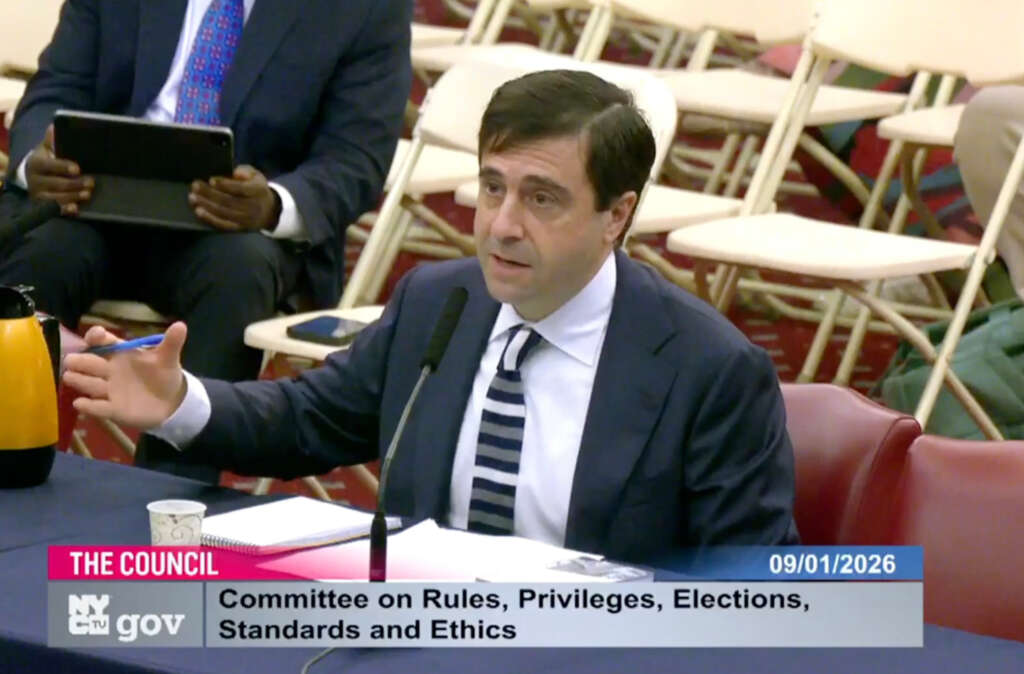
The City Council on Thursday approved Mayor Zohran Mamdani’s nominee for a key housing post, despite concerns from some who criticized the appointee as too dismissive to local residents’ concerns about new development.
John Mangin, a Department of City Planning official, will take the helm at the Board of Standards and Appeals (BSA), an oft-overlooked, five-person board charged with interpreting the city’s zoning rules and, in certain cases, whether to grant exceptions to developers whose projects don’t conform to them.
The approval comes after a tense nomination hearing last week, where lawmakers grilled Mangin—a key architect of the 2024 “City of Yes for Housing” plan to boost development across the five boroughs—about his past writings and views on community input in land use decisions.
Mangin also helped draft several housing-related ballot measures, passed by city voters last year, aimed at speeding up the approval process for new housing (including a new “fast track” option for publicly financed affordable projects, to be voted on by the BSA). The Council opposed those changes, which they said diminished their role—and in turn, the voices of their constituents—in certain development decisions.
But Mangin is backed by a bevy of housing advocacy groups who praised his resume and expertise, and appeared to have won over several initial skeptics on the Council.
That includes Councilwoman Nantasha Williams, who represents lower-density neighborhoods in Southeast Queens where many Black homeowners are concerned about the impact of new development on the area’s character. Her constituents, she said, “do not always fit neatly into the narratives often used in broader debates around development” which cast people opposed to new housing as wealthy NIMBYs looking to keep others out.
“It is a more nuanced conversation where you’re talking about homeowners who have historically been discriminated against and not allowed to to build generational wealth,” Williams said.
Mangin—who met one-on-one with dozens of Council members and accompanied several on walking tours of their communities—appears to understand those nuances, she said.
“I was encouraged by Mr. Mangin’s recognition that neighborhood character is contextual, and that areas consisting predominantly of one- and two-family homes may warrant a different analysis,” said Williams, who noted that the BSA’s powers are “still very limited” in the city’s housing processes.
The Council approved Mangin’s nomination by a vote of 40 members in favor, six against and four who abstained.
“John Mangin will be a visionary and dedicated chair of the Board of Standards and Appeals as we take on our city’s housing crisis,” Mayor Mamdani said in a statement following his approval.
“This is a very good day for housing in New York City,” Annemarie Gray, who heads the pro-development group Open New York, said in a statement. “With a rental vacancy rate of 1.4 percent, the lowest in nearly sixty years, New Yorkers deserve to have the most qualified practitioners leading the charge to create more affordable housing.”
Some lawmakers, however, remain unconvinced. “I worry that we’re creating a system where the public gets less of a say, the Council gets less of a say,” Staten Island Republican Frank Morano said when casting his “no” vote.
Other members pushed back against the idea that the Council has been a roadblock to new development. Councilman Chris Banks, who represents East New York and Brownsville and abstained from voting on Mangin’s appointment, said he and fellow lawmakers approved the vast majority of land use applications that come before them in recent years.
“The Council has been pro-housing and remains committed to building,” he said, saying he worries that the ballot measures approved last year, which Mangin helped craft, are “rooted in an approach to land use that appears to prioritize efficiency and centralized decision-making over public participation, local accountability, and and the institutional role of the City Council.”
“I have reservations about Mr. Mangin’s perspective on community engagement,” Banks said. “These voices should not be treated as procedural obstacles.”
Many housing advocates, however, argue that the status quo is what led to the city’s current housing shortage, where New Yorkers face sky-high rents and more than 100,000 people sleep in shelters each month.
They point to vastly uneven affordable housing production rates across City Council districts. In its final report, the 2025 Charter Revision Commission noted how Council members were historically able to bargain for smaller projects—and thereby, fewer affordable units—in their districts, and that some developers avoided building in certain neighborhoods altogether on the expectation that they’d face opposition from the local rep.
A Gothamist analysis found that the city lost out on some 2,600 apartments, which were cut from proposals as a result of public negotiations in 2022 and 2023.
“It is vitally important that the BSA’s review of affordable housing applications be technically sound, fair-minded, and timely,” reads a letter signed by nearly 50 housing and civic groups submitted in support of Mangin last month. “The appointment of a highly qualified leader to administer the new BSA procedures provides a bellwether of the City’s commitment to sustained affordable housing production.”
To reach the editor, contact [email protected]
Want to republish this story? Find City Limits’ reprint policy here.