


Share This Article
The nomination of city planning official John Mangin, who championed zoning reform and housing supply efforts, reignited debates about NIMBYs, YIMBYs, and community input in land use decisions.
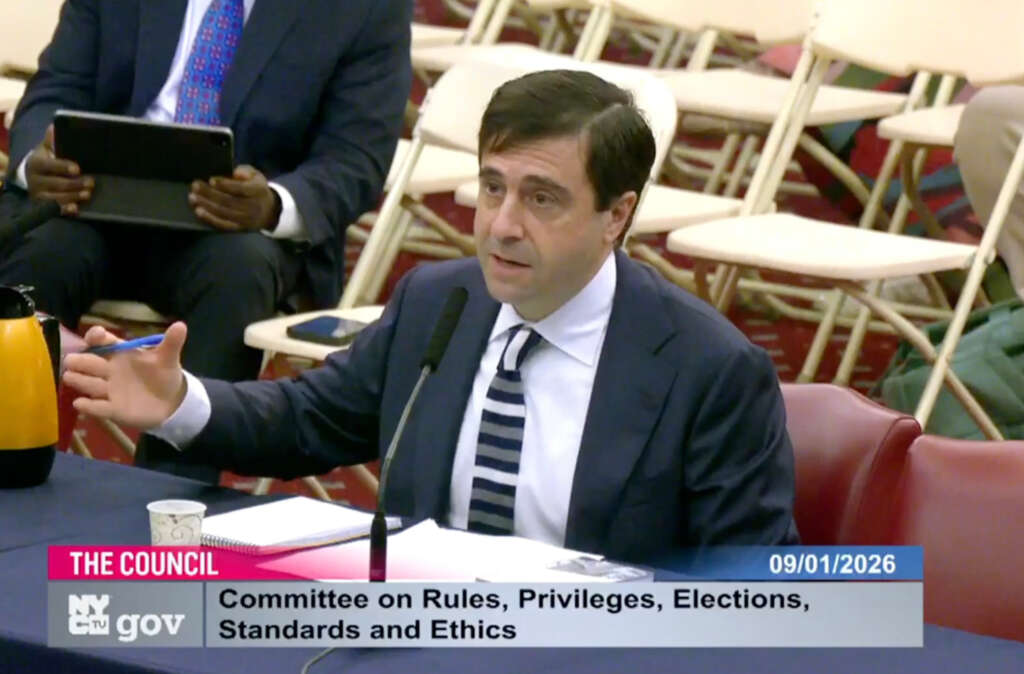
Long-running debates over how the city should go about building housing came to a head in City Council chambers Tuesday, with Mayor Zohran Mamdani’s nominee for a key, if somewhat obscure post, facing questions about his pro-development views.
Councilmembers grilled the nominee, John Mangin, for over two hours at his confirmation hearing, questioning his philosophy on community input and homeowners in his previous academic work on housing development.
A current Department of City Planning staffer, Mangin helped draft several ballot measures approved by voters last year to speed up the approval process for new housing—in some instances, by weakening local lawmakers’ oversight powers.
The testy session captured current tensions around development in New York City, even as city leaders increasingly embrace new housing as part of the solution to a persistent rent affordability crisis that will take 700,000 new units over 10 years to solve, officials say.
Facing criticism, Mangin sought to reassure councilmembers of his support for community engagement as part of planning for housing.
“I believe that local voices are paramount when it comes to projects, but also, a big theme of my career is that local voices aren’t the only voices that matter for land use decisions that have an effect on a broader community, or or even citywide,” said Mangin.
Mangin helped craft 2024’s “City of Yes” rezoning that allows for modestly increased density around the city, with the catchphrase “a little more housing in every neighborhood.”
If appointed, Mangin would chair the Board of Standards and Appeals (BSA), where he and the board would interpret city zoning rules, approve or deny zoning variances, and implement a new fast track for publicly financed affordable housing projects.
Some councilmembers expressed concerns over Mangin’s pro-housing supply academic work, which was critical of homeowners who resisted zoning changes in their neighborhoods that would allow more housing.
Mangin currently serves as the director of the housing division at the Department of City Planning, but much of the discussion revolved around his 2014 paper, “The New Exclusionary Zoning,” which argued that cities’ strict zoning regime and NIMBY homeowners were partly responsible for the insufficient housing supply, and has continued to fuel segregation by income and race.
But some lawmakers worry city efforts to build more apartments as quickly as possible could sideline their constituents’ concerns about new projects, and their ability to push for other improvements alongside development, like more schools and green space.
“I want to better understand who the real John Mangin is,” said Councilmember Chris Banks, who pressed the nominee about his characterization of community benefits agreements—deals that councilmembers sometimes negotiate as part of land use approvals—which Mangin once described as “kludgy.”
“It’s a philosophy that seems skeptical at times of how much influence local communities and their elected representatives should have over development,” said Councilmember Frank Morano.
Mangin said that he thought community benefits were helpful tools, but needed to be paired with more housing “of all types.”
The City Council is expected to vote on the nomination on Sept. 10. “He clarified some of his past statements. I haven’t made my mind up as yet,” said Banks.
While Mangin’s language from the 2014 paper worried some councilmembers, it struck true for some housing advocates.
“The fact that John has long-acknowledged the basic reality that for decades New York City’s approach to housing and land use has led to exclusionary outcomes should be a prerequisite for the job, not a disqualification,” said Annemarie Gray, director of the pro-housing group Open New York.
Casting a long shadow were several housing-related ballot measures that Mangin helped draft in his work with the Charter Revision Commission last year. The measures, approved by voters in November, added an appeals board that could overrule councilmembers when they disapprove of land use changes that produce more affordable housing, arguing that councilmembers sometimes had power to block most new housing in their districts.
The Charter changes also gave the BSA additional powers to approve publicly financed affordable housing projects.
But City Council members were vehemently opposed to those reforms, which Councilmember Nantasha Williams called “hostile” to the Council’s role in land use, and undermined their negotiating leverage with developers to secure benefits for their community.
“That definitely hangs over the Council’s head,” said Banks, who said the ballot measures expanded executive power at the Council’s expense. “Looking at the broader picture it was essential to push back.”
With Mangin’s nomination still up in the air, it remains to be seen if the city’s pro-housing coalition can keep the wins coming.
“At the time, this seemed like a somewhat novel argument that we should be in favor of more housing of all types,” Mangin said of his 2014 paper. “Today, I feel like it hardly needs to be said.”
To reach the reporter behind this story, contact [email protected]. To reach the editor, contact [email protected]
Want to republish this story? Find City Limits’ reprint policy here.
1 Comment
PatJA
City of Yes was a gift to the real estate industry.
It’s now optional to put in affordable units out-of-scale high rises. Low-rise neighborhoods that objected to City of Yes–like Chinatown and the South Bronx–are turning ever-more-quickly into unfriendly, ugly-high-rise gentrified blocks.
Compare City of Yes to the Chinatown Working Group zoning plan that would preserve affordability while creating new housing that does not ruin the character of a lively, diverse area. Chinatown will soon be as Disneyfied as Little Italy (where just a handful of Italian-Americans live).
In addition, one could be cynical about how certain districts that didn’t want dense housing got excluded from the new rules. You can see who gets to stay exclusionary in this City Limits article: https://citylimits.org/the-blocks-strips-and-neighborhoods-carved-out-of-city-of-yes/