


Share This Article
The city needs 700,000 new homes over the next 10 years to catch up with current demand and accommodate future growth, officials announced Wednesday. See which neighborhoods they say aren’t growing fast enough.
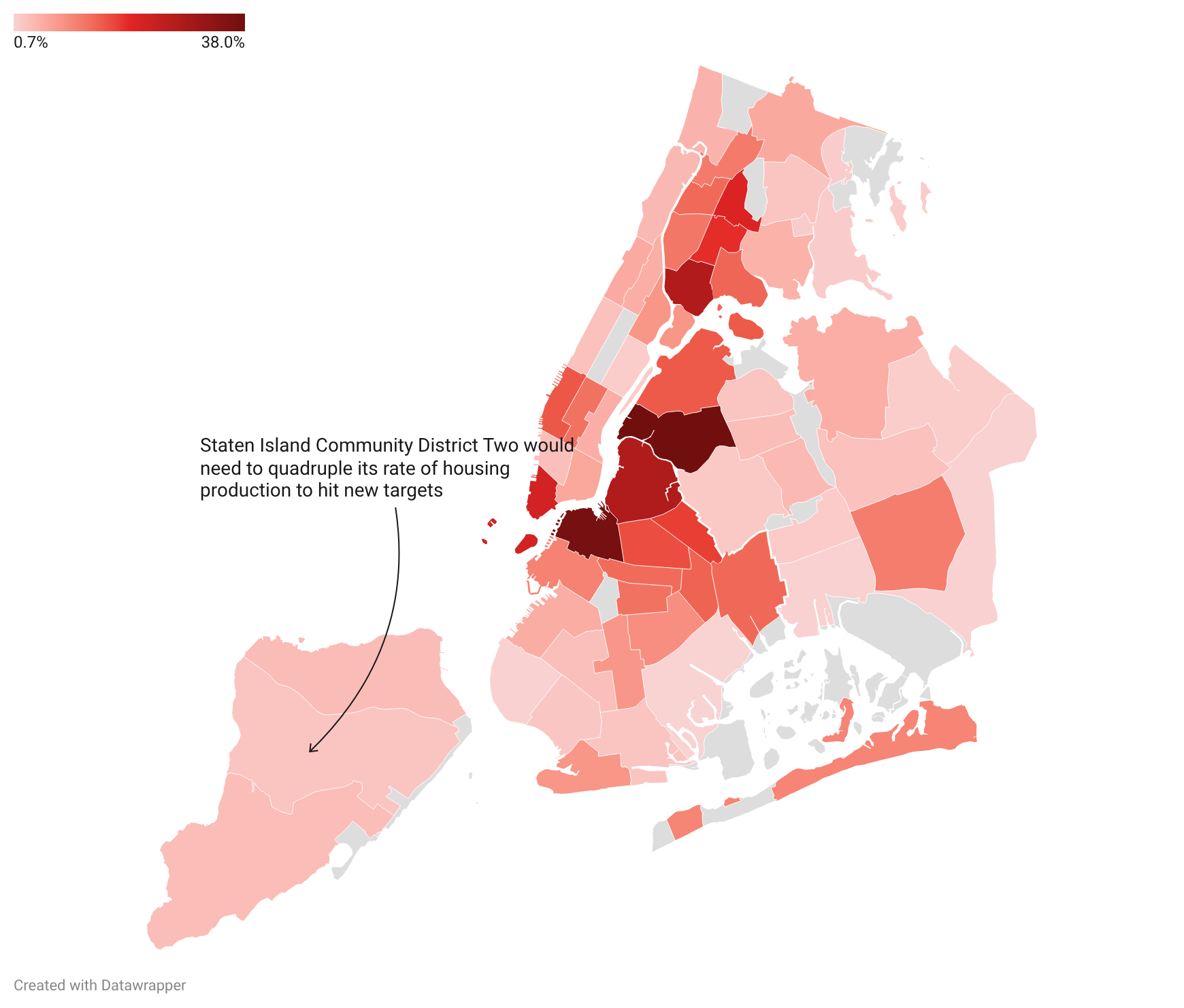
All but four of New York City’s 59 community districts need to accelerate housing production to meet citywide needs, according to new growth targets released by the city Wednesday.
The new plan estimates that the city needs 700,000 new homes over the next 10 years to catch up with current demand and accommodate future growth.
Mayor Zohran Mamdani’s administration has been trying to encourage new development as the city faces a significant shortage, particularly for the lowest income New Yorkers.
But the production targets for each community district—which the Department of Housing Preservation & Development was required to set under a bill passed in 2023—are suggestions, not mandates, which may slow progress in a city where a small percentage of neighborhoods build most of the housing.
“To overcome our housing crisis, we need every neighborhood in every borough to do its part,” HPD Commissioner Dina Levy said in a statement.
It will be an uphill battle to hit those numbers in some neighborhoods. Residents and elected officials in many of the city’s lower density areas have been critical of recent efforts to increase housing production, like 2024’s “City of Yes” and last year’s housing ballot measures.
Staten Island’s second community district, which covers the Mid-Island swath of South Beach and Willowbrook, grew its housing stock 0.24 percent a year over the last 10 years, adding just 1,200 homes, the HPD report found. To grow at the target 9.63 percent in the next five years, it will need to add over 5,000 new homes by 2030.
“Any proposal to build thousands of units of new housing without consulting the local community, and with no plan to address the inadequate infrastructure, flooding, or lack of viable transportation options, is not worth the paper it’s printed on,” said City Council Minority Leader David Carr, who represents much of the Mid-Island.
But housing advocates have long called for an all-hands-on-deck approach to filling the housing shortage. The City Council asked HPD to set the district targets during former Speaker Adrienne Adams’ tenure.
“Not only are we failing to build enough housing overall, but we are also failing to equitably distribute housing throughout the city,” wrote then-Speaker Adams’ office in 2023. “Many neighborhoods with abundant access to infrastructure and amenities like open space, thriving schools, and public transit have produced far too few housing units in recent decades.”
The city hopes that the neighborhoods that have grown the least will increase housing by about 6.5 percentage points in the next five years. Those in the middle of the pack should grow by 8.75 percent, and those that have been growing the most should continue to grow at 10 percent over five years, according to the plan.
On top of that, in neighborhoods that are already expensive, the city is asking them to build 25 percent more.
Already, most affordable housing is built in lower income, high density neighborhoods while other communities see little development.
“The housing crisis doesn’t end unless every community takes on its share. Queens CB2 has done that and more,” said Anatole Ashraf, chair of Queens Community Board 2, which covers Long Island City and parts of Woodside and Sunnyside.
The district is one of the city’s highest growth areas, and one of four neighborhoods that would meet the target rate if it kept building at its current pace.
“We conditionally supported the OneLIC rezoning—roughly 15,000 new homes and real public investment—because our own neighbors were being priced out,” Ashraf said in a statement.
Citywide, just 1.4 percent of apartments were vacant in 2024, the lowest rate in decades, and less than 1 percent of all apartments priced below $2,400 were vacant, according to the city’s housing and vacancy survey.
With these targets, the city hopes to nudge lower growth areas to catch up.
Officials said that increasing housing options is a matter of fairness: high income communities should not be able to block growth and lower income people should have the option to find homes in different parts of the city, where there might be more economic opportunity.
Despite its diversity, New York City remains deeply segregated. And a tight housing market can make it even harder for low income people, like voucher holders, to find apartments.
Earlier this year, Mayor Mamdani pledged to build 200,000 affordable housing units by 2036, with 85,000 of those constructed by 2030. But “affordable housing,” in the context of city plans means anything that has an income limit to rent. In all, 25,000 of those 85,000 new affordable units would be targeted to people making 60 percent of the area median income and below, or a family of three making less than $91,620.
The ambitious targets come on the heels of some underwhelming, but still very early, affordable housing production numbers for the first half of 2026 released last week. New development was lagging behind the level needed to meet the administration’s current goal—but housing experts said new development-friendly policies could spur more construction soon.
One of those new tools, the affordable housing fast track, goes into effect this fall. It will allow projects in the 12 communities that have produced the least affordable housing over the last five years to undergo compressed public review periods.
HPD’s housing production plan, dubbed the Fair Housing Growth Strategy, is still in the draft phase. You can submit feedback on at two virtual public briefings on Aug. 26 and Sept. 2.
To reach the reporter behind this story, contact [email protected]. To reach the editor, contact [email protected]
Want to republish this story? Find City Limits’ reprint policy here.