


Share This Article
The city is adding 10,500 new merchandise vending permits next year—which grant vendors the right to legally sell goods, rather than food—after capping the number at just 853 for decades. “I said, ‘Oh my God, this thing is really happening,'” said Calvin Baker, a longtime Harlem vendor who was among the first to apply.
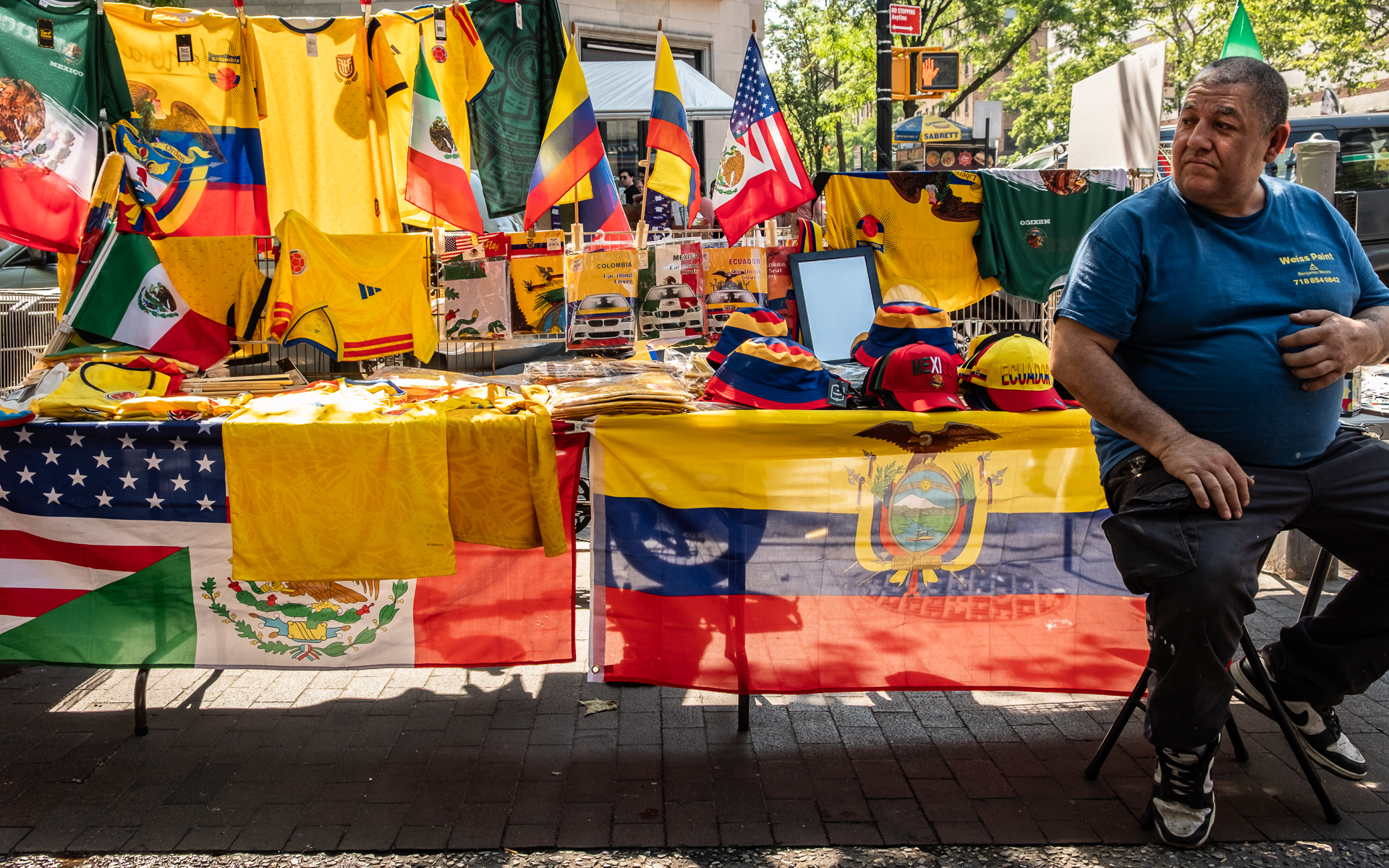
Some opportunities come along only once a decade.
For New Yorkers who earn their living as street vendors—an industry predominantly represented by immigrants, including many Latinos—that includes getting on the waitlist for a coveted city license.
For the first time in a decade, the city opened its waitlist last week for street vendor merchandise licenses, which grant vendors the right to legally sell goods, like jewelry, toys and clothing, rather than food.
“I said, ‘Oh my God, this thing is really happening,'” said Calvin Baker, a longtime Harlem vendor, describing how he felt when he was finally able to apply last week.
For decades, he and other vendors have fought against the city’s rigid 853-capped license limit, set in 1979. Since then, these licenses for non-veteran general vendors became available only when an existing license holder gave theirs up, leading to thousands of people selling merchandise on the streets without one—risking costly fines and potential criminal charges as a result.
Earlier this year, the City Council overrode former Mayor Eric Adams’ veto to pass a bill creating 10,500 new merchandise vending permits, and started taking applicants for a new waitlist last week.
“It was so good to see people that were on the line, on the struggle with me in the streets, fighting to get these licenses, sitting down there waiting for their turn to go fill out the application,” said Baker, 64, who sells hats, gloves and other apparel. “It was a blessing for me, man. I felt the peace of God. I felt satisfied.”
Previously, once a license became available, the New York City Department of Consumer and Worker Protection (DCWP) would contact applicants from the existing waitlist, which closed in 2016.
But under the new law, the city will add another 10,500 licenses—including 3,478 Citywide General Vendor or called “white,” licenses, which allow for vending anywhere in the city, and 7,875 outer borough or “green” licenses—which will become available early next year.
“It is extremely difficult to predict, but it is fair to say that we estimate that thousands of people will apply,” said Mohamed Attia, director of the Street Vendor Project, the advocacy group behind the license expansion.
In August, DCWP started giving priority to applicants who were already on the 2016 waitlist, and began contacting them, sending them letters describing the next steps. They had until Oct. 29 to submit a license application, a DCWP spokesperson explained.
After that, the new 2026 waitlist opened on Nov. 2, and will close on Dec. 16. Vendors have to submit an application to join the list, and then wait for DCWP to tell them where they stand and what they need to do next.
Baker was among the first applicants last Monday.
“It’s like you run the New York Marathon and you say, ‘Lord, how am I gonna do it? Can I finish this race?’ But then you get in it, and you finish it. The satisfaction that you feel from doing that. That’s the satisfaction I felt from filling out the application,” Baker described.
A DCWP spokesperson didn’t specify how many people have applied so far.
“DCWP is working hard to ensure the rollout of new general vendor licenses proceeds in a clear, orderly, and accessible manner,” a spokesperson said. “We know that street vendors are community fixtures—and we are proud to support these small businesses through best-in-class licensing services, proactive business education, and reforms to cut red tape.”
Where and how can a street vendor apply?
If you’re not already on the 2016 waitlist, you can apply to the new one online or by mail, and in very limited circumstances, such as “hardship cases,” in person.
Vendors can apply for either a white or green license, or both, in one application.
If you need help with your application, you can connect with the Office of Street Vendor Services at the Department of Small Business Services (SBS) by calling 888-SBS-4NYC (888-727-4692).
You can also get assistance in person by visiting NYC Business Solutions Centers during office hours (Monday to Friday, 9 a.m.- 5 p.m) at the following locations:
- The Bronx: 400 East Fordham Rd., 7th Floor, Bronx, NY 10458
- Brooklyn: 9 Bond St., 5th Floor, Brooklyn, NY 11201
- Lower Manhattan: 14 Wall St., 17th Floor, New York, NY 10005
- Upper Manhattan: 361 West 125th St., 2nd Floor, New York, NY 10027
- Washington Heights: 560 West 181st St., 2nd Floor, New York, NY 10033
- Queens: 90-27 Sutphin Blvd., 4th Floor, Jamaica, NY 11435
- Staten Island: 120 Stuyvesant Pl., 3rd Floor, Staten Island, NY 10301
Applicants can also make an appointment with the Street Vendor Project via email or phone (646-602-5679).
“There is a lot of misinformation and a lot of confusion about what this license is,” Attia explained.
“This license allows people to sell merchandise products out of the streets, the public sidewalks, out of a table, and there are so many rules around it,” he added. “So, if you are a food vendor, this license is not for you. If you have a retail business and you want to expand to some private events, some pop-up markets, this license is not for you.”
What are the requirements for applying?
The information requested from applicants is basic personal information, such as their name, address, phone number, and email. Additionally, it asks if a person has been selling general merchandise from January 2025 to Nov. 2, 2026.
Although most of the city’s street vendors are immigrants from different parts of the world, the application is only available in English. SVP said it is assisting applicants in seven languages.

The form also requires the submission of a photo ID, which may be a driver’s license, permits issued by a government agency, passport, or municipal ID card, among others.
One ironic feature of the process: previous civil or criminal summonses issued to the applicant can serve as proof of their vending experience (in addition to pictures showing the person vending, receipts for merchandise purchases, or a letter from an elected official, community leader, or nonprofit organization stating past vending activity).
SVP advocates see this as an acknowledgement that the prior system left many people without a way to sell legally, and as a reminder of how difficult it was to obtain a license under the old cap.
“The application was very easy,” Baker said. “”t took 10 minutes.”
Then what?
The waitlist application is separate from the license application, so joining the waitlist does not automatically result in a license.
DCWP will review the applications, assign each one a number, and contact applicants with information about next steps starting in February 2027.
“I’m looking for the ultimate. I’m looking for my license,” Baker said. “I will feel a lot better. I won’t have to always look around and worry about the NYPD running down on me, and just tossing my stuff any kind of way they want to without even having respect for your stuff.”
To reach the reporter behind this story, contact [email protected]. To reach the editor, contact [email protected]
Want to republish this story? Find City Limits’ reprint policy here.