


Share This Article
“When Mayor Adams presents his budget Thursday, consider the choices he’s made and the impact on the working class and the services they rely on government to deliver. As a matter of leadership, he’s giving away the store. At some point, we need to begin a conversation finally about who pays what and who subsidizes whom?”
Benny Polatseck | Mayoral Photography Office
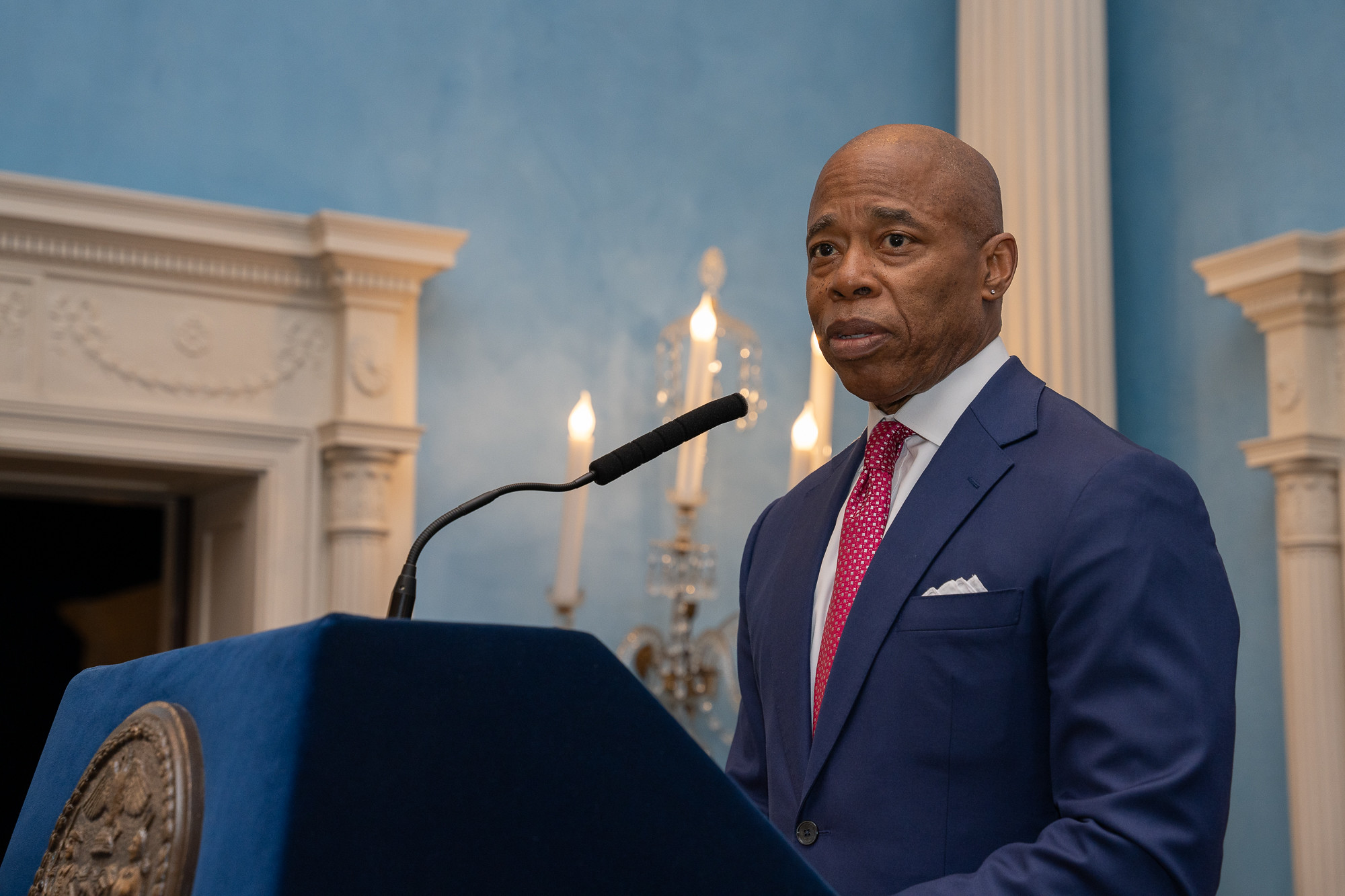
Mayor Eric Adams speaking at an event in Gracie Mansion on Nov. 14, 2023.Just days after announcing plans to chop city spending by 15 percent, Mayor Eric Adams released the Mayor’s Management Report (MMR) for Fiscal Year 2023. The report, covering his first full year in office, was the kind of report card on performance that if a student brought home, chock full of declining grades, might get them grounded. But the mayor appears unfazed, ready to forge ahead with cuts that could further undermine already diminished services.
The mayor isn’t wrong to be taking a cautious approach to the city’s fiscal outlook. The local economy is still adapting to changes following the COVID-19 shutdown, lending uncertainty to tax revenues even as city-funded spending is growing, in part due to aiding thousands of asylum seekers as well as the expiration of pandemic-related federal aid used to pay for local programs.
It is also true that spending is no guarantee of improved service delivery. But with services from applying for food stamps and cash advances to stave off evictions already in decline, and months long delays for residents to be placed in public housing and city-subsidized apartments, the steep budget cuts proposed by the mayor will almost certainly mean a further tumble. Yet as the mayor seems ready to sacrifice services, many of which the lowest income New Yorkers depend on, he seems unwilling to ask for sacrifices from the donor class and the city’s elite institutions.
When the mayor released the MMR, his press release stated, “the Adams administration continues to ‘Get Stuff Done’ for those New Yorkers who need it most…quality of life improvements for all New Yorkers.” The mayor followed up with an op-ed in amNY entitled “Delivering for New Yorkers year after year.”
The question is: delivering for whom? The New York Times reported in September: “Across the city, wages are up, but mostly for the affluent. Jobs are returning, but many are in low paying positions. Unemployment is down, but remains sharply higher for Black and Hispanic New Yorkers. The mixed signals highlight a widening chasm: the city is recovering, but many of its residents are not.” As James Barron recently wrote in a Times’ New York Today newsletter, “in a city that is increasingly unaffordable, more New Yorkers are struggling to access basic services.”
A deep dive into the data shows a significant erosion of core city services, attributed, mostly, to staffing shortages, high turnover, and mismanagement of the city’s workforce. At the same time, overtime spending by the city’s uniformed services, and particularly the police, has soared. Police overtime spending reached $871 million last year, the most in a decade, despite candidate Adams’ pledge to cut OT for cops in half. Add in overtime spending for the fire and correction departments and the total comes to nearly $1.7 billion last year—substantially more than the combined city spending on libraries and the Departments of Aging and Cultural Affairs.
While overtime for these uniformed workers has risen, service delivery has eroded. Barron noted that more than half of 65 social service “critical indicators” in the MMR fell in the past year. “[A] city official who recently left said that Mr. Adams and top officials in his administration had created a work environment where independent thought was discouraged and obedience to directives was valued,” according to a 2022 Times article.
Apparently, Adams’ “Working People’s Agenda,” which calls for “a more equitable city through a robust and strong safety net,” is not one of those directives. Parsing the daily lives of working-class New Yorkers, consider the following:
- The city’s safety net is tattered: Demand for food stamps and cash assistance has surged, while access to this assistance has declined sharply. The city processed only 39.7 percent of food stamp applications on time (within 30 days), down from nearly 93 percent in 2019. Likewise, the timely processing of cash assistance applications, which can help prevent evictions or shutting off utilities for households, plummeted to 29 percent last fiscal year, compared to 95 percent in 2019. As City Limits has reported, staff vacancies, some for more than a year, continue to hamper the delivery of these vital services.
- Delays in cleaning vacant lots: Ridding the city of rats is a mayoral priority, yet a key approach to curbing rats relies on aggressively controlling the rat population in vacant lots. Data from the MMR reveals a declining commitment to cleaning vacant lots and improving the quality of life in the city’s most impoverished neighborhoods. In Fiscal Year 2023, 1,440 vacant lots were cleaned compared with 1,652 in 2022, a decline of about 12 percent. Fewer vacant lots cleaned will only contribute to the city’s rat problem.
- Delivering bus lanes: Adams campaigned on being the “Bus Mayor,” supposedly understanding that many workers depend on bus transportation for their work and need faster and more reliable and timely routes to get them to their destinations. Yet the Adams administration failed to meet the City Council’s legislative mandate to create 20 bus miles a year. Over two years the city was required to construct 40 miles of bus lanes. Only a combined 20.7 miles were created:12.9 miles in 2022 and just 7.8 miles in 2023. Staff shortages and high vacancy rates along with questionable leadership have plagued the Department of Transportation and hampered the delivery of this vital mayoral infrastructure priority, rendering Adams’ “Bus Mayor” moniker as little more than a talking point.
- Massive delays in households moving into public housing and other city-subsidized apartments. As Gothamist reported in September, it’s taking over a year for the New York City Housing Authority to repair and rent a vacant apartment. “The average timeline for repairing a vacant New York City Housing Authority unit rose to 370 days last fiscal year, up from around 161 days the prior fiscal year and a nearly five-fold increase from the roughly 77 days it took to make fixes in the 2019 fiscal year, the latest Mayor’s Management Report shows.”
The Adams administration got the new construction or renovation of nearly 24,100 affordable apartments underway in fiscal year 2023. That may sound like a lot, but in fact it’s nearly 1,600 fewer apartments than the city began in 2019, according to the latest MMR. And while the Adams administration greatly increased the number of newly completed apartments reserved for households in the city’s shelter system in 2023 compared with 2020 (data for 2019 is not available)—from just over 400 to nearly 2,000—the time it takes to get households to move in has more than doubled. In 2020 it took a median 115 days to lease one of these apartments, in 2023 it took 243 days.
In September, Mayor Adams told the Financial Control Board “we carefully managed the city resources by staying focused on core priorities” and “accomplished this without layoffs, without raising taxes and without cutting services.” The working-class city residents who depend on government services know a very different reality. As Kim Phillips-Fein said in a recent New York Review of Books interview, “Mayor Adams’ skepticism about raising taxes and his insistence on belt tightening and the need to cut social service programs reflect a sense of who matters in the city, and who the city is for.”
Because the mayor is so dependent on the wealthy for campaign contribution, he’s asked little of them in terms of burden sharing, resulting in fewer choices for managing the city’s resources and services. If the mayor really wants to live up to some of his promises, whether dedicating 1 percent of the budget for parks or being the “bus mayor” or creating a public bank to invest in community needs, he needs to break the stranglehold—and his affinity—for the city’s wealthiest residents and businesses.

Michael Appleton/Mayoral Photography Office
Mayor Eric Adams presents his Fiscal Year 2024 preliminary budget at City Hall on Thursday, January 12, 2023.He can end the grip of austerity budget policies and choices that cripple municipal spending on core services in a number of ways, for example:
- Eliminating subsidies to ‘nonprofit’ private universities. If Columbia University, the largest private landowner in the city, had to pay property taxes on all its properties, the city would garner more than $182 million a year, according to a recent Times article. Likewise, New York University, which also benefits from a property tax exemption as a nonprofit school, would owe $145 million.
- Eliminating subsidies to nonprofit private hospitals. Over the past two decades the city has seen massive consolidation of our health system. Some 20 hospitals have closed, mostly in impoverished city neighborhoods. The remaining mega health care systems have amassed enormous wealth, with executive compensations rivaling corporate entities. Millions more in untaxed property needs to be captured for public purposes.
- Taxing of sports venues for their properties. Madison Square Garden, Citi Field, Yankee Stadium and Barclays Center all benefit from a tax exemption; the city forgoes roughly $300 million a year in so-called tax expenditures from these venues.
The city’s labor unions also have a role to play in burden-sharing and in reorienting the balance of power and resources. The municipal unions must agree to reduce their costs, offsetting labor costs that make up more than half of the city’s annual budget. Changes in labor practices can begin with implementing a four-day work-week (in many city agencies), coupled with increasing the work week to 37.5 hours, the same as the New York State government work week.
If the mayor is serious about effectively managing the city’s workforce, he should consider these changes. Three benefits would accrue: improved productivity gains will realize improved service delivery, and offer workers more time to meet their personal needs. This change will improve the worker hiring and retention problems that confront the city today. In addition, two other long-standing labor practices must be changed: ending the inclusion of overtime when calculating the pensions for retiring city employees and ending the “unlimited sick leave” provision for uniformed workforce that has been in place since the 1970s.
The mayor cannot make these changes alone. He needs approval in Albany to end the tax exemptions. And unions must agree to any of these labor changes. But if he’s unwilling to craft a budget that considers burden sharing by them, and especially the elite institutions and the city’s wealthiest residents, then the mayor is giving them a pass—and putting the burden on the rest of us.
When Mayor Adams presents his budget Thursday, consider the choices he’s made and the impact on the working class and the services they rely on government to deliver. As a matter of leadership, he’s giving away the store. At some point, we need to begin a conversation finally about who pays what and who subsidizes whom?
For over 40 years, Harvey Robins has worked in various positions in city government, non-profits and foundations, including the NYC Human Resources Administration as first deputy administrator, Board of Education as deputy chancellor for finance and administration, the director of the Mayor’s Office of Operations, The Children’s Aid Society and the Edna McConnell Clark Foundation.
1 Comment
Scott Baker
The author – like almost everyone – is ignoring the Fiscal Elephant in the room: the Pension funds (5 of them!). From Crain’s March 9, 2023 issue: https://www.crainsnewyork.com/politics/nycs-pension-fund-system-inefficiencies-create-growing-costs
“Last year, the city contributed $9.6 billion to the funds, which have about $250 billion in assets. Employees contributed about $2.5 billion, according to the funds’ financial statements.”
Then there are spiraling management costs:
“Last month, New York City Comptroller’s Brad Lander called on the state’s Department of Financial Services to review the pension fund for schools’ non-teaching staff, where spending has grown about 170% in five years. New York City’s Board of Education Retirement System’s $35 million budget exceeds the budget of the police pension, which has almost twice the membership…More than a decade ago, former New York City mayor Michael Bloomberg and then Comptroller John Liu proposed consolidating the investment management of the five pensions into a single independent investment board. Managing money internally would save the city $1 billion a year, they said. That proposal was pulled because some unions wouldn’t be represented on the new board and individual pensions wanted to maintain control over investment decisions.”
Together, this is well over $10 billion, more than the deficit that would accrue if current spending patterns were left in place in FY 2024.
But savings on pension management and “catch-up” contributions when the city has a bad year, like 2022, which are inevitably paid AFTER the asset markets have bottomed and asset prices have risen again, spread over several years. This is billions of dollars and dramatically undercuts the stated ROI over long periods.
In fact, former Comptroller Scott Stringer produced a report that showed zero ROI over a 10-year pension period ending in 2015, when he included $2.5 billion in management fees: https://comptroller.nyc.gov/newsroom/comptroller-stringer-billions-in-pension-fund-fees-paid-to-wall-street-have-failed-to-provide-value-to-taxpayers/. Then, as now, suggestions were made to consolidate the 5 pension funds. Then, as now, they were ignored.
But again, this misses the big picture. Most pension funds, after fees and deducting employee contributions too, barely generate positive returns at all.
The roughly $250 billion dollar question then, is: Why do we need pension funds at all?
The pensioners are NOT the problem. They can, should and would be better off, if they were paid a guaranteed amount equal to what they get now, with equally guaranteed COLAs every year. This could be guaranteed in the City Charter, or for state pensions (another roughly $250 billion), in the state Constitution. Lawyers and unions can figure out what legally binding agreement to use.
Then, a bunch of expensive investment managers – who, collectively, rarely beat the S&P 500 index, could be laid off. The Comptroller’s staff would shrink and he could focus on fiscal management of the city without the gross conflicts of interest that investing in commercial enterprises brings.
Then, the pension fund could be gradually sold off, say, in 5 years. Some of that could pay down city debt, immediately raising the city’s credit rating and lowering borrowing costs, which alone could pay for the absence of whatever marginal gains the pension funds might actually make.
The rest of the money might go to:
– A city Public Bank ($50 billion in deposits) that would replace the loans that the decades long disappearance of small, community banks used to lend out. Underbanked does not mean undeserving, and lending to small businesses and individuals at competitive rates – and working with existing community banks – would boost employment, security and the tax base.
– NYCHA repairs. Let’s be real. The federal government hasn’t contributed its fair share since president Reagan’s term and is unlikely to ever do so again. NYCHA can’t spend this amount all at once, but, say, $30 billion would go a long way to closing the funding gap.
That leaves $180 billion, depending on the ROI over the ensuing five years the fund is sold down. Properly managed, the city could set itself up to never have fiscal deficits or austerity again.
– Scott Baker,
Senior Advisor to the Public Banking Institute,
President, Common Ground-NYC
CEO/Founder, RiverArch Ventures LLC