


Share This Article
“If we want a small business renaissance, we have to stop treating empty storefronts as acceptable collateral damage of financial regulatory happenstance and start seeing them for what they are: a policy choice.”
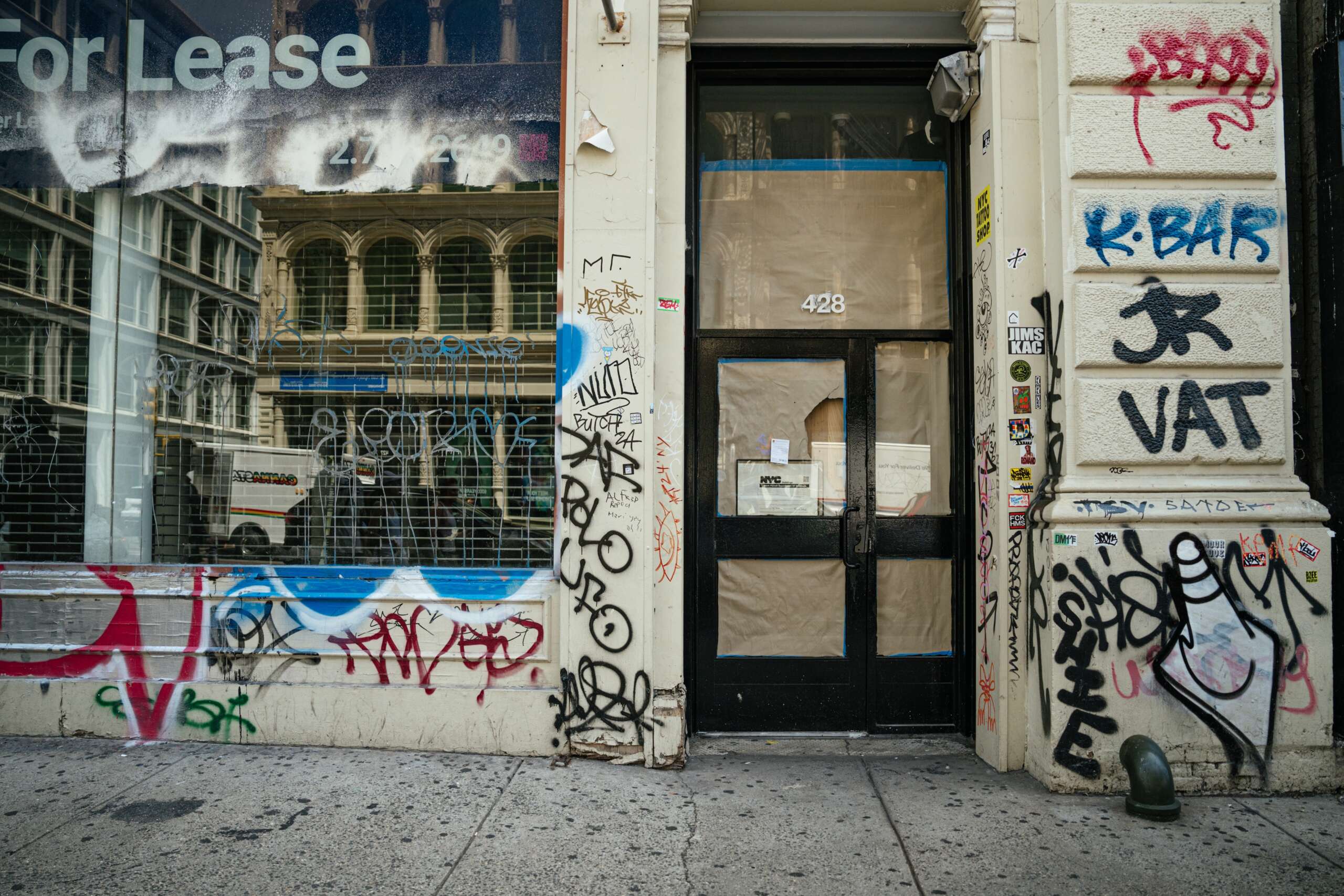

Walk down certain blocks in Lower Manhattan or Western Queens and you can count every third gate pulled down where a restaurant or bodega used to be, with its “For Rent” sign often weathered from years of exposure to the elements.
According to the city comptroller’s office, roughly 15,700 storefronts sit vacant across the five boroughs—about 11 percent of all commercial spaces—with some corridors pushing 20 percent vacancy or more. These patches don’t just look bad. They drain the life out of neighborhoods that would otherwise feel very much alive.
We’ve gotten used to explaining this away as fallout from the pandemic or blaming it on “greedy landlords” waiting for a corporate tenant. The whole story is more nuanced. New York has quietly and gradually built a system in which keeping a storefront empty can make more sense on the landlord’s spreadsheet than renting it to a local business. That is not a moral failing of individual owners so much as a policy failure—and it’s one we can fix, starting with the NYC Small Business Rent Stabilization Act, but more on that later.
First, it is important to dispel a common myth about the cause behind this phenomenon. There is no special tax deduction for keeping a storefront vacant. Owners can deduct mortgage interest, property taxes, and maintenance whether a space is filled or not, but they can’t write off rent they never collected. When a gate is down, the owner is still paying taxes, insurance, and debt service every month. A vacant storefront really does bleed money.
So why would anyone choose years of bleeding over a lower, realistic rent? Because commercial real estate in New York is financed and valued almost entirely on stabilized income potential and assessed rent levels, not on whether a local business is open on the corner. A closer look at what
actually causes this begins with a journey into the seemingly grey world of appraisers and lenders. It is in the market dynamics and regulatory frameworks that govern nearly all aspects of these few basic cogs in the economic engine where the true root cause of these undesirable external realities on the street are found.
Appraisers and lenders look at net operating income, capitalization rates, and the rent rolls, and they reward high rents from “credit‑worthy” (corporate) tenants with higher valuations and better loan terms. In hot corridors that saw a heated rent bubble before the pandemic, owners and their bankers have baked in very ambitious future rent assumptions. If those assumptions crumble, so do the numbers underpinning the mortgage.
In many cases this not only relates to the mortgage used to finance the purchase of the property itself, but often the buildings (and their typically inflated appraised income potential) are used as collateral to finance other properties, development loans or nearly any other class of financeable asset.
These chains of over-valuations that compound over time are the stuff market bubbles are made of, and the commercial real-estate market is sitting firmly atop exactly such a bubble. Seeing this from the perspective of landlords, banks and the chain of interests bound into these assets, one of the chief arguments for starting to pull the policy levers that are effectively the only cooling rods available in this kind of reactor is to govern and legislate towards an off-ramp for market
overheating, a “soft landing” to prevent a cataclysmic crash in this sector of the economy.
What this broadly translates to is: commercial rents must come gradually down. Not just for the vibrancy of our great cities to return. Not just for the dreams of ordinary people whose ingenuity, drive and natural desire is to build businesses that fill real needs and employ people meaningfully and locally. Not just for opportunity and hard earned prosperity to be within reach for people of all ethnicities and class backgrounds but also, not least, for the giant commercial real estate sector to steer clear of igniting what could be an economy-wide free-fall “correction” in the not-so-distant future.
Recent research on Manhattan storefronts shows how the prevailing logic currently dictating the business practices of lenders and appraisers creates what economists call “option value.” Landlords with long fixed leases and costly eviction rules have a strong incentive to wait for a tenant who can pay at or near the peak rent for that space, because locking in a low rent today means under‑earning for 10 years.
In New York, that incentive is sometimes hardened into contract. Some commercial mortgages now include rent floors—covenants that effectively forbid signing leases below a specified rent per square foot. When the real local market falls beneath those floors, the choice isn’t between “some rent” and “no rent.” It’s between breaching the loan by accepting reality, or enduring vacancy until someone appears who can satisfy the covenant.
From the sidewalk, that looks like stubborn greed. From the bank’s point of view, it looks like discipline. Either way, the result is the same: ghost corridors in a city that prides itself on vibrancy and street life.
The costs of this system fall hardest on small, independent businesses. The comptroller’s analysis finds that restaurants and cafés make up the single largest share of shuttered storefronts citywide. In fast‑gentrifying neighborhoods, those that survive one lease term often face a brutal reset at the end of it, as landlords try to line up their rent rolls with boom-time expectations.
In all this it is important to remember what a waste of resources the choking of a neighborhood business really is. Small businesses are not just realizations of dreams but are often built on the life savings of entire families. They embody countless years of partly unpaid work that goes into building a customer base of regulars, designing and equipping the space to fulfil its potential and so much more. Real sacrifice is made in the building of these cornerstones of our lives and real
value is created within them.
The bitter irony being that the restaurants, the bars, the cultural spaces that are the most frequent victims of this are in fact among the main drivers of the kind of neighborhood improvement that, once realtors pick up the scent, translates to gentrification and displacement of long-time residents. This only happens because perceived vibrancy in many parts of the city is scarce and concentrated in some pockets in the cityscape.
Were rents more attuned to real and actual income potentials from real and actual local businesses, the “hype” of these neighborhoods would not have to turn so destructive and exclusive with inevitable rent hikes. Were “survival rates” permitted by policy changes to rise also outside such hot-spots, these extreme zones for real-estate speculation would have much less fuel for fire.
At one Ridgewood location, my partners and I watched a promising lease negotiation collapse over this very logic. The landlord insisted on a 10‑year term with no meaningful renewal protections, in a neighborhood that is visibly transforming block by block. Friends and people we knew who had opened businesses in similar areas had in some cases seen their rents triple at renewal after a decade of building out spaces, cultivating regulars, programming culture and maintaining a staff.
Signing that kind of lease isn’t just a business risk; it’s a time‑bomb set to detonate precisely when your investment finally matures. We walked away and chose a smaller, less favorably located space whose owner would accept options to extend another five to 10 years on the same basic terms.
That kind of predictability should not depend on individual landlords. It should be the baseline expectation for doing business in New York.
The New York City Small Business Rent Stabilization Act would be a first attempt to make it so. The bill would create a Commercial Rent Guidelines Board and institute a rent‑stabilization system for non‑chain tenants, capping how fast commercial rents can rise and establishing clear renewal options for eligible small businesses. It is not a blanket freeze; it is a rules‑of‑the‑road framework aimed at keeping independently owned storefronts from being priced off their blocks every lease cycle.
Combined with a well‑designed vacancy tax, an outline emerges of how we can implement policy change that will not only revitalize our own city but reverberate around the country. A modest tax on long‑term vacant commercial space—calibrated to kick in only after a meaningful grace period—would make it more costly to warehouse storefronts as financial options. It would also generate revenue. The point is not to punish owners for every short‑term vacancy, but to make the social cost of years‑long emptiness show up in the same spreadsheets where banks and landlords currently see only potential upside.
Critics will warn that commercial rent stabilization and vacancy taxes will “hurt business” by lowering property values. But this exposes the confusion at the heart of our so‑called
pro‑business politics. For decades, when politicians of both parties have said they are “pro‑business,” they have usually meant they are pro‑asset‑holder: pro‑landlord, pro‑bank, pro‑large corporation whose primary product is a stream of passive income. The neighborhood bar that employs 10 people, the repair shop that keeps your speakers alive, the bookstore that gives your block a reason to exist after 6 p.m.—these have been afterthoughts at best.
Meanwhile, our culture has learned to worship passive income as an ideal. Scroll through Instagram or TikTok and you’ll find no shortage of being told that success is to assemble enough “revenue streams” to stop working altogether. The dream is no longer to build a business locally that answers a need in your community; it is to extract value by speculative means while someone else does the labor. In that value system, an empty storefront is not a civic failure—it’s a temporarily underperforming asset in a portfolio.
A city that takes itself seriously cannot be neutral between those two visions of prosperity.
Choosing active over passive income generators means designing policy to favor enterprises that hire people, provide services, and knit neighborhoods together, even if that means some loss of short‑term paper wealth for those who own the underlying real estate. It means accepting that a building’s “value” is not just its potential rent cash flow, but the positive externalities that come from having a bakery, a venue, or a childcare center downstairs instead of another vacant storefront.
The New York City Small Business Rent Stabilization Act and a serious vacancy‑penalty regime will not, overnight, reverse every ghost corridor or guarantee every corner store’s success. But they are a test of whether our politics is ready to be honestly pro‑business in the only sense that should matter for a city like New York: pro-family run business, pro-mom and pop shops, pro-small businesses created by craftspeople and artists, immigrants or anyone with a genuine, invested connection to their own community.
If we want a small business renaissance, we have to stop treating empty storefronts as acceptable collateral damage of financial regulatory happenstance and start seeing them for what they are: a policy choice.
Emil Bovbjerg is a leader at Small Business United, the owner of Dada bar in Ridgewood, a recording musician and long-time New York City resident.