


Share This Article
“To be sure, a small (and often overstated) segment of rent stabilized buildings face real financial distress. Adding to the rent burdens of a million households to save these outliers makes little sense.”
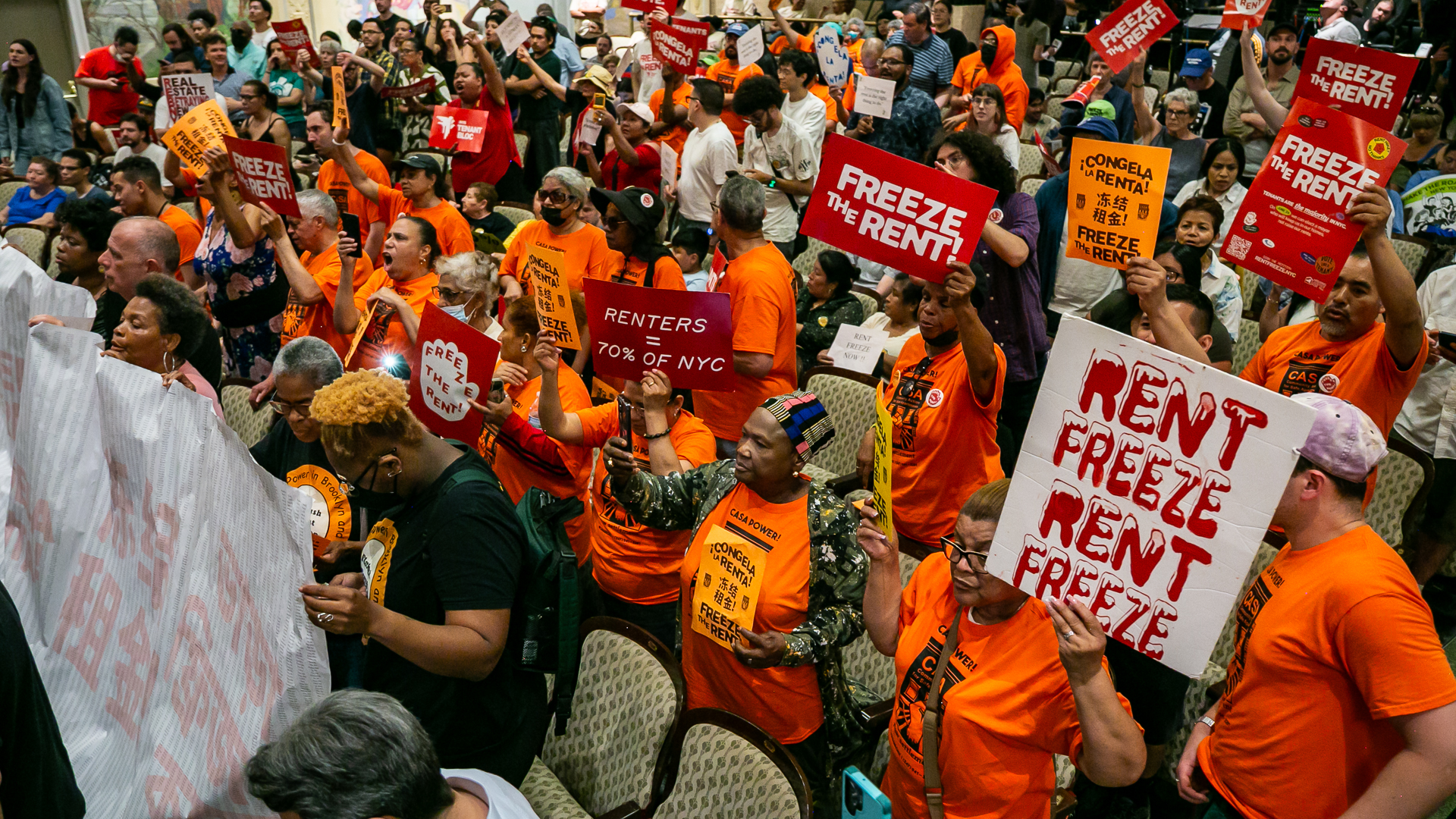

By packing the Rent Guidelines Board with members of his choosing, Mayor Eric Adams has made his move to derail Mayor-elect Zohran Mamdani’s campaign promise to freeze rents for the city’s 1 million rent stabilized households.
With few exceptions, the Board’s five public members generally control the outcome of the annual guideline setting process. One public member, Alex Armlovich, will serve out a term lasting through 2026. A second public member, Arpit Gupta, has been reappointed to a term also set to expire at the end of 2026. And a third public member, newly appointed Liam Finn, will also serve out a term expiring at the end of 2026.
These 11th hour appointments run afoul of customary deference to an incoming mayor and undermine a clear democratic mandate for leadership committed to a more affordable city. More critically, they seek to condemn rent stabilized tenants to a continuation of unwarranted rent increases.
There are several metrics for determining whether past rent adjustments have been appropriate. Public debate over rent increases routinely apply misleading metrics and miscast the relevant data.
In general, the board’s legal mandate is to limit the effects of the city’s housing shortage on rent increases. Landlords should be able to collect enough rent to cover operating costs and ensure that their net income will not be eroded by inflation. At the same time, the system protects against exploitive rent increases landlords would otherwise be able to extract from tenants searching for scarce apartments.
At its annual meetings and hearings, the Rent Guidelines Board receives a deluge of statistics about the economic health of the housing stock and conditions faced by tenants. Only a few of those statistics speak to whether the board has satisfied its legal mandate. Those numbers demonstrate that the board has indeed gone off track: Several data sources establish that landlords have, in fact, been overcompensated.
From 1990 to 2023 (the first and last year the board received comprehensive data on building income and expenses) average net operating income for rent stabilized buildings has risen 48 percent after adjusting for inflation. This growth was a product of increases authorized by both statutory changes and the actions of the Rent Guidelines Board.
Had the board adopted guidelines precisely aimed at covering all cost increases and protecting net operating income from the effects of inflation since 1990 (and disregarding the effects of statutory changes on rents), it would have authorized cumulative increases totaling 228 percent.
In fact, the board authorized increases totaling 236 percent—an 8 percent gap that favors owners. That gap was once as high as 39 percent. An inexcusably slow effort to narrow the gap began during the de Blasio administration. Even if the gap were closed, rent burdens will continue to suffer from massive rent increases brought about by statutory deregulation, vacancy bonuses and other increases that were in place until finally curbed by Albany in 2019.
To be sure, a small (and often overstated) segment of rent stabilized buildings face real financial distress. Adding to the rent burdens of a million households to save these outliers makes little sense. Reforming existing programs and crafting new ones to lower costs and finance needed repairs for these struggling buildings is a more precise and fitting remedy.
While the Board’s staff reports that some 9 percent of the stabilized stock is not meeting its expenses, the precise economic problems faced by these buildings are difficult to discern. How many hold a number of the tens of thousands of stabilized apartments being deliberately held off the market? How many are being emptied with an eye toward demolition or rehabilitation? How many are simply operated by grossly incompetent and neglectful owners?
Given the paucity of annual “hardship” applications for special rent increases available within the current system, it is clear that the primary impediments to solvency are not rent limits. More likely, tenant affordability limits, leading to non-payment of rent and expensive eviction proceedings, along with owners deliberately holding units off the market for development or rehab, explains most of the 9 percent figure.
Owners and their allies will assert that rent increases have not kept up with operating costs since 2019. That time frame is selective and misleading. What the public is not told is that relatively lower rent guidelines in recent years have served as a long overdue correction for grossly excessive adjustments adopted from 2009 to 2014.
Those rent hikes caused the greatest tenant rent burdens on record. By 2014 the average stabilized household spent over 36 percent of their income on rent—and those burdens persisted into the COVID years. By contrast, in 1970, during the first full year of rent stabilization, the average rent burden for stabilized households was 22 percent of income.
At a gut level most New Yorkers have known for years that there is something wrong with the system. By the numbers, they were right. Last November they voted for a change.
The new mayor should be allowed to do the job he was elected to do.
Timothy Collins is the former executive director of the NYC Rent Guidelines Board, author of An Introduction to the NYC Rent Guidelines Board and the Rent Stabilization System – Rent Guidelines Board and a partner in the law firm of Collins Dobkin & Miller LLP. Samuel Stein is a senior policy analyst at the Community Service Society of New York.*
*CSS is among City Limits’ funders.
9 Comments
Harry Naplps
The entire article is premised on a straightforward illusion. The statement “net operating income for rent stabilized buildings has risen 48 percent after adjusting for inflation.” That number includes any building with a rent-stabilized tenant, not buildings that are predominantly rent-stabilized. It’s the same nonsense Brad Lander foisted to the public. Over the last 20 years, the RGBs allowed rent increases for rent-stabilized renewals have trailed the RGBs’ own measured operating cost increases by a wide margin.
Guideline renewals compounded to about a 56 percent increase for a typical one-year renewal path from 2006 through 2025, while the RGB PIOC operating cost index compounded to about a 148 percent increase over the same period. In plain terms, operating costs rose roughly 2.5 times as fast as guideline rents, leaving guideline-driven rent growth at roughly 63 percent of cost growth by 2025.
Year over year, the gap persists. In most years, PIOC is above the one-year guideline, often by 2 to 5 percentage points. The gap spikes in stress years, especially 2017, 2019, and 2023, when PIOC rises materially while the guideline stays low. There are only rare exceptions, like 2016, when PIOC is negative and the guideline is zero, so costs briefly fall while rent holds flat.
Timothy Collins
Mr. Naplps –
Your commentary misses the mark in the same way Mr. Haberman’s did. Please read my extended comment below. When examining building health it is perfectly appropriate to consider overall income – not just income from stabilized units. And even buildings with 100% stabilized units received excessive guideline increases when aggregated over the period for which we have reliable data (1990 – 2023). Any other period is cherry picking.
That is, on average, RGB guidelines were more than sufficient to cover operating cost increases AND to protect net operating income from the effects of inflation. The RGB staff has examined and confirmed this data.
There is a huge push back against this fundamental reality – and it invariably rests on smoke and mirrors.
Lander
Cool man, how about you talk about the obvious unconstitutional takings in regards to rent stabilized apartments when they are vacant ? Please explain to me how you can skirt around that topic. Please let me know a legal standing that even remotely makes sense in regards to stabilization lasting even AFTER an apartment is vacant. Or the lack of compensation in regards to improvements. This is text book in regards to taking compensatory value from a property owner.
Seth Haberman
“From 1990 to 2023 (the first and last year the board received comprehensive data on building income and expenses), average net operating income for rent stabilized buildings has risen 48 percent after adjusting for inflation. This growth was a product of increases authorized by both statutory changes and the actions of the Rent Guidelines Board.”
citylimits.org/opinion-by-the…
The entire article is premised on a straightforward delusion. The statement “net operating income for rent stabilized buildings has risen 48 percent after adjusting for inflation.” That number includes any building with a rent-stabilized tenant, not buildings that are predominantly rent-stabilized. It’s the same nonsense Brad Lander foisted on the public, and it’s meant to mislead. Over the last 20 years, the RGBs’ allowed rent increases for rent-stabilized renewals have trailed their measured operating cost increases by a wide margin.
Seth Haberman
Over the last 20 years, the RGB’s allowed rent increases for rent stabilized renewals have trailed the RGB’s own measured operating cost increases by a wide margin.
Guideline renewals compounded to about a 56 percent increase for a typical one year renewal path from 2006 through 2025, while the RGB PIOC operating cost index compounded to about a 148 percent increase over the same period. In plain terms, operating costs rose roughly two and a half times as fast as guideline rents, leaving guideline driven rent growth at roughly 63 percent of cost growth by 2025.
Year to year, the gap is persistent. In most years, PIOC is above the one year guideline, often by 2 to 5 percentage points. The gap spikes in stress years, especially 2017, 2019, and 2023, when PIOC rises materially while the guideline stays low. There are only rare exceptions, like 2016, when PIOC is negative and the guideline is zero, so costs briefly fall while rent holds flat.
The net effect is predictable. For long tenured stabilized tenants, the policy cushions rent from cost shocks. For owners of buildings with substantial stabilized rent rolls, it implies margin compression unless there are offsets such as market units, subsidies or abatements, unusually low debt service, or other income. That pressure matters more after 2019 because the law change that eliminated a separate vacancy allowance reduces the traditional “catch up on turnover” mechanism, so gaps can persist longer in legacy stabilized buildings.
The main interpretive caveat is that PIOC is an index, not your building’s ledger. It describes a representative basket of costs, not your realized expenses or NOI. The right next step is to rerun the comparison using your building’s cost weights and rent roll mix, then use RGB income and expense studies as a reality check on how NOI has moved for comparable properties
Timothy Collins
Mr. Haberman’s analysis distorts and misconstrues the analysis.
First, a clear distinction is drawn between statutorily authorized rent increases, which include, high rent vacancy deregulation, and the aggregate effects of RGB increases. The 48% increase in average building NOI reflects all increases. That is a valid statistic reflecting average financial profiles of buildings, all of which were once fully stabilized.
The second part of the analysis looks at aggregate increases authorized by the RGB and compares it with annualized commensurate increases necessary to cover operating costs on a dollar for dollar basis AND to protect net operating income from the effects of inflation. That analysis clearly demonstrates that the actions of the RGB, inclusive of all vacancy adjustments (made mandatory in 1997), exceeded the target of keeping owners whole for both cost changes and inflation. The RGB authorized an aggregate of 236% in increases from 1990, while only 228% was necessary to keep owners whole.
Further, Mr. Haberman, erroneously posits that the RGB must ensure guideline increases match or exceed operating cost increases for owners to be fully compensated for cost increases. That is not true. On average, operating costs make up only about 62 cents of every dollar in rent collected. The rest is considered net operating income. Increasing rents by PIOC percentages would increase both the cost and income portions by that figure. In the RGB’s commensurate rent analysis the cost portion is increased by cost change data while the income portion is increased by the consumer price index. Since the CPI has increased at far lower rates than changes in building operating costs, to increase rents solely by the PIOC would institutionalize windfalls for owners. The real estate industry routinely and knowingly obfuscates that fact.
Finally, any analysis that focuses on a limited selection of years (ignoring known trends since 1990) is cherry picking. Grossly excessive guidelines from 2009 through 2014, coupled with 26 years of statutory deregulation, fed a massive speculative binge which crushed tenants with unprecedented rent burdens. It is not surprising that landlords, who largely ran the show in those years, protested when democracy struck back in 2019. Nor is it surprising that they are now feeling bewildered and put upon by the election of Zohran Mamdani. And it is not surprising that they continue sophisticated efforts to rationalize their unwarranted sense of entitlement.
Seth Haberman
Mr. Collins’ reply repeats the same category error that underlies the article itself, and then layers on a second error about what it means for owners to be “kept whole.”
First, the 48% NOI figure does not say what you claim it says.
The RGB income and expense studies explicitly include any building with any rent-stabilized tenant. That necessarily mixes three very different things into one headline number:
buildings that were once stabilized but are now largely market,
buildings that benefited materially from statutory vacancy deregulation and preferential rent churn prior to 2019, and
buildings that remain predominantly stabilized with long-tenured tenants.
You treat that aggregate as if it describes the third category. It does not. That is not a semantic quibble; it is the central flaw. The NOI gains you cite are driven disproportionately by market units, deregulation, and turnover-driven resets. Those mechanisms are precisely what do not apply to legacy stabilized buildings after 2019. Treating the blended average as representative is misleading.
Second, your reliance on the “commensurate rent” framework proves my point rather than refutes it.
You argue that guideline increases need not match PIOC because only ~62% of rent goes to operating costs, and that the remaining portion should merely keep pace with CPI. That is exactly the mechanism by which margin compression occurs in stabilized buildings.
Here is the arithmetic, stripped of rhetoric:
When PIOC runs persistently above CPI, as it has for much of the last two decades,
and when guideline increases are set to cover cost inflation on only part of the rent and general inflation on the remainder,
the result is structurally rising expense ratios and declining margins in buildings where rent growth is constrained to guidelines.
That outcome is not accidental. It is a policy choice. It may be defensible on distributional grounds, but it cannot be denied mathematically.
Third, your claim that guidelines “exceeded what was necessary to keep owners whole” rests on assumptions that no longer hold.
The commensurate rent analysis you cite embeds two critical assumptions:
that vacancy allowances and deregulation permit periodic rent catch-up, and
that income growth is not path-dependent on tenant tenure.
Both assumptions were substantially weakened or eliminated by the 2019 law changes. Once vacancy allowances are removed, gaps between rent growth and cost growth persist rather than mean-revert. A framework calibrated to a pre-2019 regime cannot be used to declare post-2019 outcomes “excessive” without adjustment.
Fourth, focusing on 1990–2023 does not cure this problem; it hides it.
You accuse others of cherry-picking, yet your preferred window deliberately spans the era of high deregulation, aggressive churn, and speculative repricing. That is precisely the period in which blended NOI would rise even if guideline renewals trailed costs. Aggregating across that regime and the current one erases the policy break that matters most.
By contrast, examining renewal-only guideline paths against the RGB’s own PIOC series is not cherry-picking. It is isolating the mechanism that governs outcomes for long-tenured stabilized tenants today.
Finally, rhetoric about entitlement and politics does not substitute for analysis.
Invoking speculative excess, democracy, or the election of Zohran Mamdani does not change the arithmetic. Neither does attributing bad faith to anyone who points it out. The question is not whether tenants should be protected from shocks; it is whether the RGB’s own data show that guideline-driven rent growth has, in fact, kept pace with operating costs for predominantly stabilized buildings in the post-2019 regime.
On that narrow question, the answer remains no.
The correct conclusion is not that owners are entitled to PIOC-matching rent increases.
The correct conclusion is that:
blended NOI statistics are being misapplied to a subset of buildings they do not describe, and
a policy framework that systematically allows costs to outrun guideline rents will, by construction, compress margins where turnover offsets are unavailable.
That is not smoke and mirrors. It is basic accounting.
Seth Haberman
I want to make one more thing clear about what is fundamentally wrong with your analysis.
One key point still being missed is that the oft-cited 60–62% expense ratio is not a fixed parameter. It is a starting condition.
When guideline rent growth persistently trails operating cost growth, expense ratios must rise mechanically over time. Even in years where NOI dollars are flat or slightly positive, margins compress. That compression increases the share of revenue exposed to future cost inflation, making the next cost shock more damaging than the last.
This is not a modeling choice or an assumption. It is arithmetic.
For example, with a 60% expense ratio, a year in which rent rises 2.8% and costs rise 3.9% can still produce a small increase in NOI dollars. But the expense ratio rises to roughly 60.6% in that same year. The following year, the same cost increase now applies to a larger base, while rent remains constrained to guidelines. The system becomes progressively less stable.
The commensurate rent framework treats the expense ratio as effectively stationary. That is only valid if rent growth, cost growth, and turnover mechanisms roughly balance over time. Once vacancy allowances and deregulation are removed, and when PIOC persistently exceeds guideline increases, that balance no longer holds.
So the relevant question is not whether NOI was positive in a given year or over a blended historical window. The relevant question is whether margins are stable. The data show they are not.
Positive NOI in the short run can coexist with structural margin erosion in the long run. Ignoring that dynamic leads to conclusions that are arithmetically inconsistent with the policy regime now in place.
Timothy Collins
Wrong again Mr. Haberman. The best measure of cost to income ratios conservatively places the ratio at 62% in 1970. It has hovered close to that figure for over fifty years and was last reported at 61.8% (See RGB Income & Expense Study for 2025 – fn 11). Rent Stabilization has not caused owners to lose ground. It has largely neutralized the effects of the housing shortage on rents – as it was intended to do.