


Share This Article
“Not only are we committed to immigrant artists and immigrant communities across the entire city, but we also have this dual mission of being a home for Inwood and Uptown,” said Mino Lora, executive artistic director at The People’s Theatre: Centro Cultural Inmigrante, which opened Tuesday.
Lea la versión en español aquí.
The wait for the first immigrant cultural center in New York City, and the largest Latino theatre in the state, is over.
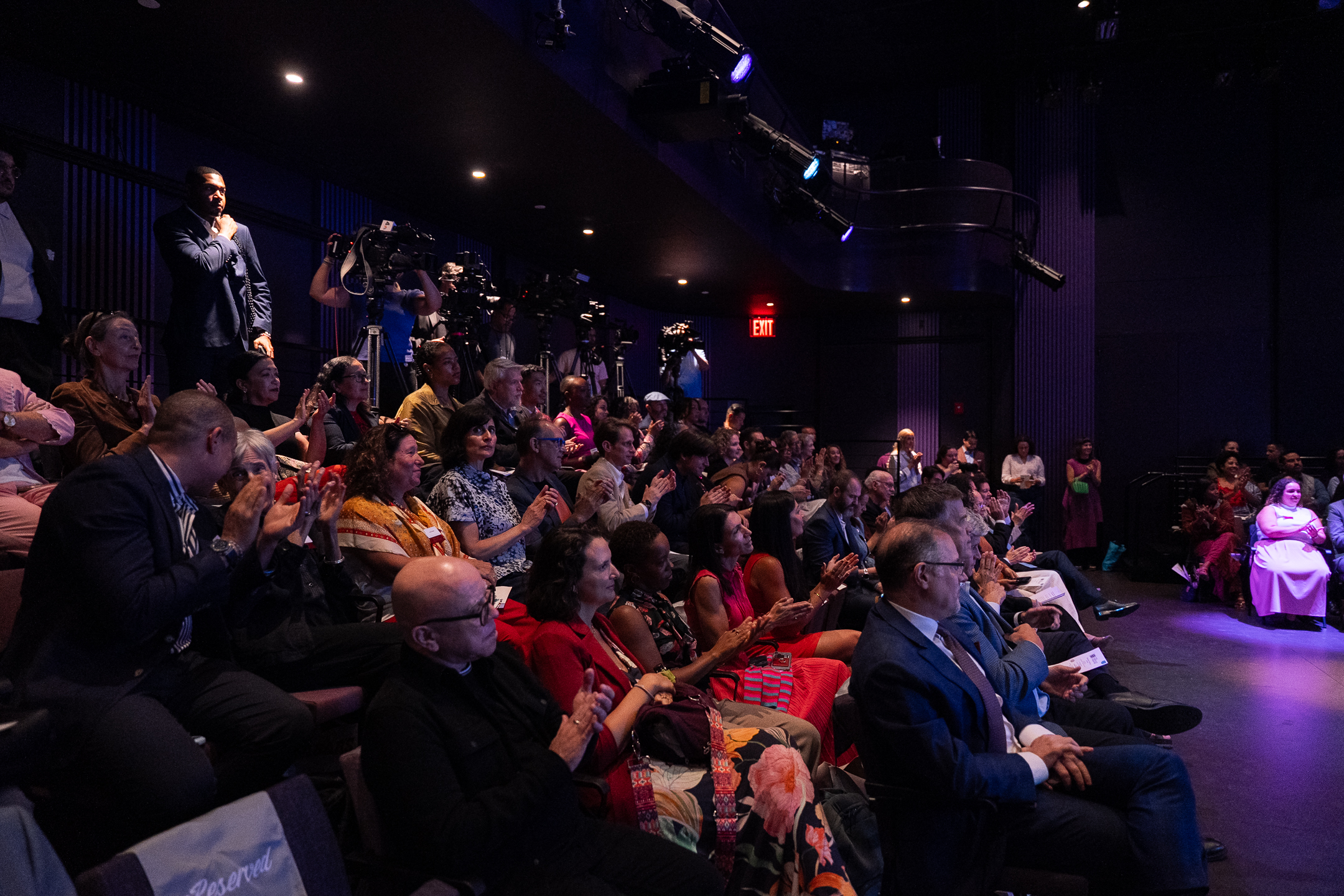
The People’s Theatre: Centro Cultural Inmigrante, a 19,000-square-foot space on West 206th Street in Inwood—one of several projects the city pledged to support as part of a rezoning of the neighborhood in 2018—opened Tuesday. Its theater season begins Saturday with the play “GUAC,” a father’s story honoring his son’s death in a school shooting, written by Manuel Oliver.
The new facility houses a mainstage theater with a capacity for 208 people, a smaller studio theater, four rehearsal studios (two with mirrors and sprung floors for dancers, and the others for musicians or actors), a soundproof practice room, an upper lobby cafe, and a lower lobby gallery space.
Its creation was one of the commitments the city made during negotiations over the Inwood rezoning plan, passed under the de Blasio administration. The Inwood rezoning “points of agreement” included plans for an “Immigrant Research Center and Performing Arts Center,” for the neighborhood, where more than 40 percent of the population is foreign-born, with the majority hailing from the Dominican Republic.
When it was proposed, advocates were fighting the anti-immigrant policies from Donald Trump’s first administration. Their sentiment was included in the project’s description at the time: “It is more important than ever to tell the stories of immigrant communities and celebrate their essential role in building a great city and a great nation,” the agreement reads.
Eight years later, the city has witnessed an escalation in the Trump administration’s crackdown on Latinos.
People’s Theatre Centro Cultural Inmigrante Executive Artistic Director and Co-Founder Mino Lora, a Dominican immigrant, talked with City Limits about her vision for the space, how it was built with and for immigrant New Yorkers, and why she sees it as both an artistic home and a hub for organizing.
This conversation has been edited for length and clarity.
City Limits: The center was built in this neighborhood where many immigrants live. How do you envision this space being used by immigrant New Yorkers?
Lora: One of the things that we are very intentional about is, as it says in the name, it is for all immigrants, and it really is the home of New York stories. No matter who we are—whether it’s immigrants themselves, first-generation immigrants, or someone you know who is an immigrant—this is a place where we envision immigrant artists, immigrant families, children, and elders coming to create work. Whether that is through our own programming (like our next production, we have folks from China, Korea, Turkey, the Dominican Republic—of course—Colombia, and other Latin American countries, so it’s multi-generational and multilingual), or it’s through our young people in our academy who are children of immigrants and immigrants themselves.
But we also want this to be a home for local groups, a twofold purpose. Not only are we committed to immigrant artists and immigrant communities across the entire city, but we also have this dual mission of being a home for Inwood and Uptown. We already have a resident company, Jazz Power Initiative, which will be here doing all of their programming for kids and for professional jazz musicians, jam sessions, and concerts. Other local smaller theater companies and schools are using and renting our space to do productions. So we are so excited to also be a home for others, not just our own productions, but a space that people can use to create.
We’ll be doing know-your-rights training and registering folks to vote. So this is a place where we really envision education, production, and advocacy to live.

CL: What are your plans for educational programming?
Lora: Our academy has two parts. One is for our elementary school students. They meet every Saturday, and there are about 100 children in that program.
The second is an academy for theater leadership and advocacy, which started before the ribbon-cutting ceremony, for middle and high school students. It’s a tuition-free six-year academy. The first two years focus on leadership, and then on artistry and advocacy. And it has wraparound services, so it’s not only about creating original theater—based on their culture, identity, and the power of who they are as young people—but also about connecting them to the resources they need: mental health, academic support, housing, or food insecurity.
Jazz Powers’ after-school programs will be here…doing arts programming starting in the spring. So this will be such a youth-centered space between 3 and 6:30 p.m.
CL: How can residents use the new facilities?
Lora: There are a few ways artists can partner with us. Individual artists who want to use the space will have community nonprofit rates. We will also have market rates for rentals, to rent by the hour, by the week, if it’s a full production.
We’ve got a couple of local groups that are renting for two to three weeks because they’re doing a full show. They’re renting the main stage theater so they can do all their rehearsals there. A yoga teacher reached out as well. We’re in conversation. There’s another local artist who’s a dancer who wants to teach salsa and bachata classes, so we’ve been talking to them. People are already reaching out, and we haven’t even advertised yet. But soon that’ll all be on our website.
People can come and get a tour of the space to see which studio is best for them. All of the rehearsal studios are fully equipped with Bluetooth and sound systems, so people can just come in, plug, and play.
CL: You’ve described this space as the first immigrant cultural center of its kind in New York City. How did you work with immigrant communities to plan it?
Lora: We had a lot of conversations throughout the process. We’ve been around for 18 years, and we’re an immigrant-led and [immigrant]-serving organization. Our board members, students, families, and artists, too. So we first had conversations with them. We have a second performance space because of those conversations.
We are members of the New York Immigration Coalition. We do a lot of advocacy at the state, city, and federal level with our young people. And our youth and family advocates have been a huge help in getting feedback. The organizing and the advocacy programming came from that.
This is a safe space for immigrants. When we say education, it’s not just for kids; it’s education for communities.
The other part of the conversation on how we serve immigrant New Yorkers is through meeting the goals of city-funded projects, which usually have MWBE [Minority and Women-Owned Business Enterprise] goals of around 30 percent. It was very important to me that we exceeded 50 percent. It’s not just about minority-owned women’s businesses; it’s also about immigrant businesses. I’m proud that we are just shy of 60 percent, built by all of these trades. Again, for me, that intentionality was so important because this is a place for immigrants, and it needed to be built by immigrants.
CL: We’re living in a time when many immigrants don’t want to go out. I don’t want to generalize, but some don’t want to go out and speak their languages. How do you plan to encourage them to go out and enjoy these spaces created for them?
Lora: One way we’re going to do that is by ensuring that our programming reflects their stories and experiences. I think the power of theater—and performing arts in general—is that they make us feel less alone. What we’ve already noticed in the process of building it and doing small tours with some of our partners and their families is that everyone who walks in feels moved and seen.
As folks will see, it is a very colorful space. It is vibrant. There are curves everywhere. Three ramps to enter our space that we have transformed into an amphitheater, “rampatorium,” as we call it. Even the architecture of the space will let people know that I am safe.
But yes, it’s a real and legitimate fear. ICE was here just a few blocks away from us not that long ago. We are organizing with our neighbors and partners to activate our communities and ensure that we support one another. We’ve seen Uptown do that. We know how to show up and stand up.
To reach the reporter behind this story, contact [email protected]. To reach the editor, contact [email protected]
Want to republish this story? Find City Limits’ reprint policy here.