


Share This Article
A new pilot program for public restrooms requires tap access with a phone or key card. Homeless advocates say it could be another barrier for unhoused New Yorkers being able to access them.
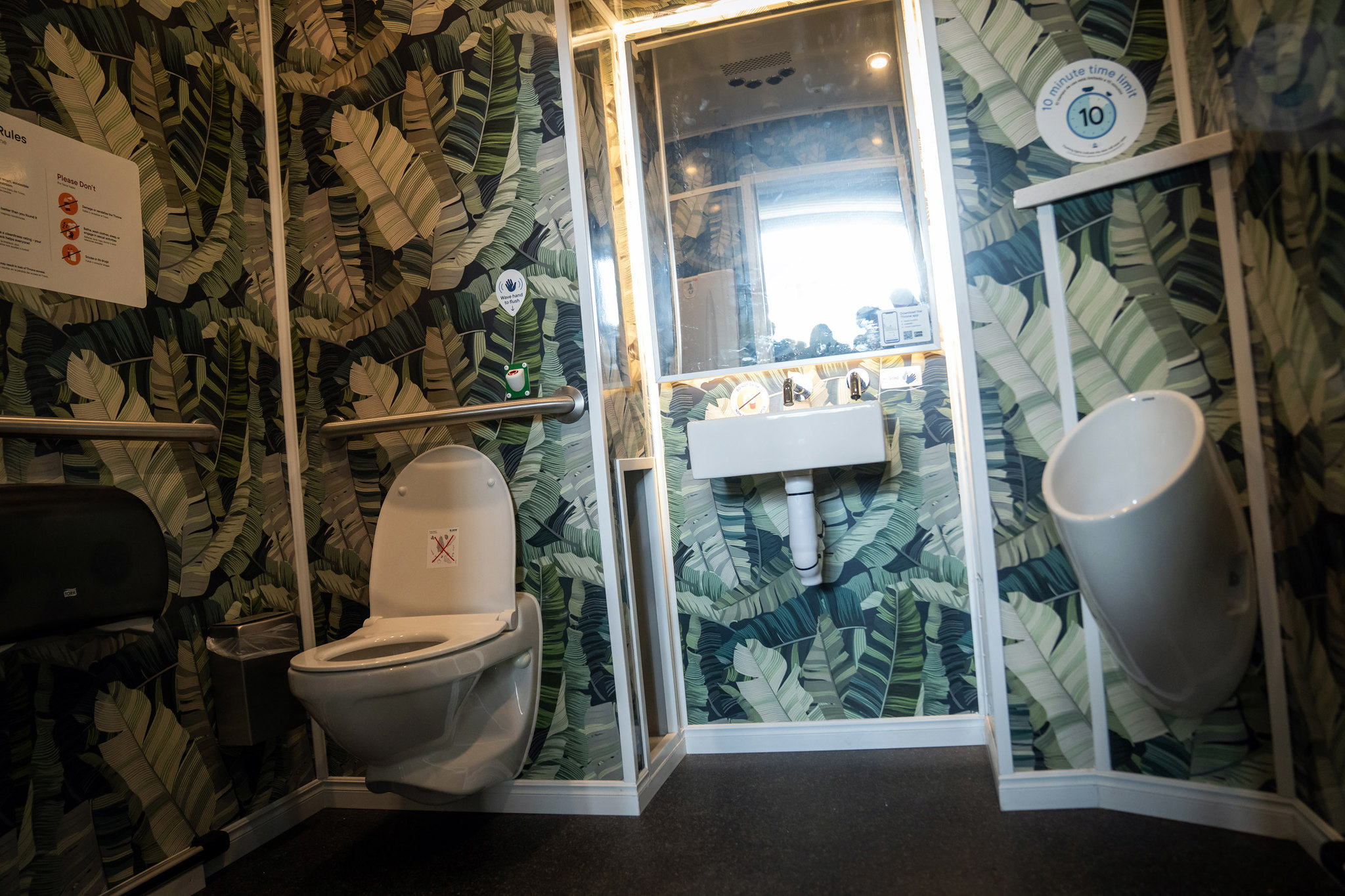
When you gotta go, you gotta go. Just make sure you have a charged phone or you planned far enough ahead to get a special key card—two requirements for accessing the city’s newest public bathrooms.
The mayor announced a pilot program Wednesday morning to add 17 free public restrooms around the city. While the initiative was largely welcomed by New Yorkers who all—at some point—gotta go, some homeless advocates are raising questions about how unhoused New Yorkers will be able to access the new technology.
The new facilites, operated by tech-bathroom company Throne Labs, require a cell phone to enter. But homeless New Yorkers, who might benefit most from more public restrooms, often lack cell phones or a place to charge them. To use the bathrooms without a phone, users will have to track down a key card from a local business or nonprofit group.
“Many may not have a smartphone or be able to easily obtain a physical tap card to open these restrooms. Others may not be able to access one of the 17 sites, particularly during the limited hours when they are operational,” said VOCAL-NY and the Coalition for the Homeless in a joint statement.
Homeless New Yorkers have been calling on the city to improve access to public restrooms for years. The city has just 1,000 public restrooms for 8 million residents, officials said. And many of the existing facilities, primarily found in parks and libraries, are limited to daytime hours or are out of service.
“It means our unhoused neighbors are discriminated against from accessing private facilities and then criminalized with a summons for simply having nowhere else to go,” said Councilmember Sandy Nurse at a Wednesday press conference.
Calls to expand access to permanent public restrooms have stalled for years. The Mamdani administration announced a plan to add more public restrooms in January, while a City Council-mandated plan to double the number of public restrooms was due in September, but is now delayed until Nov. 1.
The New York City Police Department issued a record 10,003 criminal and civil summonses for public urination in the 12 months that preceded July 1, according to VOCAL-NY. The tickets disproportionately affect people of color, Nurse’s office told the New York Times last year.
Jessica Heinzelman, the chief operating officer of Throne Labs, said that the phone access enables the company to collect feedback and cleanliness ratings directly from users.
“A lot of local institutions are going to be passing out these tap cards so that people can actually have a physical manifestation of them,” said Mayor Zohran Mamdani at a Wednesday press conference.
The bathrooms will be open every day from 7 a.m. to 10 p.m. and will have a 10-minute maximum, after which the doors will open (though users inside will be warned beforehand).
Throne labs said the time limit is for safety and to prevent activities like drug use. Users who repeatedly violate rules could see their access revoked, Heinzelman said, though they have pathways to restoring access if necessary.
“Publicly accessible private space and misuse—it’s a balance,” said Heinzelman.
The company said there would be signage on each throne about businesses with tap cards available within a 10-minute walk. But those businesses may have even more limited hours than the bathrooms themselves. A spokesperson for Throne Labs said recruitment for community partners is still in progress.
Access to the keys may be crucial to serving homeless New Yorkers, advocates said.
“We know people are going to lose cards, right? It’s going to happen? Whether someone’s in a shelter with a two-bag policy or just losing things, or if someone is on the street and their belongings are discarded via an encampment sweep,” said Adolfo Abreu, housing campaigns director at VOCAL-NY. “What’s the process gonna be like if someone shows up to a location and they’ve run out of cards?”
The new toilets, the mayor said, are more affordable and mobile than permanent bathrooms because they do not require drilling into the pipes and sewer systems.

“It’s going to be very, very challenging for the city to reach a goal of 2,100 functional public restrooms if we have to build each and every one ourselves,” said Councilmember Nurse, who wrote the City Council’s “Bathroom Bill,” passed last year, that calls on the city to double the number of public restrooms.
“I think working with an experienced provider that focuses just on this and has an entire business model that is just on this, that has an affordable cost to the city, is a good way to to approach this,” she added.
Evie Smith Hatmaker, head of community marketing and storytelling at Throne Labs, said their goal is “to make the bathroom accessible to everybody.”
“Every market that we’re in, the [homeless] community is a little bit different,” she said. “The feedback we get from our community partners here will really help us shape the program.”
The new restrooms will be at the locations mapped above, with four installed per a week, every other week for the next six weeks, according to Throne Labs and City Hall.
To reach the reporter behind this story, contact [email protected]. To reach the editor, contact [email protected]
Want to republish this story? Find City Limits’ reprint policy here.
1 Comment
Anon
Not sure how your main concern is a phone when they have cards. The bigger one is there already are bathrooms open at these times. The time in the street was late night and early morning. They are not open then. Tickets will continue. I used to not drink water after 1 pm to avoid this but it never worked. It’s made me so dehydrated and I downed Imodium. The gave me a ticket for changing a tampon. You fail the most important issue. They are not open all night.