


Share This Article
“We are invisible when it comes to understanding the challenges related to many health issues. And when we talk about HIV, it is even more alarming,” said Guillermo Chacón, president of the Latino Commission on AIDS.
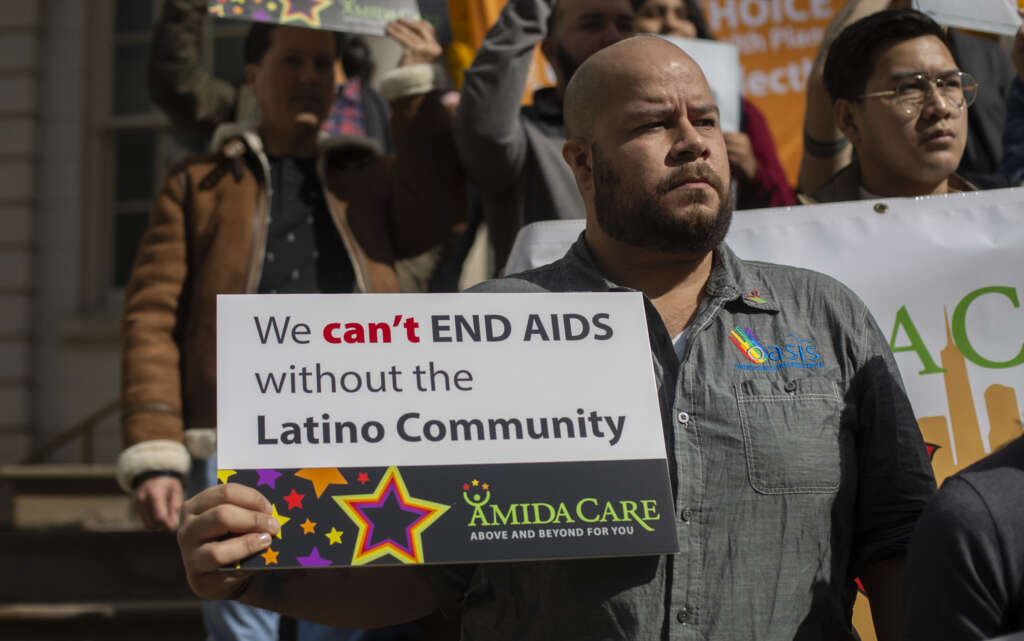
Funding cuts to HIV prevention programs could make it harder for Latino New Yorkers—who are already disproportionately impacted by the virus—to access testing, treatment and other essential health services, health advocates warn.
The concerns were raised at a press conference last month ahead of National Latino AIDS Awareness Day. This year’s theme, “Knowing Your HIV Status Is a Good Place to Start,” focused on the importance of testing as the first step toward prevention, treatment and care.
Attendees—a mix of elected officials, public health advocates and Latino leaders—also called for greater access to health services and efforts to reduce the stigma that prevents people from seeking care.
“There has been so much stigma in our communities,” City Councilmember Alexa Aviles, who represents Brooklyn’s Sunset Park, said during the event. “This is an epidemic that we have made so much progress in, and yet still Latinos are disproportionately impacted.”
According to the New York City Department of Health and Mental Hygiene’s 2024 HIV Surveillance Report, released in December 2025, the city recorded 1,791 new HIV diagnoses in 2024—up 5.4 percent from the year prior.
Latino residents accounted for 41 percent of those cases, despite making up approximately 30 percent of the city’s population.
For Guillermo Chacón, president of the Latino Commission on AIDS, the numbers reflect deeper structural problems in how public health institutions address the needs of Latino communities.
“We are invisible when it comes to understanding the challenges related to many health issues. And when we talk about HIV, it is even more alarming,” he told City Limits.
Chacón, who has worked with the organization for 32 years, said one of the main challenges is that public health systems often approach health disparities through racial categories, overlooking the specific needs of Latino communities.
He also pointed to barriers affecting immigrants who may struggle to navigate the U.S. health care system, particularly when it comes to sexual health education and access to prevention tools such as pre-exposure prophylaxis, or PrEP, which helps prevent HIV infection.
He described how even a negative interaction with clinic staff can discourage someone from returning for care. Limited operating hours can create another barrier for people who work during the day. “If people are working Monday through Friday, it is not going to work. You have to offer services at night and on weekends,” he said.
Those challenges are unfolding as federal funding for HIV prevention faces potential reductions.
Congress funded the Centers for Disease Control’s domestic HIV prevention program at $755.6 million for fiscal year 2026, according to the HIV Medicine Association. The Trump administration’s 2027 budget request would eliminate that core funding, keeping only $220 million for the Ending the HIV Epidemic initiative, and the House Appropriations Committee’s spending bill includes no money for the account.
Fiscal year 2027 began Oct. 1, but Congress has not passed a full-year health spending bill. A stopgap measure signed Sept. 2 keeps funding at 2026 levels through Dec. 11, and the Senate has yet to act. Meanwhile, the Kaiser Family Foundation reports the CDC is ending its direct, five-year grants to community-based organizations—$239.3 million nationwide—and sending supplemental money to health departments instead.
Chacón pointed to a recent three-year contract renewal for the Latino Commission on AIDS’ religious leadership program, which works with churches to provide health education and connect congregations with testing and other resources. Despite securing the contract, the organization faced a 60 percent funding reduction.
New York City’s Health Department warned last year that cuts to Medicaid, and stricter eligibility rules for Medicaid recipients that take effect in January, further threaten the city’s prevention progress. Medicaid is the largest source of insurance coverage for people with HIV in the country, according to the Kaiser Family Foundation.
On the local level, the Health Department says a new program aims to widen access.
“Hook Up and Bridge,” which began this fall, funds 26 clinical and community organizations to provide HIV and sexual health services directly or through referrals.
“Latino communities are among the most affected by HIV in New York City,” Sarah Braunstein, assistant commissioner of the department’s Bureau of Hepatitis, HIV and STIs, told City Limits.
Many groups funded through the new initiative have long served Latino New Yorkers by offering Spanish-speaking staff who are “trusted messengers.” Specific outreach plans are still being developed, she said.
Beyond testing and treatment, the initiative is meant to be a touchpoint for broader needs, according to the department. Braunstein said the program is open about sexual health, with providers trained to take sexual histories in an “affirming, open, stigma-free” way.
For Chacón, addressing the epidemic requires stronger partnerships among government agencies, nonprofits and communities, as well as confronting the stigma that keeps people away from care.
“The stigma, for me, is the fundamental obstacle to making a difference,” he said.
Find a map here of the city’s HIV testing, prevention and treatment services.
To reach the reporter behind this story, contact [email protected]. To reach the editor, contact [email protected]. Want to republish this story? Find City Limits’ reprint policy here.