


Share This Article
Thousands of public housing residents, community and religious leaders gathered for an “accountability assembly,” to press Mayor Zohran Mamdani to investigate conditions in NYCHA developments that have converted into public-private operating models, among other priorities.
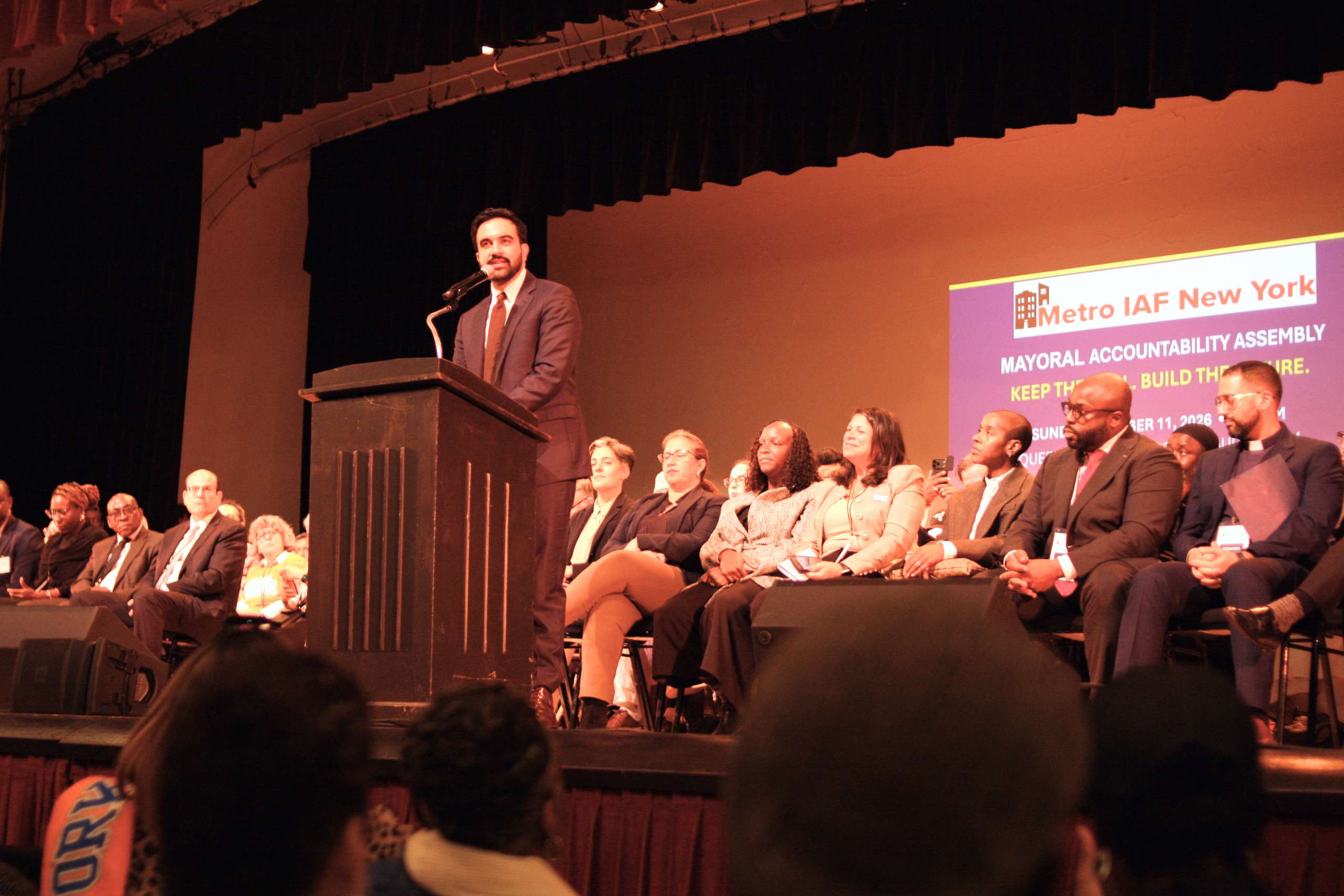
Jessenia Casiano, a resident of NYCHA’s Pennsylvania-Wortman Houses in Brooklyn, was among the more than 2,000 public housing residents and community and religious leaders who gathered at the Queens College auditorium for an “accountability assembly,” with Mayor Zohran Mamdani.
The attendees were there to press him on four community priorities they collectively raised, and Casiano said she arrived with a clear message for the mayor: “Don’t forget Penn-Wortman, Boulevard or Linden Houses,” she said. “Come back to us.”
Thousands of attendees from diverse neighborhoods and faiths braved a rainy commute to Flushing on Oct. 11 for the assembly, organized by advocacy group Metro IAF, to hold the mayor accountable on promises he made to build affordable housing and improve public safety. Metro IAF held a similar assembly last year with then-mayoral candidates Mamdani and former Gov. Andrew Cuomo.
At this year’s assembly, the mayor agreed to take action on all of the priorities the group raised: creating more mental health crisis centers, building 20,000 affordable homes each year, and expanding models for public housing residents to report critical repair needs.
“I want to acknowledge that the progress we’ve been able to make on this has been because of Metro IAF leaders coming into City Hall with ideas, with drive, with commitment, and that has helped us get to this point,” Mamdani told the crowd.
The group also got the mayor to commit to investigating what residents describe as inadequate repair work in three public housing developments that have converted from traditional public housing into a public-private operating model.
The mayor told attendees that his administration is “committed to working with NYCHA,” to hold private partners accountable, adding, “and we are committed specifically to also doing so with regards to the performance issues at Linden, Penn-Wortman, and at Boulevard.”
“That’s all we needed,” Casiano said. “This is the first time someone in leadership and in authority has decided to work with us in that way, and we’re willing to work with the mayor.”
Holding private partners accountable for unfulfilled repairs
For about a decade, the city has been using the Permanent Affordability Commitment Together (PACT) program to turn thousands of public housing developments over to private developers as a means to raise repair money.
Under the model, the New York City Housing Authority (NYCHA) continues to own the buildings and land, while private management companies take on operations and fund extensive repairs—upgrading heating, plumbing and elevators, and renovating apartments, common areas and windows.
Mamdani allocated $5.6 billion for NYCHA in his housing plan released in May, and just less than half of that will funnel into two funding tools, namely the PACT program and the Public Housing Preservation Trust, that the housing authority uses to convert its developments from traditional public housing under the government’s Section 9 program to another federal program called Section 8.
This enables the housing authority to receive up to twice as much in federal subsidies. The PACT program on-boards private partners, while the Trust is a public entity that can issue bonds to raise funds, and was created in 2022.
The strategy has faced opposition from NYCHA residents who oppose the involvement of private developers in public housing, and Mamdani’s support of PACT has earned him the ire of some tenant leaders.
NYCHA, however, refers to the PACT program as one of its “most successful tools for modernizing its aging housing stock and providing a better quality of life for NYCHA residents,” as it enables the housing authority to qualify for larger federal subsidies, and also secure funds to repair its aging buildings—where decades of government underfunding has fueled deteriorating conditions.
Casiano said she moved into Pennsylvania-Wortman Houses about six years ago to support her grandmother, a resident of 35 years, who suffered an accident.
“We’re not against PACT, but we’re here today because it has to be done right,” Casiano told City Limits.
Casiano serves as a community leader for an advocacy group affiliated with Metro IAF, called East Brooklyn Congregations (EBC), which has been organizing residents around conditions at three East New York public housing developments—Pennsylvania-Wortman Houses, Boulevard Houses, and Linden Houses—that were converted to PACT around 2021.
EBC complains of “a lack of transparency regarding rehabilitation plans,” between residents and the private partners now operating the buildings, “especially in areas like plumbing, where tenants are seeing leaks and other negative consequences,” the group said in a statement.
A spokesperson for C+C Apartment Management, which took on day-to-day operations at Pennsylvania-Wortman and Linden Houses, told City Limits that “the well-being of…residents has been the top priority,” since the group took over management, and that completed repairs include new elevators, roofs, security systems and upgraded common areas.
Despite those repairs, Casiano said, “mold is growing extensively in the apartments,” and during especially bad leaks, she added, “people hold umbrellas up.”
Casiano also said she acknowledges how the development’s private managers, which also include Dantes Partners, L+M Development Partners, SMJ Development, have worked with EBC and Metro IAF to improve other concerns residents raised, like extra security measures and cameras.
“The C+C Apartment Management team regularly meets with the Linden and Penn-Wortman Tenant Associations, as well as EBC leaders and NYCHA representatives, to collaborate on ways to improve building services and resident living conditions,” said a spokesperson for the management company.
“While we have made meaningful progress addressing some important areas of concern, we are committed to making additional improvements across the buildings,” the spokesperson added. Those improvements include bringing on additional senior staff, implementing new maintenance procedures and bringing on a specialist to troubleshoot building operating systems.
A spokesperson for Boulevard Together Management, a collective of developers, construction and property management companies that work together to repair and oversee Boulevard Houses, told City Limits that it “takes resident concerns seriously and remains committed to providing safe, well-maintained homes for Boulevard Houses.”
“Maintenance teams respond to all plumbing-related work orders within 24 hours, with follow-up repairs and additional work scheduled to ensure the issue is fully resolved and prevent recurrence,” the spokesperson said.
From July to September this year, about 3 percent of total work orders at the development were leak-related, while about 1 percent were mold-related. The management team also implemented a 24-hour call center and online reporting system about a year ago to streamline how residents submit and track work orders.
Private partners completed new construction and repairs at Linden and Pennsylvania-Wortman Houses around December 2025, while renovations at Boulevard Houses wrapped up in 2024.
At the assembly, Mamdani agreed to seek accountability from NYCHA and its private partners on those issues—across PACT-converted developments in general, and at those specific three public housing developments.

Reporting critical repairs
The mayor also announced a date for when public housing residents can expect to access an expanded program to report urgent and long-standing repairs needs, called the Critical Repairs Initiative (CRI). The mayor introduced the program in his housing plan in May, stating that residents who call the service can “expect clear communication and stronger case management to ensure that repairs are completed.”
It’s modeled off the Ombudsperson Call Center (OCC), a program launched in 2019 as part of a settlement in a class-action lawsuit where tenants sued the housing authority for unremediated mold infestations.
The OCC—which operates independently of NYCHA, and is overseen by a court-appointed attorney—has received more than 100,000 calls since its launch.
Residents can call the OCC to report leaks and mold, and many say it’s improved how quickly the housing authority responds to those complaints while also adding more accountability, cooperation and transparency to NYCHA’s several-step repair process.
The new CRI program will work similarly, but will accept reports of critical and longstanding repair needs beyond mold and leaks, including missing or unusable cabinets and fixtures, and major structural damage like holes, floor or ceiling damage.
Mamdani—who pledged to expand the OCC model while campaigning for mayor and included funding for it in his first budget deal—said the Critical Repairs Initiative will be ready for residents to use no later than June 30, 2027.
“It’s nice to see the promises Mamdani made during his campaign turn into reality,” Carolina Payero, a medical assistant who has lived in Baruch Houses for 13 years, told City Limits,
Payero, who lives in traditional Section 9 public housing that does not involve private company managers, spoke on stage about how delayed repairs to her bathroom caused plumbing issues, as images of a leaking pipe and a water damaged wall in her apartment were displayed behind her.
“We are seeing action from NYCHA from the OCC,” she said. “Our community needs to feel more safe, and to live without mold and leaks.”
She described the experience as her first time talking in front of thousands of people.
“As a woman and as an immigrant, to have the opportunity to raise my voice was a beautiful thing for me,” she told City Limits.
To reach the reporter behind this story, contact [email protected]. To reach the editor, contact [email protected]
Want to republish this story? Find City Limits’ reprint policy here.