


Share This Article
For Stephanie, a mom of three from Brooklyn, securing a home away from her former partner and abuser offered “the chance to breathe.” But rental assistance alone isn’t always enough, according to a new report, which calls for vouchers to come paired with “aftercare” support for families.
Stephanie, a self-described “single mom from Brooklyn,” who asked City Limits to withhold her full name over privacy and safety concerns, described securing a home away from her former partner and abuser as “the chance to breathe.”
“Being married to my abuser brought a myriad of difficulties and complexities,” she said, “and all of those things encompass who I am.”
“It’s disheartening when I look back at how much I tolerated,” she said, describing moments when she realized that speaking up about wanting to be involved in their shared finances and rental apartment lease often resulted in her partner escalating threats, breaking furniture, and at other times, assaulting her.
“He would throw dishes, or those metal children’s thermoses or destroy furniture,” she said of her former partner, who she is still in the process of divorcing, “and I lived with that for years.”
The COVID-19 pandemic triggered the federal government to create an emergency housing voucher (EHV) program in 2021, to provide rental assistance to thousands of people across the country who were struggling to make rent. Of the 70,000 vouchers issued nationally, about 1,168 were reserved for individuals and families in New York City who were fleeing household abuse, like Stephanie.
The vouchers were originally expected to provide rental assistance for 10 years, but in March of last year, the federal government announced it would end funding to the program early, by the end of 2026. Since then, the New York City Housing Authority, which administers over 5,200 of those vouchers, has been working closely with the government to identify alternative housing options for EHV holders—a process that has been rife with developments that require everyone involved to be prepared for quick pivots in their plans. Last week, Congress announced more funding to assist people whose EHVs are expiring.
For survivors like Stephanie, the rental assistance has been a lifeline.
“The pandemic allowed me to look and say, maybe we can be free from this apartment,” Stephanie said, and about a year after she secured the emergency voucher from a family center in Brooklyn, she finally found a home that would work for her and her three children, who she lovingly calls her “chickies” because of the way they would trail behind her when they were younger.
“I am bragging about those chickies because they are just as much as a survivor as I am,” Stephanie said, adding, “They still have to interact with their abuser, who is their father, but they’ve been able to heal in such a way where they were not when we were not in a safe home.”
After securing the emergency voucher, Stephanie was connected to an “aftercare” program, run by New Destiny—a nonprofit that builds affordable housing, and provides social support for the city’s domestic violence survivors and their children. She believes the resources she received from that program “should last longer,” and “be open to everyone who needs it.”
New Destiny’s EHV Aftercare program provides one-on-one support to more than 500 survivors of intimate partner violence who hold EHVs. Participants receive up to nine months of “‘light touch’ case management services” and mental health support, including referrals for therapy and legal services, help navigating forms, and emotional support during events like divorce proceedings and custody battles.
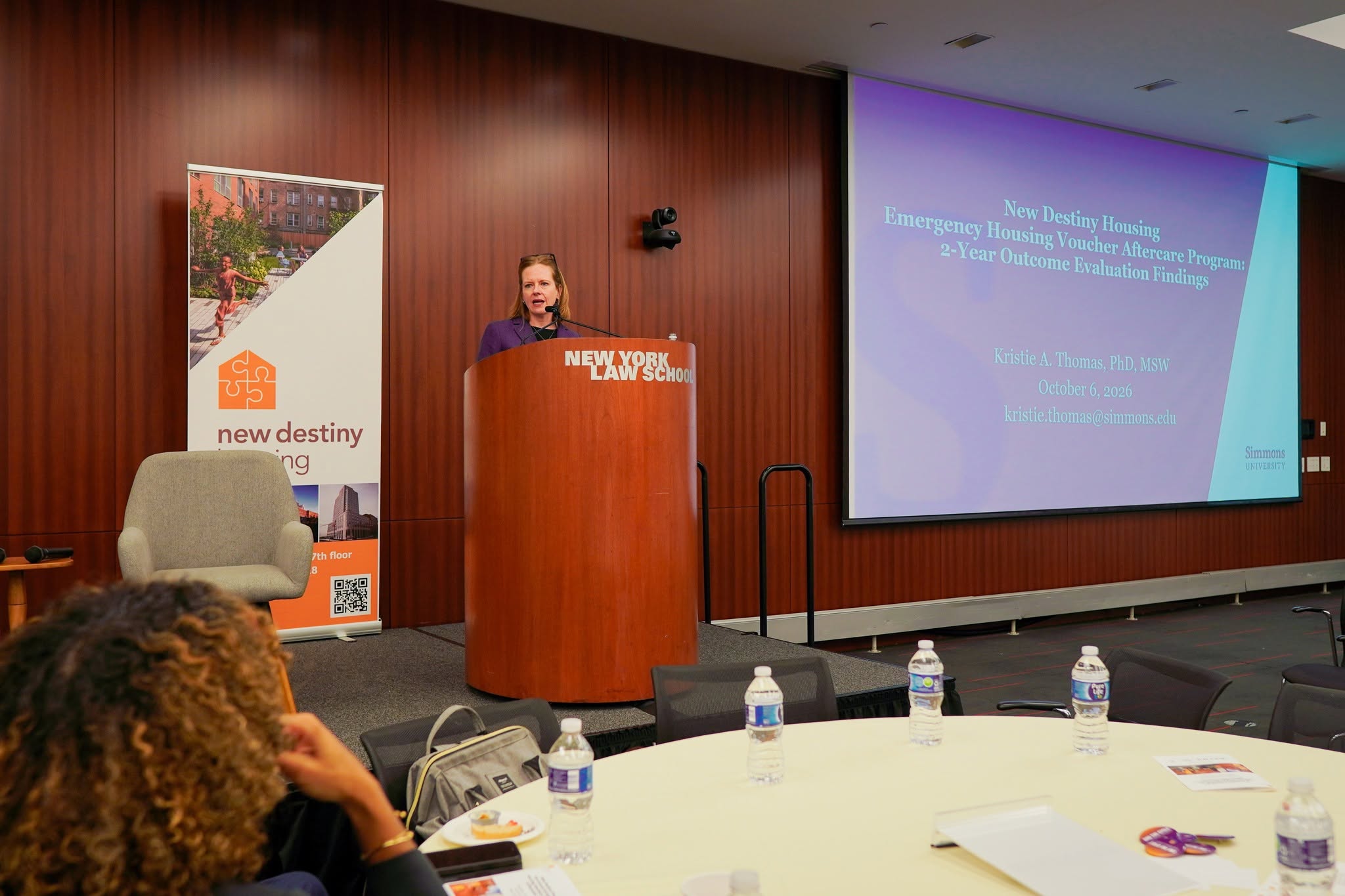
On Tuesday, New Destiny released findings from the second phase of an externally-conducted evaluation of the program, which aims to measure changes in participants’ housing and financial stability two years after they signed leases with their emergency subsidies, and over a year after they stopped receiving aftercare support services. It also explores the impact of both the voucher and the aftercare program on survivors’ children and their mental health.
Out of 224 participants who completed the group’s two-year evaluation, almost all retained their housing subsidy; the majority had not experienced intimate partner violence since moving into their new place with the voucher, and most were engaged with formal services for housing, health and financial needs.
According to 2018 city estimates, about 40 percent of families cited fleeing domestic violence as their reason for entering a homeless shelter, which was “by far the single largest cause of homelessness,” according to the city’s comptroller. In 2025, more than 12,000 people spent time in the city’s domestic violence shelters—more than 6,800 of them children.
“The intersection of domestic violence and housing instability creates a situation of survival-focused coping, where you are essentially dealing with massive crises that cause a lot of problems in every domain of your life, your mental health, your physical health, your employment, your social support,” said Kristie Thomas, an associate dean at Simmons University who led the evaluation.
She described New Destiny’s aftercare program, which provides individualized support, as “having a team that helps you troubleshoot the different challenges that come up,” offering a comparison to the arcade game whack-a-mole.
“Maybe you’ve hit housing, but then all these other things keep coming up that makes you feel like your finger is always on the dam of other challenges, and you need help,” Thomas said.
Thomas conducted her evaluation of New Destiny’s program using a reflexive control group, “which means you’re comparing someone to themselves,” as opposed to a standardized control group that did not receive supportive services from New Destiny, she explained, citing the ethical concerns of withholding supportive services from vulnerable populations.
The evaluation measured several outcomes at three-month, nine-month and two-year timepoints, including housing and financial stability, subsidy retention, re-victimization rates, and housing satisfaction, and concluded in September 2025.
It measured housing stability using metrics and questions laid out by Housing Instability Index, a 10-item assessment tool that’s been used by the government to examine the intersection between partner violence and housing, and measured financial stability using questions from the Family Resource Scale, a 30-item questionnaire that measures how financially stable households are.
Of the 522 participants, about 373 people voluntarily agreed to complete the series of surveys to evaluate the program. Of those, 224 completed the final two-year follow up survey. “For a population of people who have a lot going on in their life,” Thomas said, “that’s a very good response rate.”
Like Stephanie, the majority of participants, or almost 80 percent, remained in the unit they moved into using their voucher two years later, and nearly 99 percent kept their subsidy, according to the findings. The majority of participants also said they hadn’t experienced domestic violence since they moved in.
Despite the gains in housing and financial security, a sizable portion of the participants continued to struggle with financial instability—with about 40 percent reporting they continued to struggle “fairly” to “very” often to meet basic needs, pay utilities, and pay other bills.
Participants’ satisfaction with their housing was mixed, according to the evaluation. While more than half reported being satisfied with their housing situation, over 60 percent of participants said they would move if they could. Factors that often affected their satisfaction include having a unit with enough space, feeling safe from their former abuser, and having a responsive and respectful landlord.
In her evaluation, Thomas also qualitatively assessed how residents felt about the support they received from the voucher and the aftercare program.
One of those findings include “how profoundly grateful the participants are for these vouchers.” She described families who said having housing they felt safe in “allowed their kids to be a kid again,” and single parents who were able to receive custody of their kids because of help from the voucher.
“We have enough evidence to suggest that this program should be continued, replicated, all of that,” Thomas said.
The individualized support of aftercare programs can be paramount for survivors, she added, especially as other city agencies are “totally strapped as well” in managing the “folks who are in shelter and need to leave.”
The evaluation’s key recommendations include increasing funding for federal housing vouchers, calling on government offices to “embrace the mindset that housing vouchers are prevention.” It also recommends that other city agencies that distribute housing vouchers provide long term, individualized services designed to meet people where they are, and should expand beyond case management services to include mental health therapy.
A spokesperson from New Destiny told City Limits that the evaluation shows that “aftercare is an incredibly effective tool,” in helping people stay housed and rebuild their lives “after the twin traumas of homelessness and domestic violence.”
“New Destiny believes that it is critical for every voucher issued in New York to come paired with housing navigation and an aftercare component,” the spokesperson said, adding, “services aftercare provides will help break the cycle of homelessness and trauma that many families, especially those who have escaped domestic violence, face.”
The evaluation also sought to explore the impact of the voucher and support offered by the program on survivors’ children and their mental health. In general, over 70 percent of participants reported improvements in their children’ s mental health and school performance.
Stephanie described her family’s move away from her abuser as “the move that allowed my kids to shine.” She said her three children, aged 14, 12 and 10, have been thriving in school, with one receiving top marks in state exams and another who tested into an accelerated elementary school, she said.
“They are the brightest little chickies now,” she said, “and I’m so proud that they were able to heal.”
To reach the reporter behind this story, contact [email protected]. To reach the editor, contact [email protected]
Want to republish this story? Find City Limits’ reprint policy here.