


Share This Article
The lawsuit accuses the NYPD and NYCHA of violating residents’ rights by covertly using a free internet program to give police access to public housing surveillance cameras. The police department says the arrangement is a vital crime-fighting tool.
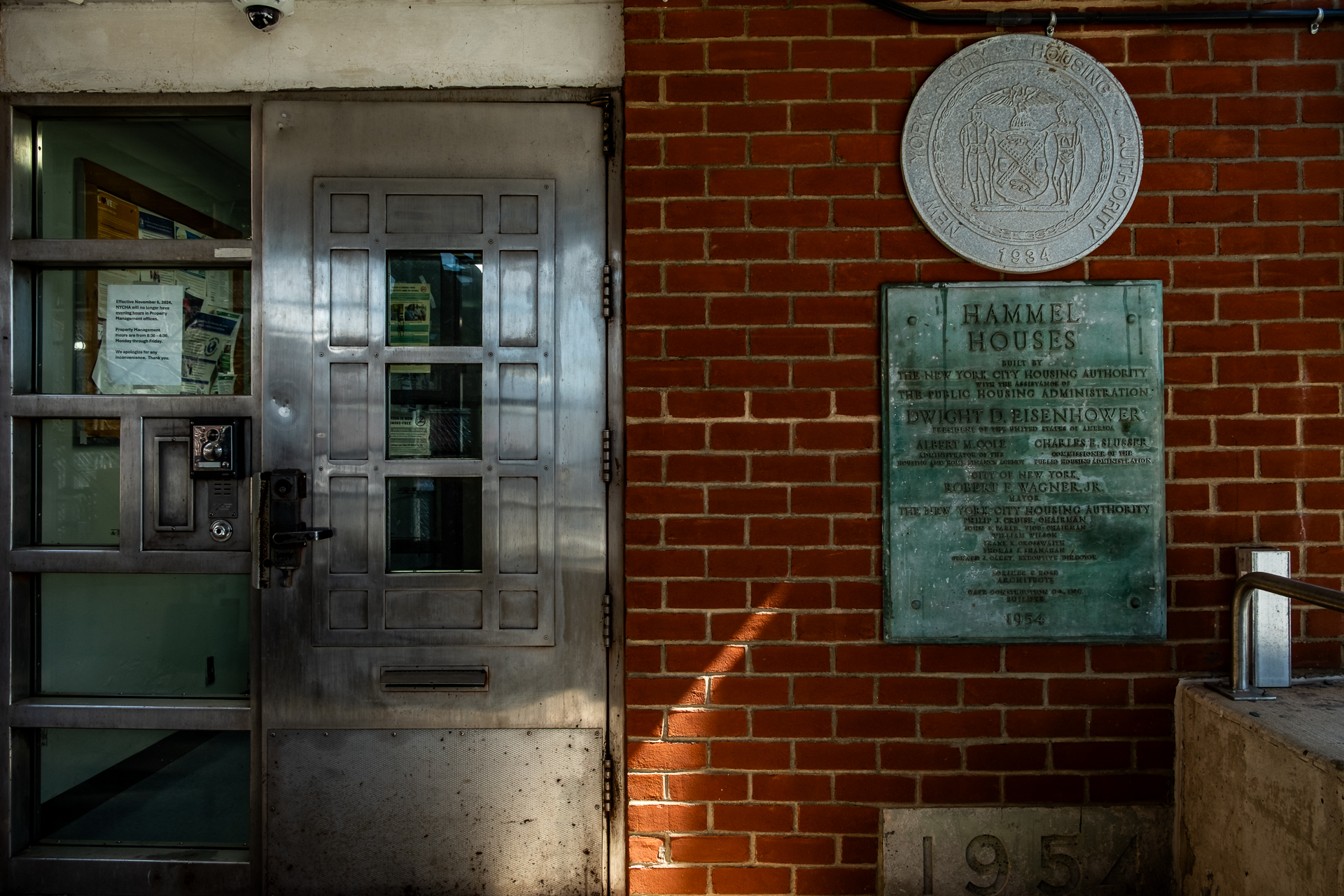
Two NYCHA tenant associations in Brooklyn accused the city of violating residents’ rights by covertly using a free internet program to give police access to public housing surveillance cameras, according to a lawsuit filed Thursday.
The suit, filed by Brooklyn Defender Services and law firm Beldock Levine & Hoffman LLP on behalf of tenants at the Tilden and Hughes Houses, takes aim at an agreement struck last year in which the housing authority allowed the NYPD real-time access to dozens of existing NYCHA camera feeds through Big Apple Connect, a city program that provides free internet in public housing.
Residents were not notified of the arrangement, which was first revealed by the news site New York Focus, and which officials plan to expand across all NYCHA developments—what the NYPD says will save police crucial time in investigating and solving crimes.
But the lawsuit called it “unlawfully discriminatory and an unreasonable intrusion on the privacy of low-income New Yorkers.”
“The cumulative effect of these disproportionate police surveillance and monitoring activities has been to place public housing residents, who are majority people of color, at a distinct and enduring socioeconomic disadvantage by making these residents hyper-visible to the NYPD,” the suit reads.
“Residents feel like they are being targeted because they do not pay as much rent as other people, and question why the same surveillance is not being implemented at private residences across the street,” the legal complaint continues. “They feel watched rather than supported.”
Both the NYPD and NYCHA declined to comment Friday, citing the ongoing litigation.
At a City Council hearing last September, NYPD officials pushed back against accusations that the cameras would be used to surveil tenants, saying the access through Big Apple Connect merely allows police to view footage more quickly in the case of a crime.
“Historically, detectives conducting investigations on NYCHA property have had to physically retrieve video footage from a NYCHA office, during business hours, on a DVD or thumb drive,” Inspector Anthony Mascia told lawmakers at the time.
The NYPD had already been able to tap into select NYCHA camera streams at 37 buildings for about a decade, he said, describing three separate incidents last year—a shooting, homicide, and an attempted murder—where that access was used to identify the perpetrators.
“This expansion of the department’s direct access to NYCHA cameras will significantly increase the speed and efficiency of our criminal investigations and will ultimately help reduce crime in NYCHA buildings,” Macia said.
At the same hearing, NYCHA Chief Operating Officer Eva Trimble said all of the housing authority’s cameras are outside of buildings or in common areas, “not pointing towards doors or any areas that have assumed privacy,” and that they aren’t monitored 24/7.
“Every single resident leader I ask for asks for additional cameras,” she said at the time.
But the tenants and their lawyers said the expansion gives the police tremendous surveillance capabilities, connecting cameras to the NYPD’s controversial Domain Awareness System (DAS), a crime-fighting and counter-terrorism tool that the lawsuit describes as “a vast repository of data collected from and about New Yorkers.”
“I believe this level of surveillance access is dangerous because it can become discriminatory and prejudicial to the people in our community. It can become pure harassment,” Gina Boatright, president of the Tilden Houses Tenant Association, said in a statement Friday.
“I object to NYCHA or law enforcement taking advantage of residents because that internet was provided free of charge. If Big Apple Connect is being used in this way, I would rather NYCHA take it back.”
Here’s what else happened this week in housing—
ICYMI, from City Limits:
- Political candidates often court the vote of NYCHA residents and tenant association leaders. But what do public housing residents find appealing in a candidate? Showing up, some told us.
- Here’s what we know so far about the Trump administration’s new “public charge” rule, which could impact future green card applicants who use certain government benefit programs (including housing assistance). But experts say the real aim is spreading fear and confusion.
- Many city government workers are struggling to afford housing in the city they serve, according to Robin Blair-Batte of the CWA 1180 union.
ICYMI, from other local newsrooms:
- Some City Council members are pushing back against Mayor Zohran Mandani’s effort to appoint the Department of City Planning’s John Mangin as new chair of the Board of Standards and Appeals, Politico reports. Mangin helped draft City Charter amendments, passed by voters last fall, which trimmed back some of the Council’s power when it comes to development decisions.
- New Yorkers looking to avoid the city’s new pied-à-terre tax on expensive second homes must show their tax returns to prove their primary residence—a process which Gov. Kathy Hochul says could help identify New Yorkers who’ve fraudulently filed taxes out of state, according to The City Reporter.
- The families of several Harlem residents who died during an outbreak of Legionnaires’ disease last year are suing the city, the Times reports.
To reach the editor, contact [email protected]
Want to republish this story? Find City Limits’ reprint policy here.