


Share This Article
Over 10 months last year, the city received 34,532 claims for stolen SNAP benefits, the vast majority of which—92.9 percent—weren’t reimbursed. The most were submitted by residents in East New York, Brooklyn a predominantly Black and Latino neighborhood with high food insecurity and high participation in SNAP.
Lea la versión en español aquí.
Last month, Makani Chester was getting ready to pay for her groceries at the supermarket register when she found out that her food benefits account didn’t have enough funds.
Somebody, somewhere, had stolen $1,400 from her Electronic Benefit Transfer (EBT) card, which helps her buy food for her five children. Once she logged into her account, it showed 26 transactions made at 4 a.m.—when few supermarkets are open—in several different places out of state.
Chester lives in East Flatbush, Brooklyn, and her account showed transactions hundreds of miles north of the city, in the little village of Brushton, located in Franklin County, near the Canadian border.
“It was devastating,” said Chester, 35. “I depend on that to feed my children.”
For several years, New York has been a hotspot for EBT “skimming”—when thieves use hidden devices to steal payment information after someone swipes their card. The state-administered EBT cards still don’t have security chips to protect users from this type of fraud, and victims have no recourse to recover the benefits.
Makani visited the Human Resources Administration (HRA), which handles all Supplemental Nutrition Assistance Program (SNAP) cases. She was informed that once the benefits were gone, they were gone forever: there was no way to get reimbursement, and there was no emergency support available, either.
“I struggled for a while: pantries after pantries,” Chester said. “Getting help from close family and friends, which was also a hassle because everybody has their own family to feed.”
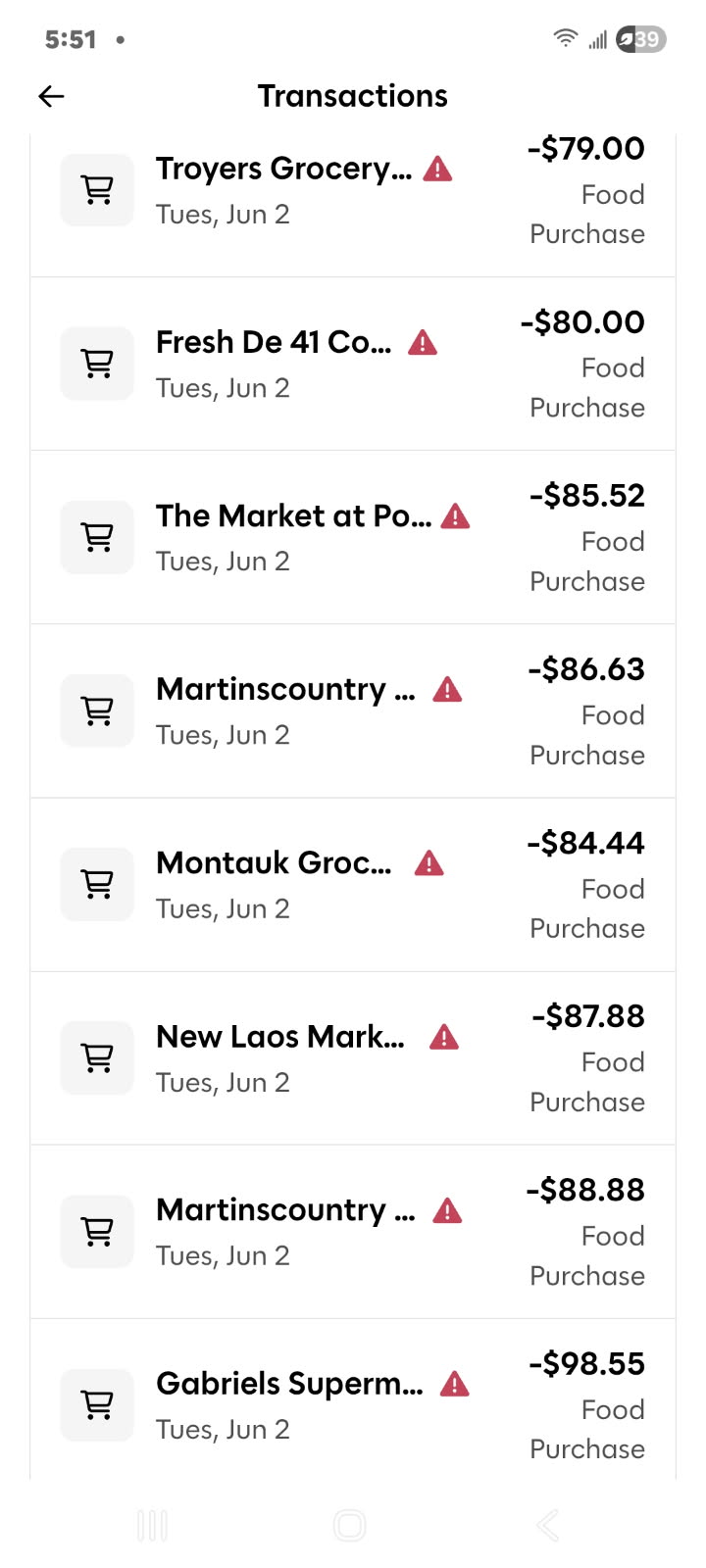
on Chester’s EBT card, which showed
purchases made hundreds of miles north
of the city.
Roughly 1.7 million people in the city benefit from SNAP, the federal program—also known as food stamps—designed to help low-income people afford groceries. A bit more than half a million of those city SNAP recipients are children.
However, it’s hard to know exactly how many households have had their EBT funds stolen by skimming or cloning in New York City. That’s partly because both the city and the state stopped keeping records of EBT thefts reported after Oct. 1, 2025, when the federal government stopped reimbursing skimming victims.
While Congress created a reimbursement period for stolen SNAP funds that ended on Dec. 20, 2024, what confused many people was that—for the next 10 months— victims could still request reimbursements for benefits if thefts occurred before that deadline.
City Limits obtained this data and mapped out where those claims were coming from, finding that the top zip codes were in predominantly Black and Latino neighborhoods.
The city’s Department of Social Services officials stressed repeatedly that the data offers a very limited snapshot of the overall skimming issue in the city—once people learned the federal replacement benefits had stopped, many stopped reporting the incidents. City officials admitted that the problem is much bigger than these figures show.
Per records, in the final week of 2024 and those first 10 months of 2025, people around the city self-reported losing about $17,136,654 in EBT funds to skimming.
Chester said she knew others who lost more than she did: a little over $2,000 for a family with eight kids. “She lost all of hers as well,” Chester said.
Abby Biberman, a public benefits attorney at New York Legal Assistance Group, said one of her clients lost thousands of dollars in stolen public benefits last year.*
Her client only used her EBT card once, after which her entire balance was drained in just five minutes—via multiple purchases in different states, charged to her account at 6 a.m.
That same summer, another client of Biberman’s won over $1,000 in retroactive SNAP benefits. But those were depleted as well.
None of the funds could be recovered.
“The bigger picture issue is just how little we value the rights and dignity of low-income people who are relying on these benefits, and how upsetting that is,” Biberman said.
Between Dec. 21, 2024, and Oct. 1, 2025, HRA received 34,532 total claims for replacement SNAP benefits, and the vast majority of those—92.9 percent—from January to the end of September, weren’t approved for reimbursement, meaning the thefts most likely occurred after the federal reimbursement period ended.
Brooklyn had the most theft reports (13,235) during those months, followed by Queens (8,770) and the Bronx (6,004).
| Monthly SNAP Amount Reported Stolen | ||
| Months | # of SNAP Claims | SNAP Amount Reported Stolen |
| December* 2024 | 1,792 | $789,340 |
| January 2025 | 5,765 | $2,725,157 |
| February 2025 | 3,238 | $1,705,369 |
| March 2025 | 2,256 | $1,181,050 |
| April 2025 | 4,145 | $2,120,253 |
| May 2025 | 5,612 | $2,858,670 |
| June 2025 | 3,982 | $1,930,185 |
| July 2025 | 2,406 | $1,236,466 |
| August 2025 | 2,391 | $1,142,154 |
| September 2025 | 2,937 | $1,448,010 |
| Total | 34,524 | $17,136,654 |
| * Between Dec. 21-31, 2024 | ||
| SNAP Amount Reported Stolen by Borough | ||
| Borough | # of SNAP Claims | SNAP Amount Reported Stolen |
| Bronx | 6,004 | $2,988,025 |
| Brooklyn | 13,235 | $6,628,173 |
| Manhattan | 3,723 | $1,766,972 |
| Queens | 8,770 | $4,403,714 |
| Staten Island | 1,000 | $560,430 |
| Note: Data doesn’t include claims and amounts for December 2024 | ||
Black and Latino New Yorkers ‘are being targeted‘
The ZIP code with the most theft claims during those 10 months was 11207 in East New York, Brooklyn, a predominantly Black and Latino neighborhood with high food insecurity and high participation in SNAP, according to the city.
Part of this ZIP code is represented by the head of the State Senate’s Committee on Social Services, Sen. Roxanne Persaud. The Committee oversees the Office of Temporary and Disability Assistance (OTDA), which administers the SNAP program statewide.
When asked about her district leading theft claims in the city, Persaud said it was consistent with her understanding.
“The issue has persisted since October 2025,” when the government stopped accepting reimbursement claims, Persaud explained, “including in May of this year, affecting those who missed the reimbursement reporting period.”
Assemblywoman Nikki Lucas, who also represents part of this zip code, said her office continuously deals with complaints about stolen EBT funds. “It is unacceptable that hardworking families, many of them Black and Latino are being targeted by criminals,” Lucas said.
Since 2023, state legislators tried unsuccessfully to pass laws that would require New York to upgrade to chip-secured EBT cards, proven in other states like California to offer stronger protection against skimming.
Only in 2025 did OTDA request proposals from vendors to modernize the old magnetic stripe cards, and recently this year finalized the contract with Fidelity Information Services (FIS) to provide the updated cards.
Gov. Kathy Hochul announced last week that about 2 million new cards would be issued to SNAP recipients across the state in the first quarter of 2027. According to Persaud, it will cost at least $16.8 million this year.
In the city, HRA has been partnering with community-based organizations to spread the word about skimming, explaining how it happens, how to spot skimming devices attached to card readers, and how to use the EBTedge app and website.
Last month, the Secret Service led an operation searching stores in three boroughs to uncover skimming devices used by criminals to drain accounts.
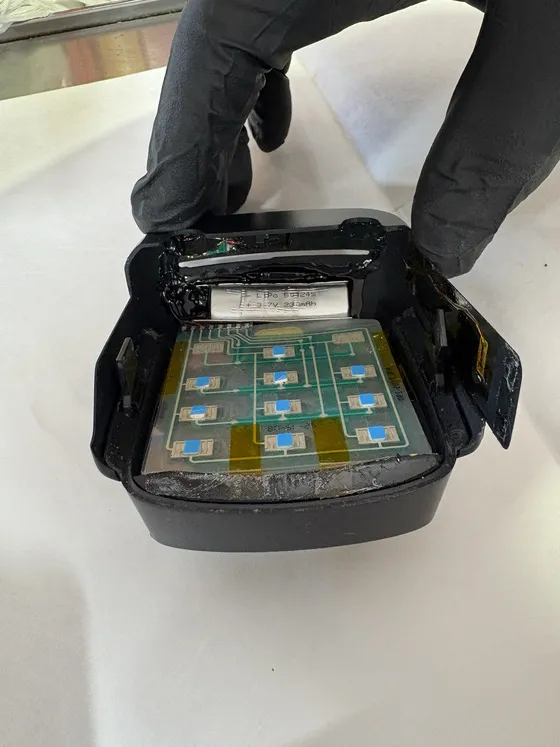
reader during a recent federal investigation,
according to the Secret Service.
When asked, the Secret Service didn’t provide the ZIP codes where the skimming devices were found during its latest operation. According to June’s press release, there were 15 devices discovered in Brooklyn, 10 in Queens, and nine in the Bronx —corresponding to the boroughs with the most reported thefts in the data collected last year.
“We see the most skimmers being found in EBT-accepting retailers that include small markets, bodegas, international markets, and convenience stores,” said Michael Peck, assistant special agent in charge of the Secret Service’s criminal investigative division.
Personnel from the New York City Department of Investigation participated in the operation, and its Commissioner, Nadia I. Shihata, said that skimming remains an important issue for the department.
“One of the most significant steps in preventing skimming will be the chip-enabled EBT cards that New York will begin issuing in early 2027, an effort that DOI has publicly supported,” Shihata said in a statement.
The majority of the top ZIP codes for theft claims were located in Brooklyn, closely followed by Queens (in neighborhoods like Jamaica, Briarwood and South Richmond Hill), with a few others scattered across the Bronx (in places like Mott Haven and Port Morris) and Manhattan (in East Harlem).
The second area with the highest number of claims was zip code 11212, which primarily covers the predominantly Black neighborhood of Brownsville.
“Even a casual look at the demographics shows the persistence of poverty, one of the city’s largest concentrations of public housing, and a comparatively high number of people who depend on EBT and SNAP,” said Assemblywoman Latrice Walker, who represents the area. “With the high number of benefits recipients and the vulnerabilities built into the system, it follows logically that New Yorkers in the 11212 ZIP code would be victimized more often.”
Walker said her office constantly receives complaints about EBT card thefts.
“The numbers represent cruelty, the theft of food from children, seniors, people with disabilities, and families in Brownsville who often don’t know where their next meal is coming from,” Walker said.
Part of the Assembly district represented by Social Services Committee Chair Maritza Davila ranked third in the number of reports. Davila expressed her concern, though said she was not surprised. The 11206 zip code covers parts of Williamsburg, Bushwick, and Bedford-Stuyvesant, and is roughly 39 percent white, and 34 percent Latino.
“My district includes many working families, seniors, and individuals with disabilities who rely on SNAP benefits to put food on the table. When those benefits are stolen, families are forced to make impossible choices between food, rent, medicine, and other basic necessities,” Davila said.
For years, state lawmakers have been unable to pass a bill that would create a state-run program to reimburse people’s stolen SNAP funds.
Brooklyn Community Services, which operates a “Food for Families” program that distributes free fresh produce and groceries across Brooklyn, noted a significant increase in the number of bags of groceries it has distributed, from 500 to nearly 1,000 per month, due to stolen benefits as well new federal rules for SNAP.
“It was not intended to backfill problems like this, and so we struggle to sort of keep track and keep pace with the problem, and this is all happening at the same time that people are losing their benefits for other reasons as well,” said Jodi Querbach, BCS’ chief operating officer.
Given that the new cards won’t be available until next year, advocates, city officials, and even local politicians have been holding educational sessions to urge SNAP participants to use all available security options (freezing their card when not in use, disabling out-of-state charges, changing PIN numbers constantly, etc.), while directing victims to nearby food pantries.
“If they [the state] needed to get something done, they needed to get something done ASAP because it’s still happening,” Chester said. “Something like this needs to be handled immediately.”
*This story was updated after publication to correct the description of Biberman’s first client; they did not win “Fair Hearing,” as previously stated.
To reach the reporter behind this story, contact [email protected]. To reach the editor, contact [email protected]
Want to republish this story? Find City Limits’ reprint policy here.