


Share This Article
A post-pandemic boom in e-commerce correlated with statewide health inequities that are hitting low-income communities the hardest, the report found. “The reason why a lot of these warehouses are placed where they are is based on histories of redlining,” its author told City Limits.
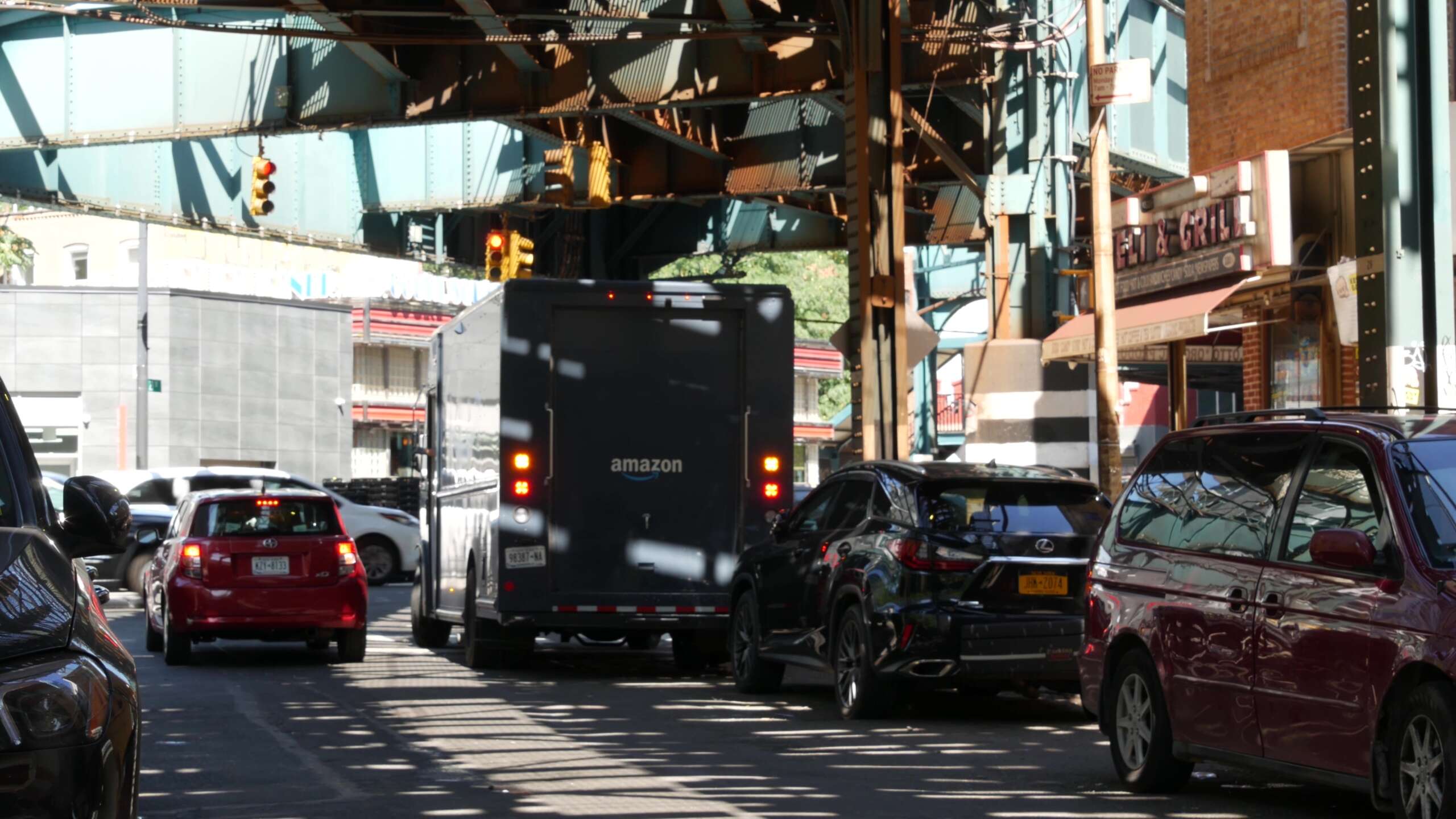
A new report published by the Environmental Defense Fund (EDF) details how rapid growth in warehouses and delivery truck trips across New York has increased fossil fuel emissions over the last five years—pollution that’s hitting lower-income communities of color the hardest.
Shifts in supply chains during the COVID-19 pandemic led to a massive expansion of warehouses, often used as last-mile logistics facilities for e-commerce, across the country. In New York State, EDF estimated nearly 2,900 warehouses—occupying 355 million square feet, or over 6,100 standard football fields—generate approximately 260,000 truck trips per day. Around a fifth of these warehouses and truck trips are in the New York City region.
Adverse health impacts from pollutants released from diesel truck trips are unevenly distributed across demographic groups, EDF’s analysis suggests. In New York City, low-income populations are 1.2 times more likely to live within half a mile of a warehouse, and 75 percent of warehouses are located within “disadvantaged communities” —census tracts that are already disproportionately burdened by climate change, as defined in state law.
Diesel trucks emit a significant amount of nitrous dioxide (NO2) and fine particulate matter (PM2.5), which have been linked to asthma and other public health consequences. The EDF report attributes approximately 13,500 new cases of pediatric asthma to NO2 pollution across the state.
“If current trends continue, New Yorkers will suffer more asthma cases, more exposure to polluted air, and more cardiovascular disease,” said Karla Sosa, one of the report’s authors, in a press release announcing the findings.
To approximate the downstream impacts of air pollution from warehouses and distribution facilities on New Yorkers, EDF used what it calls “proximity mapping” to integrate social, demographic and health information about communities located near these hubs of truck traffic.
In New York and the 10 other states EDF examined, “Black, Hispanic/Latino, Asian, Indigenous American and low-income people face the greatest risks from living near warehouses,” the report states.
“The reason why a lot of these warehouses are placed where they are is based on histories of redlining,” Sosa told City Limits. “It is a historical failing of the government to protect its people that creates situations where there are certain communities that are targeted on a recurring basis for these types of developments.”
In the south Brooklyn neighborhood of Red Hook, for example, Amazon opened two large facilities in 2021 and another in 2023, mere blocks away from NYCHA’s Red Hook Houses, Brooklyn’s largest public housing complex. Soon after, residents began to notice a decline in air quality, causing headaches and trouble breathing, according to published reports.
In 2023, Consumer Reports and The Guardian investigated pollution from e-commerce, installing traffic, air quality, and sound sensors in Red Hook to gather data. Preliminary results showed upticks in traffic on two-lane roads and elevated particulate matter in the air.

“Residents like myself feel hopeless in the face of all of the harms we endure: health impacts from polluting vehicles; traffic accidents and injuries—especially children who use our parks adjacent to a truck route,” Red Hook resident Andrea Sansom testified to members of the City Council that year during a hearing on the impacts of local truck traffic.
In response to questions from City Limits, an Amazon spokesperson pointed to efforts the company has made to green its operations, including delivering more goods by foot or via electric vehicles and e-cargo bikes.
“Across the U.S., we’ve rolled out more than 30,000 electric delivery vans and globally, we’ve reduced carbon emissions per shipped unit by 39 percent compared to 2019,” said Margaret Callahan, a spokesperson for Amazon. “We’ll continue investing in electrification and new technologies as we work to decarbonize our transportation fleet and meet our Climate Pledge goal to reach net-zero carbon across operations by 2040.”
EDF and ElectrifyNY, a coalition of environmental advocates, have endorsed the Clean Deliveries Act, a bill in the state legislature that would implement an “indirect source rule,” that would require warehouse operators to take action to offset their emissions. According to Sosa, an indirect source rule in southern California led companies to adopt rooftop solar, incorporate electric vehicles into their fleet, or simply reduce truck trips.
“Study after study confirms what neighbors in Red Hook and Sunset Park have known for years: the explosion of last-mile trucking has made our air more polluted and our streets less safe,” State Sen. Andrew Gounardes, who represents the South Brooklyn district that includes Red Hook and sponsors the Clean Deliveries Act, said in a statement.
“It’s working-class and middle-class families that bear the brunt of this public health crisis, and we owe it to them to work toward a safer, cleaner, fairer future,” the lawmaker added.
Gounardes also sponsored a bill that, like the Clean Deliveries Act, recently passed the Senate and would require the state’s Department of Environmental Conservation to analyze the role of permit approvals for warehouses in its existing community air quality study. The bill would also create a public listing of warehouses receiving permits.
Neither bill managed to pass the Assembly before Albany’s legislative session wrapped last week, meaning lawmakers will have to pick them up again in 2027.
At the city level, other policy interventions are reportedly reducing the adverse impacts of truck traffic. The NYC Department of Transportation (DOT) last week concluded the first stage of its Microhubs Pilot, where trucks can transfer deliveries onto sustainable modes of transport like cargo bikes and handcarts, at several sites across Manhattan.
DOT estimates that the pilot program replaced more than 3,000 truck trips in a year, reducing approximately nine grams of pollutants from the air. The pilot program is entering its second phase, with the city seeking more logistics companies to join as partners.
To reach the reporter behind this story, contact [email protected]. To reach the editor, contact [email protected]
Want to republish this story? Find City Limits’ reprint policy here.