


Share This Article
NYCHA told City Limits that it anticipates moving forward with the Permanent Affordability Commitment Together (PACT) program at Red Hook West. Tenant Association leader Karen Blondel hopes to leverage the initiative to advance an ambitious redevelopment plan—and lock in guarantees for tenants.
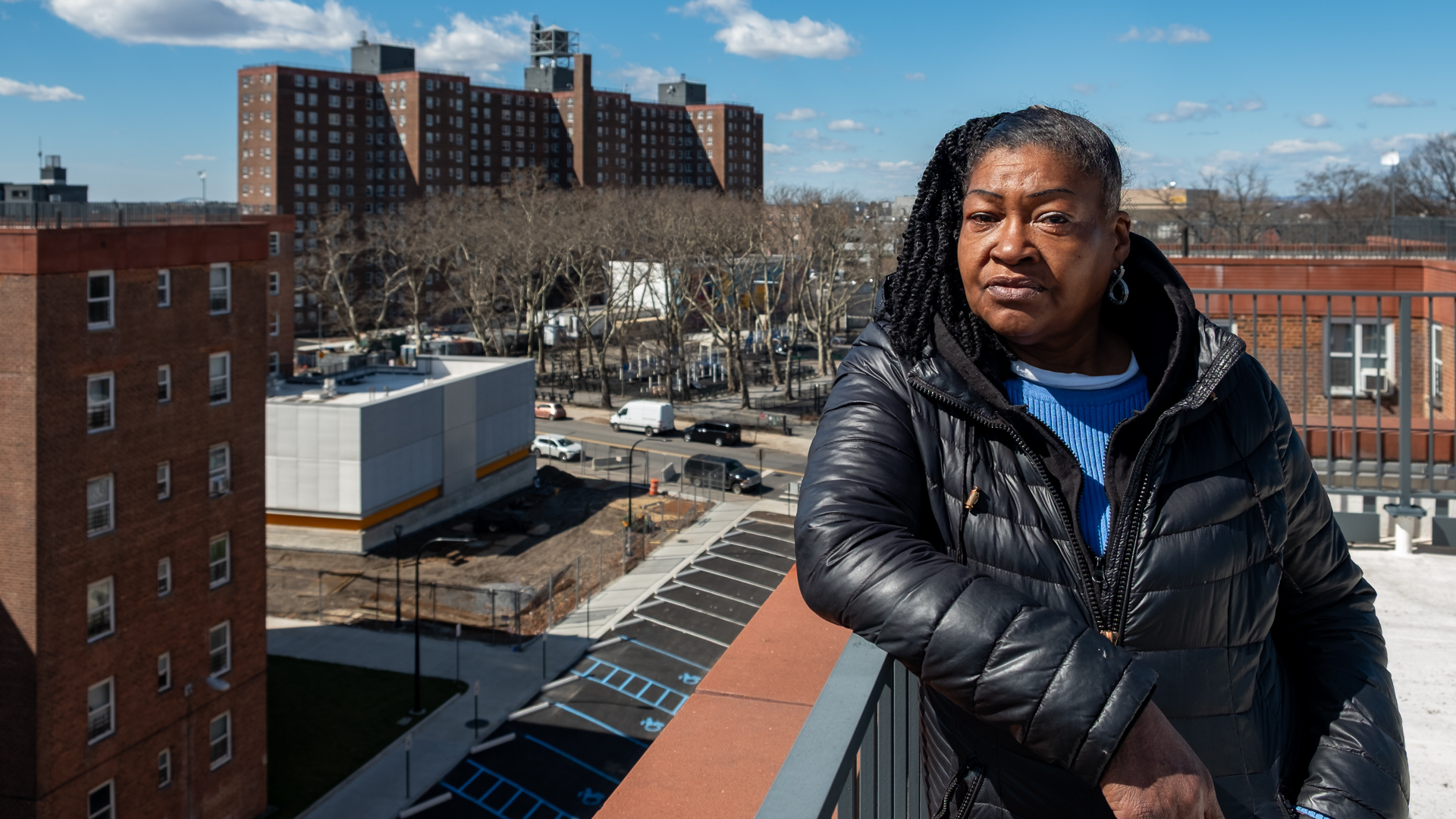
For Red Hook West Tenant Association President Karen Blondel, converting her public housing development to the Permanent Affordability Commitment Together (PACT) program is more than an opportunity to fund overdue renovations by bringing in private management. It’s a chance to realize a vision for the buildings she’s lived in for 50 years, one she’s been developing as a community organizer and civil engineer assistant that she says would increase the number of units, put new buildings on top of community space, and improve accessibility.*
Whether any developer would agree to her ambitious terms remains an open question. Whether she can get her fellow residents on board, and convince them their voices will continue to matter, is an even bigger one.
NYCHA confirmed to City Limits that it anticipates moving forward with PACT for Red Hook West, and is gearing up to issue a Request for Expressions of Interest from developers this summer—and while Blondel’s vision, and other tenants’ opinions, will be considered throughout the process, the housing authority is not committing to any of her specific proposals or their overall scale.
But the tenant leader is optimistic.
“This is an integrated idea. It’s not about just stabilizing the buildings. It’s about really creating an opportunity zone … that actually works to help residents go into self sufficiency. We have to get off of these campuses,” said Blondel, who moved into the development in 1982 as a 19 year-old single mother.
PACT is NYCHA’s implementation of a federal program where public housing authorities can lease their properties to private developers, who then collect market-rate rents—from tenants paying 30 percent of their income, and Section 8 vouchers covering the rest. In exchange, developers have to finance and coordinate massive renovations. They also have to bring in social service providers to assist residents suffering from financial hardship.
Blondel wants to both improve conditions at Red Hook West, and use PACT to expand services like financial counseling and workforce development that would help residents move out of NYCHA into private sector housing. The average NYCHA tenant lives there for 27 years, she noted, compared with six years for the average public housing resident nationally.
“This isn’t even about us. It’s about us having a space for future residents and folks who will need food, shelter, and love,” she added.
So far, NYCHA has transferred about 37,000 units across the city out of the underfunded federal Section 9 public housing program through PACT, a shift officials say has raised a collective $8.6 billion for repairs at those sites.
Residents at a handful of developments have gotten to vote on whether they want to join PACT, but the majority of sites were selected by NYCHA through a somewhat opaque process that considers the buildings’ physical needs and tenants’ desires—although previous conversions have not necessarily been in developments with the greatest repair needs, or where PACT is particularly popular.
While TA presidents have oftentimes supported conversions on behalf of tenants, many remain skeptical of PACT, hearing about higher eviction rates, poor management and low-quality repairs at some already converted developments.
But Blondel has more experience than most TA presidents, as well as free time, which she thinks will enable her to leverage the program to advance her redevelopment goals for Red Hook West—and guarantee tenants’ rights in the process.
In 2023, she quit her job and contacted NYCHA about her aspirations after receiving $200,000 for The David Prize, awarded to five New Yorkers per year with a vision to uplift their communities. The idea emerged two years earlier while she was a Loeb Fellow at The Harvard Graduate School of Design, where she was involved in designing the Public Housing Preservation Trust, established in 2022.
The Trust also funds renovations by moving public housing tenants to Section 8 vouchers, but instead keeps buildings under NYCHA management. Blondel sits on the Trust’s board, and while she supports the new model, she says it’s not ready yet to meet the needs of Red Hook West.
Past projects at other developments, she said, have already illustrated that PACT can improve the lives of NYCHA tenants, convincing her that it’s currently the best path to achieving her dream.
One of the problems, though, is that it’s not everyone’s dream: at least one advocacy group recently protested the prospect of PACT at Red Hook West, echoing similar disputes playing out at other NYCHA developments in recent years.

Major repairs—and debate about how to make them
Red Hook West is one of NYCHA’s oldest and biggest developments, containing 1,464 units with over $730 million needed for repairs in the next three years. The buildings suffer from cramped apartments, elevators that don’t reach the top floors, and temporary boilers standing in for outdated ones. The buildings are also susceptible to flooding due to their proximity to New York Bay, and have still not entirely recovered from damages they endured during 2012’s Hurricane Sandy.
Blondel’s plans would address what she sees as the root causes of these problems. One element of her proposal would demolish two three-story buildings on Wolcott Street and move residents to a new, taller building, which she proposes to construct on top of a community farm currently sitting between them.
Many of the other buildings would stay standing under her vision, but Blondel wants to add additional floors on top of them, increase square footage per apartment, and create new Single Room Occupancy apartments. If developers need extra funding to finance these proposals, she’s discussed allowing West 9th Street to cut through the development and selling the piece of land that would now be separated to the north to other private developers.
The idea isn’t resonating with everyone. “It seems like they’re trying to gentrify the projects,” said Ayanna Pullen, a tenant, in reaction to the plans.
Today, the buildings’ interiors show a history of inadequate funding, with layers of dirt-coated paint jobs intersecting over damaged walls. In 2024, residents spent months without cooking gas after construction workers hit a gas line. The buildings’ heating systems—alongside the plumbing and electricity—require fundamental upgrades.
Courtyards are exposed to the direct sun after NYCHA ripped out trees during Hurricane Sandy restoration efforts, and rats swarm the grass between them and the buildings. NYCHA has attempted some improvements, recently repaving some paths, but they’re already crumbling after a snowy and salty winter.
NYCHA says conditions will continue to deteriorate without PACT because the federal government refuses to fund public housing at previous levels, let alone adequately.
“It’s a very obvious, unfortunate, bipartisan mandate that Section 9 is not a priority, nor is it an investment that the federal government is willing to continue to make,” said Barbara Brancaccio, chief communications officer at NYCHA.
The city’s democratic socialist elected officials, who represent Red Hook West on both sides of City Hall, are also divided on how to support NYCHA tenants amidst this federal funding reality. Mayor Zohran Mamdani has embraced PACT, while Councilmember Alexa Avilés opposes it.
“I am not a fan of privatization, but I also respect the residents’ self determination to choose what they want and the disruptions they want to deal with. But I want them to get honest information and I think, unfortunately, what NYCHA does is shows the glossy kitchen and then says, ‘[PACT] or the status quo, which is to just keep your shitty apartment,'” said Avilés. “It’s a false choice and really disrespectful.”
PACT critics say the initiative removes tenants from the publicly-managed NYCHA system, reducing transparency around internal decisions, and prevents residents from transferring to NYCHA’s Section 9 developments (though there is a process for PACT residents to move to other PACT sites).
Some tenants also worry about whether they’ll have to be relocated during renovations and, if so, where and for how long. While NYCHA has stressed that all tenants have a guaranteed right to return—and will not have to pay for packing or moving expenses for temporary relocations—the moves have at times been controversial.
“When you move people for like six months, a lot of them don’t come back because now they start a new life,” said Gene Bray, a 71-year-old Red Hook West tenant who opposes PACT.
“It’s a weapon. It’s got nothing to do with fixing buildings. These people want this neighborhood,” he added, in reference to Red Hook’s surging real estate prices.
NYHCA previously only relocated tenants when it was necessary for the repair work, but have changed policies after their data showed resident complaints surge during construction, leading them to conclude that relocation while work is underway results in a better tenant experience.
“We’ve been moving to a model where we’re going to have tenants relocated on a temporary basis because now we’ve proven that this is not a displacement strategy. This is all about reinvestment in these communities,” said Jonathan Gouveia, executive vice president and chief real estate officer at NYCHA.
One other concern for residents is which private management companies they would end up with, as two were fired at other PACT developments for poor performance—first at Bushwicks Hope Gardens in 2024 then at a collection of Manhattan developments last January.
To give residents some control over the decision process, NYCHA will assemble a resident review committee at Red Hook West, which will consider proposals from companies vying to work with PACT. Committee members cannot speak publicly about the proposals, though, as NYCHA requires them to sign non-disclosure agreements, officials explained at a City Council oversight hearing last year.
For some residents who saw Red Hook West through its lowest moments, any management company that brings renovations would be an improvement compared to NYCHA’s current maintenance record.
“When I was growing up in the 70s, it was way better and cleaner and the people that worked for housing actually cared,” said Vakeen Warmsley, who is 53 and has lived in the buildings his whole life. “We need a new makeover. They keep fixing the outside, but they never fix the buildings. And that’s the major problem. I don’t think these buildings can hold up anymore.”
The changing voice of tenants
When PACT was first rolled out, tenants didn’t have a real voice in the conversions, spurring outcry. Gouveia says NYCHA learned from this and has since invested in meaningfully including tenants’ views.
This includes through elections at select campuses, where NYCHA asks residents to vote if they want to join PACT or the Trust or to remain in Section 9 (a vote is required by legislation that established the Trust, and must take place whenever it’s on the table as an option). Out of eight developments where residents got a chance to vote so far, only one—Randall Avenue-Balcom Avenue in the Bronx—has chosen PACT. During the most recent election in March, tenants at the Isaacs Houses chose to remain in traditional Section 9 public housing, and only 2 percent of voters there chose PACT.
Instead of a vote, residents at Red Hook West can express their opinions in a series of ongoing meetings the tenant association has organized with NYCHA and planners.
“Our neighbors in NYCHA deserve safe, dignified places to live, and they deserve to be in the driver’s seat on decisions that affect their homes,” said State Sen. Andrew Gounardes, who represents the district. “The best way for residents to have their voice heard, and to share questions or concerns, is to get involved and attend those meetings.”
These meetings are not a space to consider NYCHA’s other options, though. As far as the housing authority is concerned, residents have already made clear that they want PACT.
“Ideas [from the meetings] will go into a solicitation for a PACT partner and they’re not necessarily going to be hard requirements,” said Gouveia. “We’re going to see what the development community comes back with because, first and foremost, our goal is to get our residents of Red Hook West into high quality housing as quickly as possible.”
Tenant associations have the right to be involved in their buildings’ management per federal regulations, but their specific powers are vague. Blondel hopes to leverage hers to get concrete guarantees in the lease agreement NYCHA will sign with developers.
She wants protections against downsizing tenants’ apartments, which NYCHA requires when the members of a household change (someone with a three-bedroom apartment, for example, would be asked to move into a smaller unit if their children grow up and move out.) And she wants NYCHA to reserve apartments in other buildings converted to Section 8 for Red Hook West residents who want to move.
This attempt to receive upfront guarantees would be a first of its kind for a PACT conversion—though it could be an uphill battle, as some of Blondel’s demands fall outside the purview of a typical lease, and could conflict with federal regulations.
“The residents of Red Hook West should be encouraged to seek clarity on any questions they have about rights and protections and to talk about ways to memorialize any agreements they reach regarding specific repairs or activities at their development to ensure enforceability where needed,” said Lucy Newman, supervising attorney of the Legal Aid Society’s public housing unit.
It could also be difficult to find a developer who would agree to such strict and costly terms, especially if they cut into potential profits. And construction specifics aren’t usually decided on until after a lease is signed.
Blondel is willing to withdraw her support from PACT if she doesn’t receive these guarantees, though, loyal only to her vision for Red Hook West.
“When the [Request for Expression of Interest] goes out, it’s gonna have everything in it, including the kitchen sink,” she said. “Nobody might want this shit because I’m putting everything in there. Everything!”
NYCHA could just proceed without her requirements, though, as they are already preparing to publicize the conversion in the coming months. With or without her support, Red Hook West is likely bound for private management.
Tenants can contribute to the solicitation process at in-person and virtual meetings listed at redhookwestpact.com, including a community workshop scheduled for this Thursday, 4/23.
*A previous version of this story incorrectly identified Blondel as a civil engineer; she previously worked as a civil engineer assistant.
To reach the editor, contact [email protected]
Want to republish this story? Find City Limits’ reprint policy here.
2 Comments