


Share This Article
“If construction stalls, Chinatown would have a large construction site for a few more years. In the meantime, more families would endure the demeaning trip to Rikers, and more legally innocent people would be subjected to the hellish process of getting to court from Rikers.”
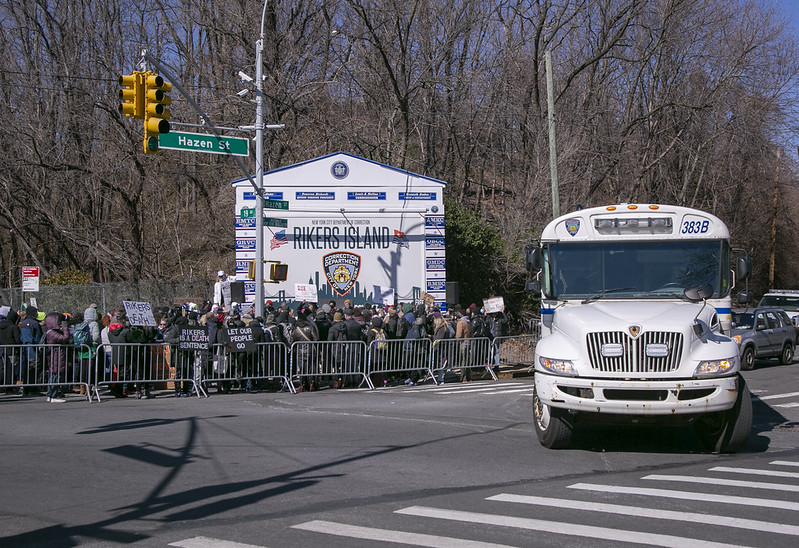

The first time I visited Rikers Island I was in my early 20s, traveling with my mother to visit my younger brother. The trip from the Lower East Side was grueling—from the train, to another train, to a bus, to the Department of Correction (DOC) visitor center, to wait for yet another bus to take us to the jail my brother was at—one of 10 on Rikers.
On top of the trip that felt deliberately exhausting, the way we were treated when we got there sent a clear message that the powers-that-be thought people on that island, and the people who love them, deserved isolation and harsh punishment.
That struck me as wrong in a few ways. First, more than 80 percent of people on Rikers aren’t even convicted. They’re just awaiting their day in court, which most of them could do from home if they could afford to pay bail. Second, people heal with the support of their community, and we are all better off when people coming back from Rikers—whatever they have done or not done—maintain their connections to family.
Furthermore, whatever pre-judgement has been passed on people who are in jail, there are New Yorkers who love them and will make it our business to see them. Why should we be punished in the process?
I’ve traveled to Rikers many times over the years to visit family members, usually while they were struggling through mental health and substance use challenges. That place never gets any better. That’s why I am so excited to see New York City deliver on the historic promised of closing “Torture Island.”
But it’s not just closing the buildings that’s important to me—it’s ending our over-reliance on incarceration and transitioning to a borough-based jail system designed to treat people like people. At the same time, I’m worried that misguided and at times misleading opposition from a few advocacy groups could stall completion of the Manhattan jail, and extend the existence of Rikers. That would be a result that serves no one.
I have lived in lower Manhattan for more than 45 years, and have long been active in my community, from working with young people with disabilities, to chairing my community board, to fighting for racial justice. I know my neighbors are dealing with many challenges, and I know that we share some very tight spaces.
Large construction projects always have impacts in the community, and the city should do what they can to minimize those impacts. That includes using sound barriers and avoiding loud work during late night and early morning hours, paying the cost of independent monitoring, and providing support for local businesses. Another way the city can minimize the impacts of construction is by finishing projects as swiftly as possible, including the redesigned jail that is in progress to replace The Tombs.
Unfortunately, a proposal to move this jail to another site flies in the face of that goal. Starting a brand new land use approval and design process on any site, even a few blocks away, would delay completion (and therefore, the closure of Rikers) by years, and leave a huge vacant site on White Street for who knows how long.
An added complication with the proposed alternate site is that the federal government owns it, and there is no clear path or timeline for them to turn it over to the city. On top of all that, the suggested site isn’t next to the relevant courthouse, like the current site is (and The Tombs was). So detained people would be shuttled to court in vans, instead of escorted through an enclosed walkway—a worse result for them, and for local traffic.
For all of these reasons, Mayor Zohran Mamdani must stick with the plan to rebuild the Manhattan jail on the site of the previous one, next to the courthouse, where construction has already started, and work to complete the project sooner than the 2032 projected timeline.
Given how impractical and improbable a site relocation is, the most likely impact of entertaining that proposal is to prolong rather than stop the current construction. The same is true of a recent lawsuit—more delay, but no tangible benefit that I can see for Chinatown residents or the mass of New Yorkers.
If construction stalls, Chinatown would have a large construction site for a few more years. In the meantime, more families would endure the demeaning trip to Rikers, and more legally innocent people would be subjected to the hellish process of getting to court from Rikers (commonly known as ‘bullpen therapy’).
The jail’s price tag would also climb, not because of any improvements to the design, but just to shell out more money to a construction company. I would much rather see those extra dollars invested in the many needs my community has. I sincerely hope that lower Manhattan residents can come together to direct our efforts toward that goal. Closing Rikers can and should be an investment in all New Yorkers.
Alysha Lewis is a community activist and former chair of Community Board 3.