


Share This Article
“One of the best ways to protect and center workers is to ensure that jobs that will never be automated pay enough for workers to live comfortably.”

Workers are anxious, and for good reasons. The specter of AI looms, and they have questions: Will my job be here in five years? Will it be here next year? Can a robot replace me? What job will even be available to me if I lose this one?
Unlike prior periods of automation or job displacement, these anxieties cross all backgrounds and income levels, from high-income financial services workers to entry-level data entry employees, or even sophomores at CUNY hoping to land on their feet after graduation.
While it’s not yet clear which industries will be most impacted by AI, or how it will impact workers in those sectors, New York needs to find ways to inoculate its economy from AI-driven shocks.
One of the best ways to protect and center workers is to ensure that jobs that will never be automated pay enough for workers to live comfortably. Highest on that list are the human service workers who care for our loved ones as they age, our neighbors with developmental disabilities, and virtually every other vulnerable resident of New York.
Such vital work between a human caregiver and a human patient can never be, or at least should never be, automated. The unfortunate reality, though, is that these workers’ wages are stagnant, and not nearly enough, despite their importance and the difficult nature of their profession.
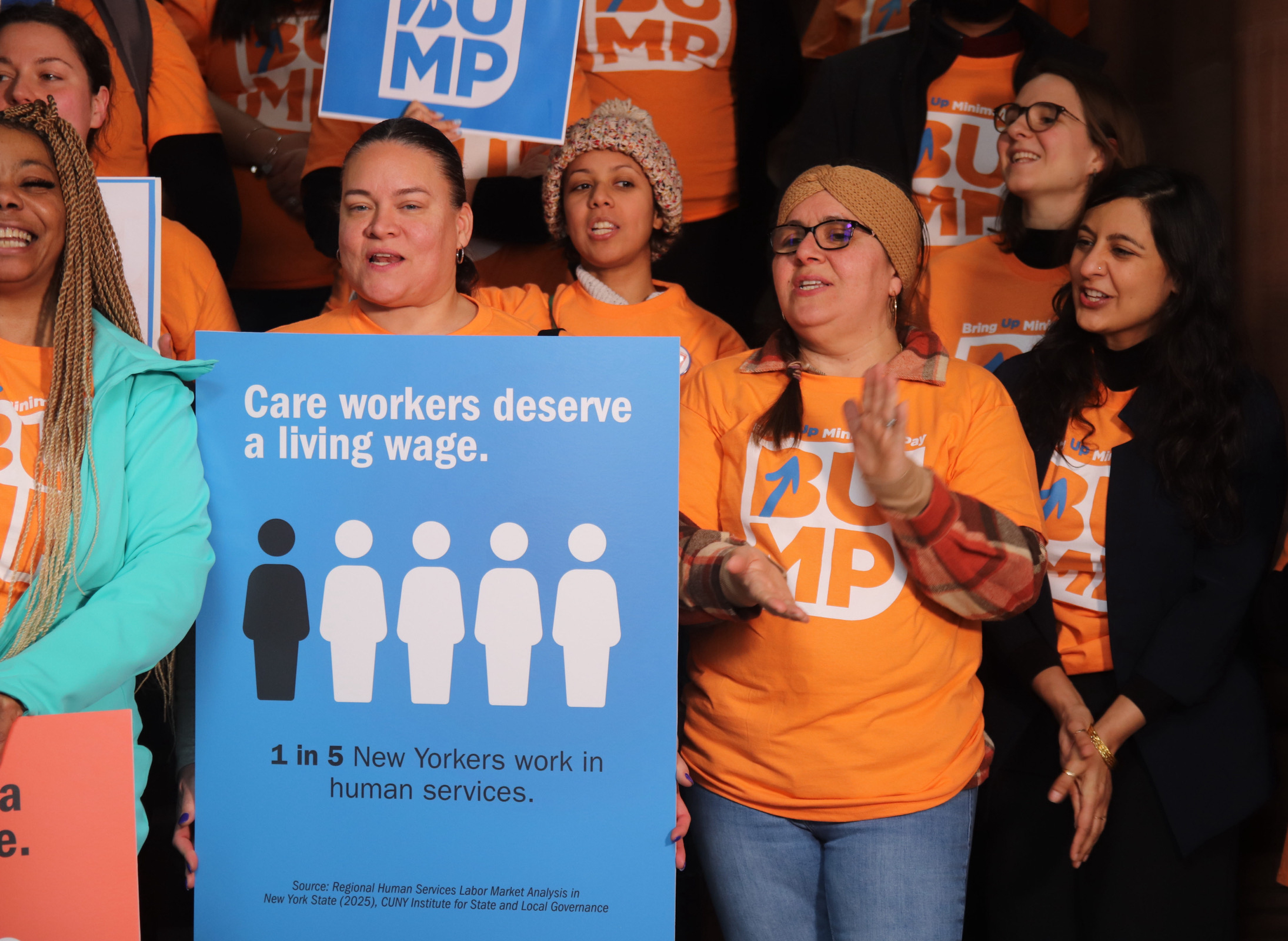
That is why I am proud to support the Bring Up Minimum Pay (BUMP) campaign, which is fighting for living wages for all human service workers supported by state government contracts by establishing a statewide $29 an hour wage floor with guaranteed cost-of-living increases. These wages are set through contracts and budgets between the government and the nonprofit entities employing the workers, and BUMP seeks statutory mandates for to increase these baseline rates.
Across New York, about 88 percent of all human service workers earn less than $60,000, considered the minimum needed to account for the cost of living statewide. In New York City alone, that means about 380,000 people do not earn enough to live in the boroughs despite providing in what in many cases is literally life-saving care for people we love. These workers represent some of the best New York, and they are being left behind.
This is a humanitarian crisis that we have a moral obligation to end. And the urgency is magnified even more by the fact that the government is a key contributor. Expecting more and more from workers while maintaining poverty wages does not comport with where these contracts need to be.
With the looming AI crisis that is coming, it is more important than ever before to ensure that jobs requiring human ingenuity and compassion pay well enough to be a viable option for New Yorkers. That’s not just limited to human services, though it’s a crucial part of the equation.
We are living through a moment of great change for New York. The Mamdani administration is bringing a new approach to economic development and economic justice —one where workers are centered and where good jobs pay fair and livable wages. Statewide campaigns like BUMP are using similar logic to address big wrongs.
Centering and lifting workers is the right approach and requires more hard work and advocacy by public officials, workers themselves, and the organizations that champion them. We all share the common goals of better wages, workforce development, reimagined economic training programs, and new conceptions of lifelong worker education.
CWE has been doing this work for decades by connecting New Yorkers to training, education, childcare, and employment. This is essential infrastructure. After all, no society can function equitably if individuals are excluded from stable employment, education, or meaningful pathways for advancement.
We all have a role to play in creating a more equitable and just New York. As we look to future-proof our economy for working people, we cannot forget the most important element of all, and something no robot or LLM can replace: the human touch.
Marco A.Carrión is president of the Consortium for Worker Education, the workforce development arm of the New York City Central Labor Council, and a member of the BUMP campaign.