


Share This Article
“Short-term rental income was, for many of these families, not a luxury. It was the margin between keeping the house and losing it. Local Law 18 closed that door, and the people who closed it are now waving away 57,000 empty apartments as statistical noise.”
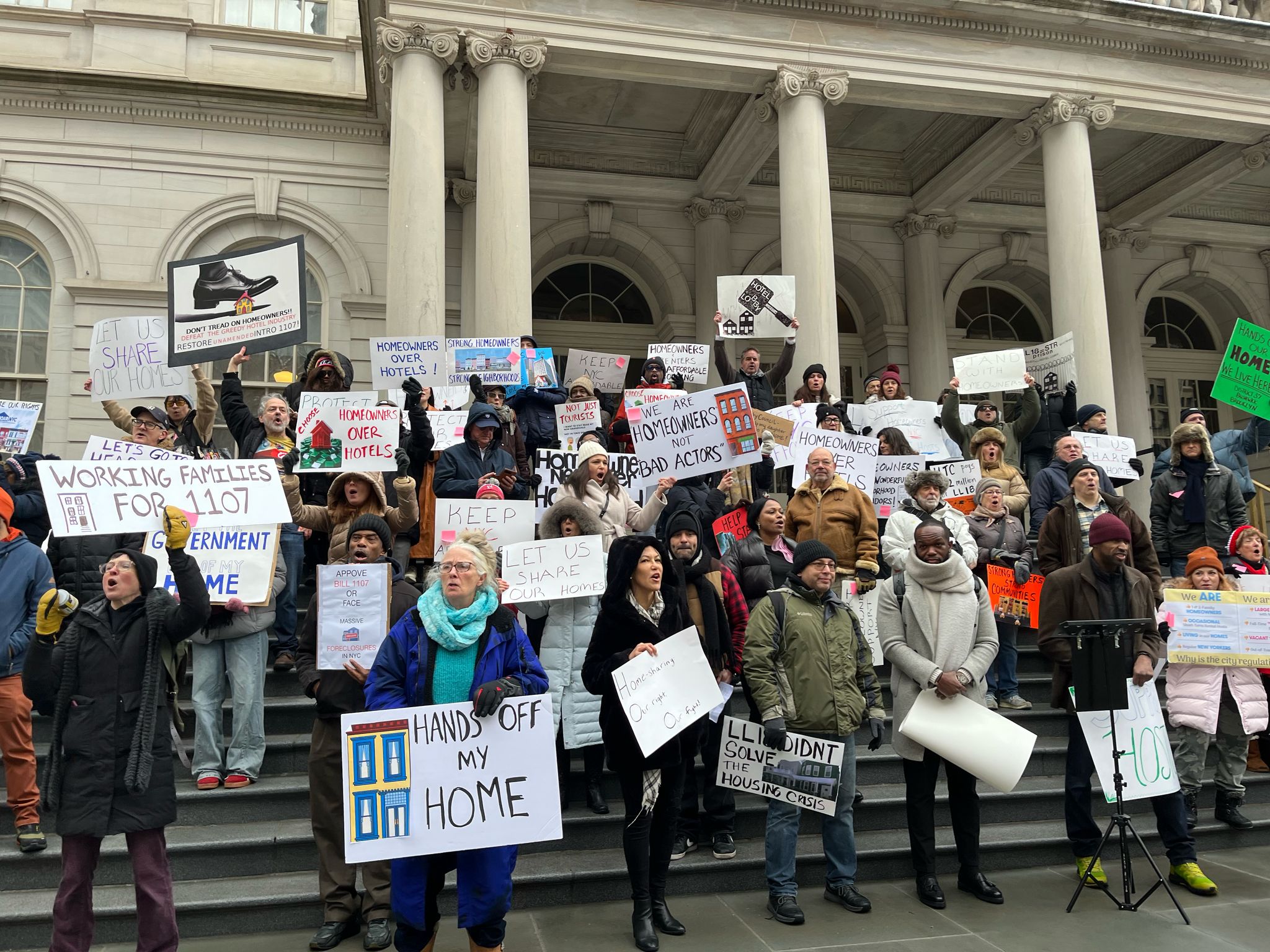

Every indicator in New York City’s housing market is pointing in the wrong direction.
Rents are at historic highs. Foreclosure notices are climbing in Black and brown neighborhoods that never fully recovered from the last crisis. Deed theft, the predatory stripping of generational wealth from families who built their equity over decades, continues to devastate communities from Brownsville to Jamaica.
On top of all these factors, there were more than 57,000 rent stabilized apartments sitting completely empty as of April last year. That number grew by 8,000 units in a single year, with the sharpest increases hitting Brooklyn and Queens hardest.
Brooklyn and Queens. My neighborhoods. Your neighborhoods.
You would think that news of 57,000 empty affordable apartments in the middle of a housing emergency would produce outrage, emergency hearings, and demands for accountability. Instead, New Yorkers got a collective shrug from opinion leaders.
Read that again: 57,000 families could be housed in those apartments. Households currently paying market rent, doubled up, couch surfing, or one missed paycheck from the street, could have relief. And silence from the city’s housing leadership, activists and coalitions.
From my experience having been chair of the Subcommittee on Affordable Housing in the Assembly, that is not advocacy. That is surrender.
These are the same voices, the same institutions, the same political class that successfully lobbied to effectively ban short term rentals in New York City through Local Law 18. At its peak, Airbnb had roughly 20,000 listings in New York City, nearly a third the number of apartments currently sitting vacant and padlocked in the rent stabilized system. The campaign against those listings was relentless, loud, and wrapped in the language of affordability and housing justice.
Where is that energy now?
Where are the press conferences about landlords warehousing stabilized units while families sleep in shelters? Where is the legislation with teeth? Where is the outrage that was apparently plentiful when a Black homeowner in Bed Stuy wanted to rent out her spare bedroom to make ends meet?
Because that is exactly who Local Law 18 hit hardest. Not the corporate bad actors. Not the hedge funds. The struggling homeowner, disproportionately Black, disproportionately in Brooklyn and Queens, who used their home as a small economic engine to survive in a city that grows more expensive by the month.
Those families were told their activity was destabilizing the housing market. Those families were fined, delisted, and legislated out of a livelihood. And now we learn that 57,000 stabilized units are sitting empty while rents spiral and foreclosures mount, and the response from housing advocates is essentially: that’s just how big numbers work.
This is not sound policy. This is politics. And the communities paying the price know the difference.
I have spoken with homeowners across Central Brooklyn who are barely holding on. They bought their homes, sometimes one generation removed from the Great Migration, and they have watched the equity they built become both their greatest asset and their greatest vulnerability. Predatory lenders, deed theft schemes, and rising property taxes all circle that equity like wolves.
Short-term rental income was, for many of these families, not a luxury. It was the margin between keeping the house and losing it. Local Law 18 closed that door, and the people who closed it are now waving away 57,000 empty apartments as statistical noise.
Everyone in this fight knows what needs to happen but will not say it out loud: Local Law 18 needs reform. Common sense reform. The kind that distinguishes between an investor running a ghost hotel and a homeowner renting a room. The kind that actually targets bad actors instead of penalizing the most economically vulnerable property owners in the city.
I hear it in private conversations with elected officials, with housing attorneys, with planners. The consensus is there. The political will is not, because the same advocacy groups and political donors who pushed the original law are still in the room, and nobody wants to take their call.
What this moment requires is courage, not calculation.
Every month that passes with 57,000 empty stabilized apartments is a month of families in crisis, of shelter costs ballooning, of neighborhoods destabilizing. Every month that Local Law 18 remains unreformed is another month a Black homeowner in Flatbush or Hollis faces impossible choices that wealthier New Yorkers simply never have to make.
You cannot ban the small and ignore the large. You cannot mobilize armies of lobbyists against a homeowner’s spare bedroom while shrugging at tens of thousands of warehoused affordable units. You cannot claim to stand for housing justice and then tell 57,000 families worth of empty apartments that the math just works out this way.
The hypocrisy has to stop. Politics have to give way to people. And the officials and advocates who have the power to fix this, who know what needs to be done, have to decide which side they are actually on.
Because from where I stand, in the communities I have served for decades, it is very clear who is being left out in the cold.
Dr. Annette Robinson is a former member of both the State Assembly and City Council in Brooklyn.
3 Comments
Cip
This is a pretty amazing rant. How about we just get people into these empty apartments instead of veering off about airbnbs?????
Tom Cayler
Dear Dr. Robinson:
All LL 18 does is require “hosts” to register w/ the City, as does any business in the NYC, and comply w/ all City and State Laws. There are 3000 legal STRs in the City. Many of whom benefited from the WC and all of whom can make extra income by “sharing” their spare bedrooms. Sharing spare bedrooms is legal in NYC under LL 18.
Registration is easy.
Since you seem confused about the law, as, I assume, Airbnb explained it to you, reach out to me, I’m not hard to find, and I’ll go over it with you. I wrote the first draft of LL 18. I know it pretty well.
FYI, LL 18 was written and passed by Housing Advocates, not an army of lobbyist.
Airbnb employs that army, not us.
Tom Cayler
Coalition Against Illegal Hotels
Hell’s Kitchen, NYC
Doumey Ihn
Cool chat gpt rant. Any original ideas?