


Share This Article
New York City and State cut the ribbon Thursday on phase one of a 2,000 unit, 100 percent affordable housing development on a church parking lot in Brooklyn. Could church-owned housing projects see a resurrection in New York?
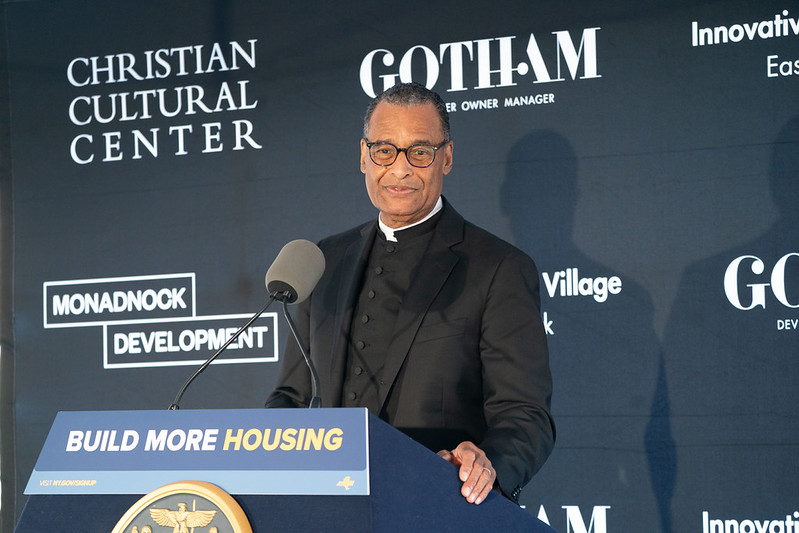
Yes in God’s backyard?
The city cut the ribbon on the first phase of a nearly 2,000 unit, 100 percent affordable housing development Thursday on a large East New York church parking lot.
The development, Innovative Urban Village, will see 10 apartment buildings, along with a new grocery story, child care center, and performing arts venue rise on the campus of the Christian Cultural Center at Flatlands and Pennsylvania avenues near Starrett City.
A half dozen local, state, and national elected officials gathered to celebrate the opening of the first phase of the project Thursday, which included 385 units of affordable housing.
But efforts to unlock more housing projects on land owned by churches and religious institutions have stalled in the state legislature—and may be due for resurrection.
Christian Cultural Center (CC) Pastor A.R. Bernard conceived the Urban Village project idea back in 2016, around when large swaths of East New York were rezoned.
“Today represents the manifestation of a dream held dear,” said Bill Wilkins, executive director of the Local Development Corporation of East New York.

Like many affordable housing projects, the road was bumpy. A collaboration between CCC and the Gotham Organization, the plan went through the city’s often contentious land use review process, called ULURP.
“Most developers promise the community the world when we’re going through ULURP. Then, after they get their approval, they start to back it up. Pastor Bernard didn’t back it up. He doubled down,” said Wilkins, who added that the project created construction jobs and job training for community members.
Years of community conversations focused on how to create those jobs, and new affordable housing, without causing gentrification and displacement. The zoning application passed the City Council in 2022.
“Because only God could touch the hearts of key individuals who had the power to say no, and some did. And I watched hearts change and transform,” added Bernard.
ULURP has been the target of recent reforms in New York City, like a new affordable housing fast track and affordable housing appeals board, which seek to speed up new projects and skirt City Council approval when local reps stand in the way of development.
“I think you’re seeing some of the shift in terms of a willingness to set statewide parameters, while still being respectful of local concerns, but not having local concerns be veto points in the construction of new affordable housing,” said Brooklyn State Sen. Andrew Gounardes in an interview.
A proposal from Gounardes in the state legislature, the Faith-Based Affordable Housing Act, would see new affordable housing projects on church land avoid ULURP altogether if developments include around 25 percent affordable housing.
Despite a multi-year push from pro-housing groups and a coalition of faith leaders, Gov. Kathy Hochul didn’t include the measure in her last two state budgets. The bill failed to advance out of committee, with some lawmakers citing concerns about preserving the character of existing church sites and enabling large developments.
At Thursday’s groundbreaking, the governor praised Innovative Urban Village.
“Let this be an inspiration to those other developers and other leaders and faith leaders and people who say it’s just too hard. It is not too hard,” Hochul said.
Gounardes and a coalition of pro-housing groups and faith leaders are hoping that encouragement will turn into action.
“That’s very encouraging to hear the governor say,” said Gounardes, who co-sponsored the legislation alongside Brooklyn Assemblymember Brian Cunningham.
“I would hope that as she’s thinking about her agenda for next year with housing, that the Faith-Based Affordable Housing Act can be a significant part of that,” he added. “We estimate that this can be somewhere in the neighborhood of 60 to 70,000 units of housing statewide.”
In New York City, research from the Furman Center suggests that land use change would be necessary to create that housing, since 60 percent of faith-owned lots in a sample of their data are not zoned for residential construction.
Hochul’s office did not respond to questions about whether the governor would support the bill or suggest any modifications in the upcoming legislative session, which kicks off in January.
Advocates say that fixing the city’s housing crisis will require more action from the state—and other states like California and Washington have empowered faith organizations to build housing, with some success.
“The fact that New York City is really embracing the tools that it controls as New York City is huge—but that has a limit,” said Annemarie Gray, director of the pro-housing group Open New York.
Here’s what else happened this week in housing—
ICYMI, from City Limits:
- Domestic violence advocates are pressing Hochul to sign a bill, passed by state lawmakers in May, that supporters say would make it easier for survivors without children to access city homeless shelters—changing the current funding formula for those beds, which incentivizes the placement of families with children.
- Queens City Councilmember Lynn Schulman and Center for NYC Neighborhoods CEO Christie Peale make the case for passing the Community Opportunity to Purchase Act, or COPA, which would give pre-approved nonprofits and mission-driven groups an early chance to bid on some residential buildings that come up for sale. The long debated bill is expected to come up for a vote in the City Council next week, according to Crain’s.
ICYMI, from other local newsrooms:
- The city is spending millions on street homeless outreach, but advocates say the network is disorganized and inefficient, Gothamist reports.
- City & State spoke to 30 City Council members about recent changes to the city’s land use review process that curb some of their approval powers. See what they had to say.
- Negotiations over an apartment building planned for Bay Ridge has reignited the debate over parking spaces in new housing development. Streetsblog has the details.
- Crews are moving forward on repair work at the Midtown Manhattan high-rise that nearly collapsed this summer, where a developer is converting the office building into apartments, the New York Times reports.
To reach the reporter behind this story, contact [email protected]. To reach the editor, contact [email protected]
Want to republish this story? Find City Limits’ reprint policy here.