


Share This Article
“We did have higher expectations,” said Michelle Mendez, owner of Florence Prime Diner in Elmhurst, of turnout during the World Cup. Other businesses reported a bigger boost from the games, which they say brought people together.
With additional reporting by Summer Gonzalez.
Lea la versión en español aquí.
Over the past few weeks, the streets of New York City were filled with crowds of people wearing soccer jerseys in their countries’ team colors, as the FIFA World Cup took place just across the river.
“You felt the energy, and everybody knew that the city just felt great in terms of coming out of the Knicks win, the Fourth of July, and then just the richness of all the visitors that were here,” said Jessica Walker, Manhattan Chamber of Commerce president & CEO.
What is still being analyzed is the economic impact—specifically, whether the proximity to MetLife Stadium in New Jersey, where the eight games were played, delivered the boost in business that officials predicted it would. In neighborhoods with large immigrant and Latino populations, where soccer is a major cultural touchstone, sources reported mixed results.
From the outset, both the FIFA World Cup organizers and the city projected that the event would generate $3.3 billion in economic impact. The city launched a plethora of initiatives to celebrate and promote the competition, such as watch parties, soccer streets, and fan events. Officials said the first five games had generated $1.2 billion in direct visitor spending, with a total economic impact of $2.1 billion, indicating that they were on track to exceed expectations.
“Even where sales have not increased significantly,” said Lisa Sorin, president of the Bronx Chamber of Commerce, “members are seeing value in the community energy these events are creating. The Knicks run and the World Cup have given neighborhoods another reason to gather, celebrate, and support local businesses.”
However, not all industries benefited equally. Although hotels experienced an increase in business, it was far below expectations. Sorin called the economic impact “real but uneven.”
In the predominantly Latino South Bronx, lodgings like the Opera House Hotel on East 149th Street “did not benefit from the World Cup as much as anticipated, with occupancy numbers much lower than expected,” said Pedro Suarez, executive director of the local Third Avenue Business Improvement District (BID).
The Manhattan Chamber of Commerce worked with Placer AI—a company that uses cell phone data to estimate how many people visit a place—to understand the impact of the World Cup on the local level. (The data excludes most international cell phones, so the true total boost is probably larger than what the visitation numbers alone show.)
Manhattan was the most visited by non-residents (meaning people who don’t work or reside in the borough), seeing an 8.3 percent increase during World Cup game days compared to those same dates last year, followed by The Bronx, which saw a 7.7 percent boost.
Surprisingly, the borough that saw the biggest uptick in visitors was Staten Island (which saw a 6.3 percent bump), followed by Brooklyn (a 5.2 percent increase) and Queens in last place, where visitors were up 4.3 percent.
When zooming in on some of the neighborhoods with large Latino populations, Washington Heights was the only one with fewer visitors during World Cup days than on those same days in 2025 (down 1.9 percent), while other neighborhoods saw only slight increases: visitors to East Harlem and Corona increased by 0.3 percent, Inwood by 0.4 percent, Sunset Park by 1.1 percent, and Jackson Heights by 3.2 percent, according to the data.

Michelle Mendez, owner of Florence Prime Diner in Elmhurst, said her restaurant saw more customers on key match days, but not consistently, and the World Cup didn’t transform business as much as she expected. Most of the customers were local and regulars, she said, as opposed to new or international visitors.
“We did have higher expectations,” Mendez said. “For the first week [of the World Cup], we expected every day to be busier, but it was like that for the first match, and then after that, it just kind of went down a little bit until Mexico played again.”
Leslie Ramos, executive director of the 82nd Street Partnership in Jackson Heights, noticed that the crowds were getting sparser as Latin American teams were eliminated from the tournament, and that the excitement died down once Colombia was knocked out.
“Oh, my God! Yeah, that was probably the peak for this community,” she said, referring to the June 30 game between Mexico and Ecuador.
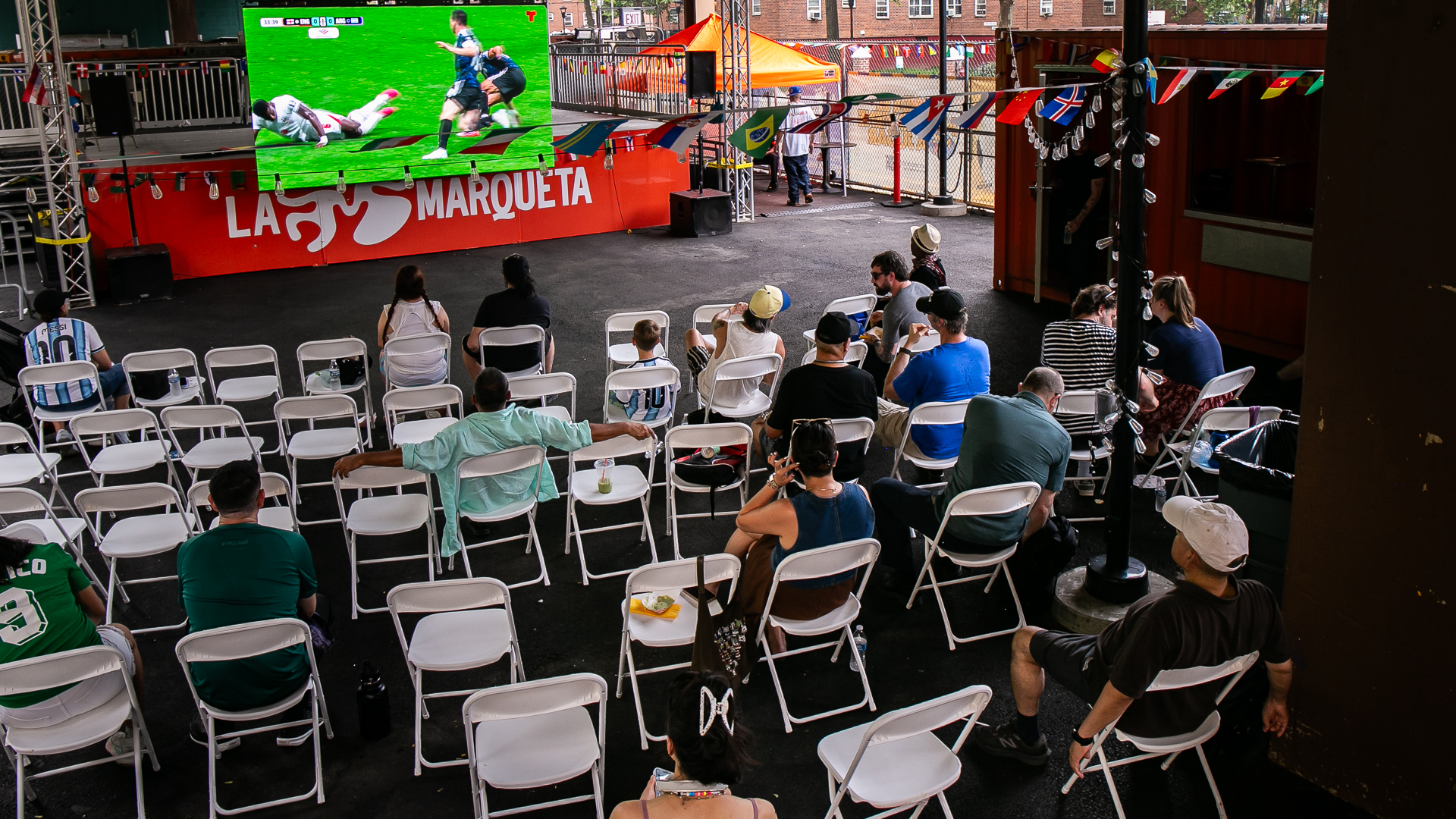
In East Harlem’s El Barrio, only a modest crowd turned out to a watch party at La Marqueta, the public market on Park Avenue, for the July 15 semifinal between England and Argentina, which landed during a heat wave.
But Carey King, director of the local BID Uptown Grand Central, said that overall the World Cup proved to be a “beautiful thing” for the community, both socially and economically.
“The first game we showed was one of the Mexico games, and the next game we showed was one of the Senegal games, which really united East 116th Street, Little Mexico, and then West 116th Street, Little Senegal,” she said.
“It’s just been amazing to see the local small businesses … to see those businesses being supported by the community, to come watch the games, and also to buy the cuisine—people are having watch parties in their houses and so they’re buying the jollof, and the empanadas, and everything to serve.”
Bars and restaurants in New York profited from watch parties
Cora Fusion on 37th Street in Queens, a restaurant serving Peruvian and Colombian cuisine, opened three months before the start of the FIFA World Cup.
“It’s a business we’re just getting started with, so it hasn’t exactly been easy to get off the ground,” co-owner Andrea Prada said in Spanish. “The World Cup really helped us, by giving us visibility and getting people to know about us.”
Prada said the restaurant saw a significant increase during the series, especially during Colombia’s matches, with an overall 50 percent increase in sales, compared to months prior.
She acknowledged that this was the result of a comprehensive strategy they implemented: partnering with influencers, running radio ads, and hosting pre-World Cup parties featuring a DJ and themed gifts.
“Businesses that planned for the moment by hosting watch parties, offering specials or creating World Cup-themed programming are seeing stronger turnout around those events. For many others, day-to-day business has remained relatively steady,” Sorin said in a statement.
Questions remain about outreach and planning
A few blocks from Cora, in Queens, Mendez said the increase in sales was modest: about 15 percent better compared to the previous year.
One of the strategies that turned out to be profitable for the eatery was joining the “Five Boroughs Winner Special,” a citywide initiative in which participating restaurants and bars offered $26 price-fixed food specials along with commemorative, limited-edition cups that venues could buy from the city.
“We sold out like two weeks before the final match,” Mendez said.
Although this idea helped boost sales at this restaurant, other restaurants in the area never found out about it.
More than 1,000 businesses joined the Five Boroughs Winner Special initiative, according to New York City’s Tourism & Conventions, which coordinated the action for the World Cup. Most of them (nearly 60 percent) were in Manhattan. In Brooklyn, 192 establishments took part and 160 in Queens. The other boroughs lagged behind, with roughly 3 percent of businesses in the Bronx (about 36) registering for the promotion, and 31 on Staten Island.
As City Limits reported before the start of the World Cup, registration forms for several of the city’s promotional initiatives were available only in English, something the directors of business improvement districts representing small businesses in some Latino-heavy neighborhoods criticized.
“The general sentiment of people we have spoken with,” said Suarez, executive director of the Third Avenue BID in the South Bronx, “is that significant community-based planning for the World Cup in the city was limited to the last three to six months, giving local businesses little time to coordinate with the city for a robust visitor and tourism strategy.”
City officials and New York City’s Tourism & Conventions Corporation as well as the NYC Department of Small Business Services (SBS), said they did outreach in all parts of the city.
SBS used many different marketing strategies, like email, webinars, workshops, and door-to-door tours, to reach almost 500 stores in neighborhoods like Jackson Heights, Sunset Park, Little Haiti, Port Richmond, the South Bronx, Astoria, and Manhattan’s Koreatown, with materials available in Arabic, Spanish, French, Korean, Bangla, and Haitian Creole, officials said.
“The FIFA World Cup 2026™ is a generational opportunity for our entrepreneurs, which is why SBS worked tirelessly alongside our community partners to promote the full suite of free resources the city offers to ensure that our small businesses thrive even when the tourists go home,” said SBS Commissioner Kenny Minaya in a statement. “Being game ready was never easier.”
To reach the reporter behind this story, contact [email protected]. To reach the editor, contact [email protected]
Want to republish this story? Find City Limits’ reprint policy here.