


Share This Article
“The mayor deserves high praise for making food affordability a priority—but the approach is wrong. There are better, proven, and far less costly solutions that would help many more New Yorkers struggling with food insecurity.”
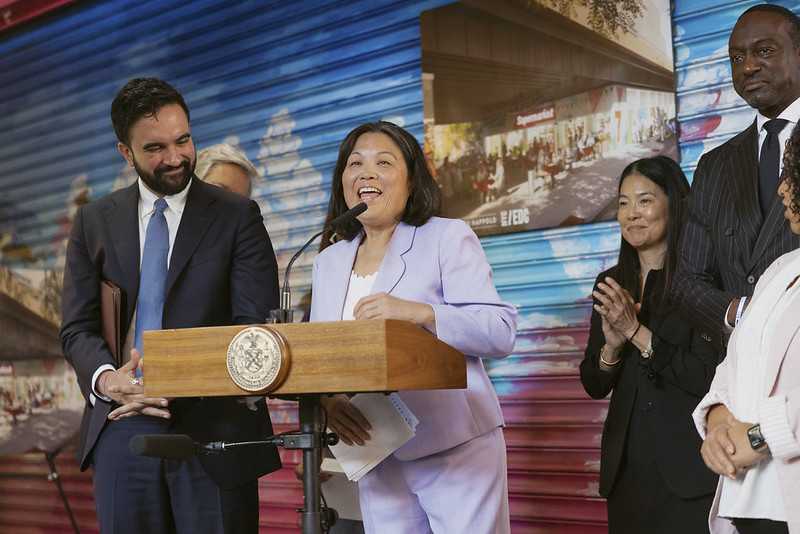

Mayor Zohran Mamdani is moving quickly to fulfill one of his central campaign promises: building New York City’s first public grocery stores. The city has allocated $30 million in capital funds to construct a store in East Harlem, with four additional locations planned for a total recommended capital cost of $70 million. In addition to capital costs, the operating cost of one city grocery store is around $4 million in city subsidy.
The mayor deserves high praise for making food affordability a priority—but the approach is wrong. There are better, proven, and far less costly solutions that would help many more New Yorkers struggling with food insecurity.
Since the city grocery concept was introduced on the campaign trail, it has drawn a considerable amount of criticism and some cautious optimism. Critics point to the steep cost, untested operating and supply assumptions, the reality that most New Yorkers will live too far away to benefit, and the unfair competitive pressure on nearby private grocery stores and bodegas.
But there is a larger problem: according to a report from Community Food Advocates, for the city-run grocery stores to have real impact on affordable groceries, the economy of scale would require 20 stores (not five), with weekly sales of $970,000 per store, $400 million in capital start up costs and $385 million in annual city operating subsidy.
While these costs are staggering, the Mamdani administration has yet to issue a detailed policy justification for its city-run grocery store program. The city is preparing to spend tens of millions of dollars on an untested model while successful, existing city programs sit underfunded and underutilized.
The city already operates a successful program to help low-income residents with the cost of groceries. It’s called Get the Good Stuff (GTGS), administered by the NYC Department of Health and Mental Hygiene in partnership with the Fund for Public Health in New York. Launched in 2019, the program has run continuously for seven years—and it works.
Here’s how: GTGS serves the 1.7 million low income New Yorkers who receive a monthly SNAP cash benefit. At participating grocery stores, SNAP recipients receive a dollar-for-dollar match—up to $10 per visit—when they purchase fresh fruits and vegetables. The match can then only be spent on the same categories of healthy food, including:
- Fresh fruits, vegetables, and herbs
- Frozen fruits and vegetables (no added sugar, salt, or fat)
- Canned and jarred fruits, vegetables, beans, and lentils (no added sugar, salt, or fat)
- Dried beans, lentils, and fruit (no added sugar, salt, or fat)
The financial impact is real. Two store visits per week generates $20 in additional purchasing power—roughly $1,000 per year for a participating household. Critically, SNAP recipients shop with dignity and choice: no food pantry lines, no dependence on donated inventory. GTGS is a year-round program. And notably, it accomplishes the same nutritional goals as Mayor Mamdani’s proposed city grocery store—at a fraction of the cost.
So why hasn’t anyone heard of it? GTGS is one of the city’s best-kept secrets. There is almost no public outreach or marketing.
GTGS has a counterpart for the rest of New York State called Double Up Food Bucks New York (DUFBNY)—and the disparity between the two programs is striking. While GTGS caps the match at $10 per visit, DUFBNY offers up to $20 per visit. The statewide program operates with $4 million annually—more than three times New York City’s budget—even though the city has far more SNAP recipients.
| Region | SNAP Recipients | Share | FY 26 Budget |
| Rest of New York State | 1,088,831 | 39% | $4,000,000 |
| New York City | 1,701,491 | 61% | $1,300,000 |
| Total | 2,790,322 | 100% | — |
Source: SNAP data is from NYS Office of Temporary and Disability Assistance, February 2026.
Even though New York City has hundreds of thousands more SNAP recipients than the rest of the state, there were 25 GTGS participating grocery stores last year vs 109 DUFBNY participating grocery stores in the rest of the state.
The disparity extends beyond the state to the rest of the country. A comparable SNAP grocery store program operates in 25 states with a $20 per visit match. It’s only in New York City where SNAP recipients can only get a $10 per visit match.
City SNAP households will be purchasing much more if they can get $20 per visit for free. Two of those visits per week translates into a cash infusion of $2,000 annually. This is real money that can help struggling New Yorkers right now.
Yet the program operates on a shoestring: for the past six years, the GTGS annual budget has been around $1.3 million, funded entirely by a federal USDA grant, with zero contribution from the city budget.
The recently adopted city for fiscal year 2027 budget included $3.1 million for the program. Once again, Mayor Mamdani deserves much applause here. But that amount will not cover the $20 per visit match opportunity. City SNAP recipients deserve the same nutrition incentive and financial support as SNAP recipients in the rest of the state and 25 other states.
The underfunding of GTGS also produces a serious geographic equity problem within the five boroughs. Due to lack of funding, the program has dropped from 25 participating stores last year down to only 21 citywide. But even when the program was operating with 25 stores last year, large swaths of the city were effectively excluded. Southern Brooklyn, most of Queens, and all of Staten Island have little or no access to GTGS.
| Borough | SNAP Participants | 2025 GTGS Stores |
| Bronx | 474,022 | 11 |
| Brooklyn | 588,245 | 7 |
| Manhattan | 234,538 | 4 |
| Queens | 323,000 | 3 |
| Staten Island | 72,000 | 0 |
| Total | 1,691,805 | 25 |
While Brooklyn has 588,245 SNAP recipients—the highest of any borough—six of the GTGS were located in the northern half of Brooklyn with only one serving the southern half. For example, the Coney Island neighborhood has 33,000 SNAP recipients, but it’s miles from a GTGS store. Queens, the largest borough by area, has 323,000 SNAP recipients and just three stores. Staten Island has 72,000 SNAP residents and not a single participating store.
At the same time, neighboring Westchester County, with a SNAP population of 68,000 people, has three DUFBNY participating grocery stores. While it’s great to see SNAP participants benefiting in the rest of the state, the city’s participants deserve the same access to purchasing less costly fresh fruits and vegetables.
A second program, Health Bucks, operates similarly to GTGS but directs spending to neighborhood farmers and green markets. While these venues are largely seasonal—typically running four to five months per year—they play a valuable role in connecting SNAP recipients to fresh, local produce. Expanding Health Bucks alongside GTGS would broaden impact and reinforce both programs’ goals.
New York City also has a large and successful network of food coops already operating throughout the five boroughs. A subsidy to the cooperative neighborhood-based grocery stores network will go a long way to helping struggling New Yorkers (including economically struggling New Yorkers that do not receive SNAP). The city also offers the FRESH program: a highly successful set of zoning incentives that has resulted in 32 new grocery stores built in underserved “food desert” neighborhoods
The math is straightforward. Instead of committing $30 to $70 million to build five stores and another $4 million (per store) to operate, Mayor Mamdani could invest at least $4 million to dramatically expand existing programs. That investment would:
- Double the number of participating stores, bringing GTGS access to hundreds of thousands SNAP families in Brooklyn, Queens, and Staten Island for the first time.
- Raise the per-visit match from $10 to $20, putting the city on par with the rest of the state.
- Extend benefits to every SNAP household in the city, not just those who happen to live near a proposed city-run store.
Mamdani has made equity a centerpiece policy of his administration. GTGS is an equity issue. The program is underfunded, under-publicized, and geographically uneven. Fixing it is not only possible—it’s urgent.
Mayor Mamdani, drop or at least delay the city-run grocery store. Instead, take $4 million—a fraction of the planned expenditures—and transform a quiet, successful program into a citywide lifeline. Expand Get the Good Stuff. Increase the Health Bucks budget. Give every SNAP household in New York City the same $20 match that families across the rest of the state already receive.
That’s not a campaign promise. That’s a proven solution.
David Rubel has run a public policy research consulting firm in New York City for the past 30 years.
2 Comments