


Share This Article
Inspections by the city’s Department of Housing Preservation and Development are one of the only tools NYCHA tenants have for securing overdue repairs. But tenants and legal advocates say scheduling snafus make those fights even harder.
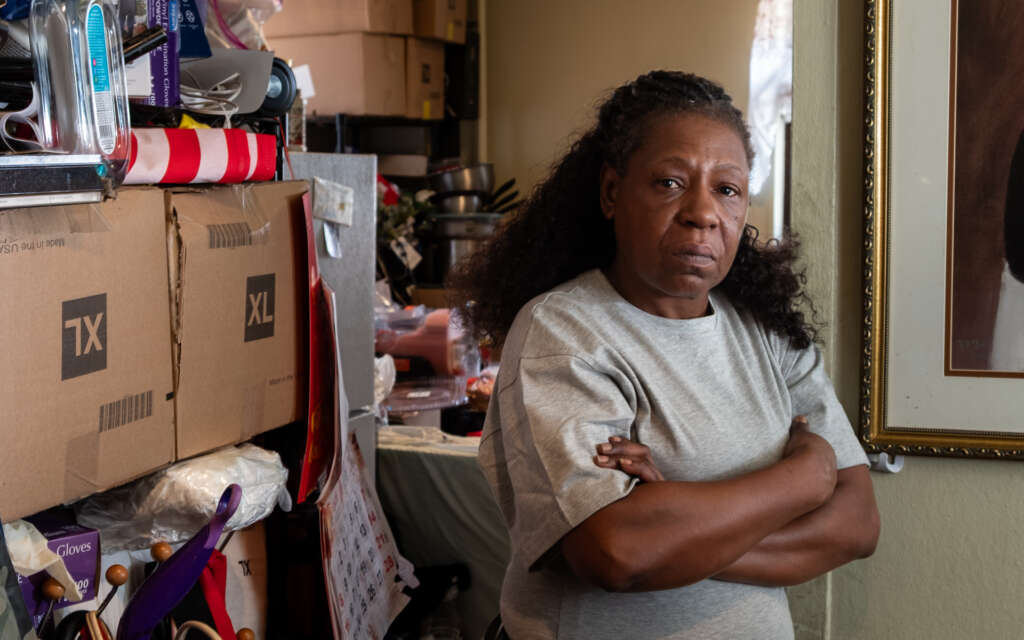
Sabrina Dingle spent 57 years living in the same Manhattan apartment in NYCHA’s Jacob Riis Houses. She raised her sons there, survived Hurricane Sandy, and built a rock-solid community with her neighbors.
But the place she called home for most of her life kept making her and her sons sick, she said, recalling mold inside the windows and walls, concerns about the building’s tap water, and signs of lead and asbestos. The conditions got so bad that in 2024, NYCHA relocated the family to an apartment in a different development, where they still live. The move was supposed to be temporary, but Dingle has lost hope that she’ll ever be able to return home.
Dingle spent years fighting a legal battle to force NYCHA to repair her original apartment—something the agency says is already done. She laughed incredulously at that claim, saying the repairs were shoddy: for example, she says NYCHA fixed her moldy windowsills by replacing the glass, but not the frames. “Whatever they did, they pretty much cleaned their ass and left the face dirty,” said Dingle.
When tenants take their repair disagreements with NYCHA to court, the Department of Housing Preservation and Development (HPD) acts as a neutral third-party assessor—in theory. Typically, a court will order an inspection on a specific date for a specific window of time, say June 30 between 9 a.m. and 1 p.m. HPD inspectors should arrive in that window, review issues raised by tenants, and record inspection reports that then act as key evidence in housing court.
Except tenants say that the system rarely functions this smoothly.
When pursuing legal action, tenants fill out an inspection request form that asks for a phone number; since Dingle no longer lives in the apartment she had to evacuate, she provided NYCHA’s number on the form. Ahead of court-ordered inspections, HPD would call NYCHA, NYCHA would fail to answer, and HPD would say access to the apartment was not granted.
Three failed inspections later, Dingle feels no closer to resolution than when she first started trying — in 2022, two years before her relocation. “I’m just stuck. Stagnated,” she said. “It’s like I’m in a time warp.”
Her experience epitomizes an issue NYCHA tenants and legal advocates describe as persistent: ahead of court-ordered inspections, HPD will call the number listed on the inspection request form to confirm someone is home and can provide access. If no one answers, they say, HPD skips the inspection. It’s hard to estimate how often this occurs, given the inspection system’s lack of transparency. For example, though HPD has long-shared inspection results for privately-owned housing, it only just began doing so for NYCHA developments at the end of last year.
A call ahead of an inspection sounds plenty reasonable: why should an inspector show if no one is home? But a number of issues can arise. Tenants often don’t know to expect a call and, like most people, hesitate to pick up what resembles spam from an unknown number. Even if a tenant does know to look out for a call, it’s easy to miss one brief moment in an inspection window that may span half the day or longer. Whoever is home to provide access might also not be the person who wrote their number down on the request form. And even if someone does pick up, language barriers can prevent clear communication.
“With access windows being so large, a phone call might give tenants a heads up that HPD is about to come. Maybe if you ran over to a neighbor’s or to pick your kids up from school, you know, to hurry home,” said Sophia Fenn, a housing attorney at the New York Legal Assistance Group. “It’s a good step. But skipping knocking at the door, if you don’t pick up the phone call, that’s the real issue.”
NYCHA is notorious for repair delays and failures—largely, officials say, thanks to decades of government underfunding for public housing that’s fueled an enormous repairs backlog. As of this April, the housing authority takes an average of 444 days to complete repairs, and it has more than 600,000 open work orders. Often, as in the case of the Dingle family, the public housing system relocates families more efficiently than it fixes their apartments.

That’s due, in part, to NYCHA tenants suffering a unique dependence on legal mechanisms for repairs. They can try reporting issues to management, but the chances of that succeeding don’t always rate particularly high, according to Shaquana Boykin, a Brooklyn NYCHA tenant of 16 years and an organizer at Communities Resist.
If management doesn’t respond, residents must request a repair via an online portal or by phone, depending on the building. It can take multiple hours to file a ticket by phone, and Boykin says ticket requests often go ignored. “They cancel out your ticket; you could have a ticket and you’ll go back to it, and you’re like, ‘What the hell, it’s gone,'” said Boykin. “And you have to start again.”
If the ticket system fails or stalls, NYCHA tenants cannot call 311 to request an inspection like renters in private-market apartments. Doing so simply re-routes them to the same ticket system already failing them. After exhausting their other options, NYCHA tenants can file what’s known as an “HP action” in housing court, where an HPD inspection serves as irreplaceable evidence and a key piece of leverage.
But the HPD inspection process can become a maze within the NYCHA repair maze, says Tuhfa Begum, a housing attorney at Manhattan Legal Services. “Within the HP proceeding, which is essentially an extra lawsuit NYCHA tenants have to file just to get repairs, a judge will disregard their lived experience,” said Begum. “Tenants might go through 50 steps just to file an HP, but if the inspector never shows up to report what the conditions are, then the judge just kind of dismisses them.”
Cherrine Howard, a NYCHA tenant living in the Red Hook East Houses, agrees that a missed phone call compounds an already frustrating process. Howard says she’s frequently had HPD inspectors arrive well outside an inspection window, sometimes by entire days.
On one occasion, an inspector arrived almost a week early, just as she was heading out the door, saying he had a cancelled appointment and figured he could slot her in. “I’m a sickly lady, almost 60 years old,” said Howard. “I go back and forth to the doctor. I cannot just drop everything and cancel a doctor’s appointment because it suits y’all. I can’t do that.”
A spokesperson for HPD explained in an email that since “inspection lengths vary significantly from apartment to apartment,” broad inspection windows “help prevent missed appointments.” The agency says that inspectors “do not typically call ahead of an appointment,” but may do so if they are unable to access an apartment. “The agency’s goal is to continuously find new and innovative ways to conduct inspections as efficiently as possible.”
NYCHA, the largest public housing authority in North America, manages more than 520,000 residents across 335 developments. That’s about 1 in 17 New Yorkers. It’s no secret that aging infrastructure, decades of government disinvestment, and sky-high construction costs make for derelict housing conditions that frequently threaten the health of tenants. The housing authority estimates that it would cost $78 billion over the next 20 years to fix its aging buildings.
As NYCHA developments continue to deteriorate, problems compound, and once-minor repairs can escalate into major renovations. The Jacob Riis Houses where Dingle lived for most of her life requires nearly $640 million in repairs, according to NYCHA’s 2023 Physical Needs Assessment.
In large part, NYCHA has faced the enormity of the problem by advocating for converting its housing to the federal Section 8 program, which unlocks additional repair money and—in the case of one initiative, called PACT—turns public housing developments over to private managers. More than 40,000 units in the city fall under Section 8; 22,000 more will undergo conversion over the next three years.
A spokesperson for the agency said NYCHA is “constantly working to develop management, operations, and preservation solutions despite decades of federal disinvestment,” and touted the “$17 billion in comprehensive renovations completed, under construction, or in pre-development” across its PACT portfolio.
But private money is no silver bullet. A 2024 audit of the program by then-Comptroller Brad Lander found that the eviction rate of converted NYCHA houses “significantly exceeded” that of NYCHA. And an investigation last year by The City Reporter found more than 14,200 housing code violations in PACT developments since January 2021 (though NYCHA disputed those numbers, and another analysis from the Citizens Housing and Planning Council found PACT buildings had fewer open violations than other multi-family properties in the city).*
Residents at the Riis Houses, Dingle’s longtime home, voted against PACT conversion last year.
For his part, new Mayor Zohran Mamdani seems to have embraced conversion as part of his overall approach to housing. The mayor’s comprehensive “Block by Block” housing plan—released at the end of last month—promised that NYCHA will put an additional 62,000 homes “on stronger financial footing” by converting them to Section 8.
The administration has also vowed to collaborate with the City Council to overhaul its housing code inspection and enforcement processes, in part as a response to complaints lodged by tenants in private-market apartments who showed up to the mayor’s “Rental Ripoff” hearings earlier this year. City Hall is holding a series of similar forums for NYCHA residents this spring.
In the meantime, tenants like Dingle are left to wait. “The only thing I can do is thank God I got a roof over my head,” she said.
*This story was updated after publication to cite additional research on violations at PACT buildings. To reach the editor, contact [email protected]
Want to republish this story? Find City Limits’ reprint policy here.