


Share This Article
“Public housing residents deserve art that honors their history and tells the stories of their communities, and the tools to make that happen already exist.”
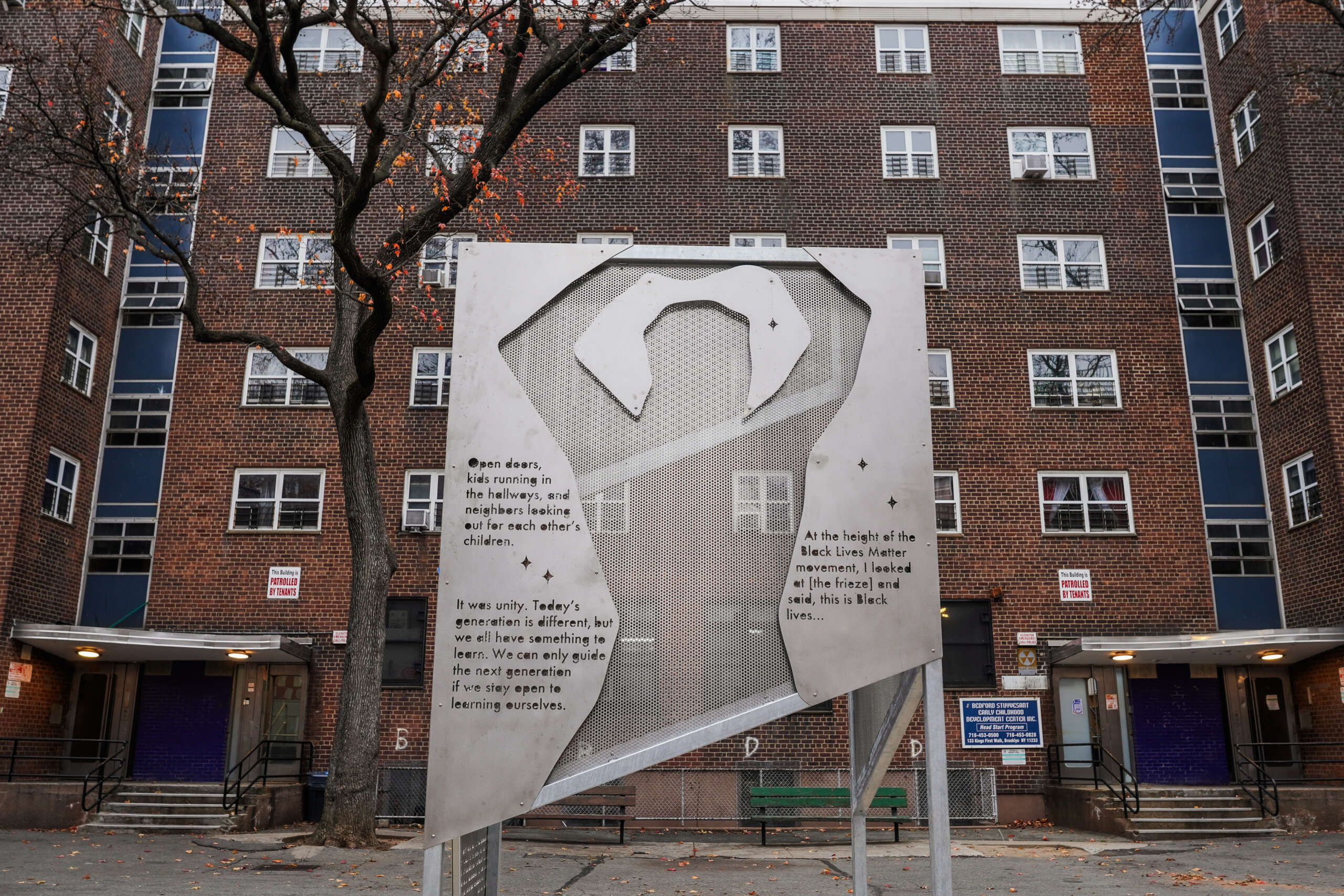

Beginning in the latter half of the 20th century, public art exploded throughout New York City. This cultural shift was boosted in part by the city’s Percent for Art law, which requires 1 percent of the budget for eligible city-funded construction projects to be allocated to public art. As a result, public art has proliferated in civic spaces across the city, and it has become an assumption that they should include art in some form.
Decades earlier, a generation of public art took shape through the New Deal’s Works Progress Administration (WPA). In New York City, Mayor Fiorello LaGuardia championed public art installations in places like public housing. After the WPA ended, affluent New Yorkers and cultural institutions helped sustain this support, at least through the era of the Civil Rights Act.
Despite the trend of investment through WPA and Percent for Art regulations, New York City Housing Authority (NYCHA) residents across the city have to fight for cultural programming, such as the public art enjoyed by residents of neighboring communities. The Percent for Art program falls short in public housing, and it’s time for that dichotomy to end and for NYCHA campuses to host works of art that honor the stories, histories, and dreams of the communities that call public housing home.
That isn’t how it’s always been. The planners of public housing believed they could take a well-rounded approach to improving daily life, taking into consideration things like open space, light and air, but also dignity, order, and civic pride, and art fit squarely into that framework. Basically, if well-off New Yorkers could enjoy art, residents of newly created public housing should experience that same joy. As a result, the earliest NYCHA developments—First Houses, Williamsburg Houses, Queensbridge Houses, and Harlem River Houses—all included commissioned artworks.
Those works included a statue of wrestling bears and wading penguins by the sculptor Heinz Warneke, which served as community centerpieces of life at Harlem River Houses from its inception. Writing about the development in The New Yorker in 1938, the urban theorist Lewis Mumford observed that the animal sculptures both served to enhance the space and activate it by inviting children to play on them.
Other local early works broke barriers in the art world as well. The murals commissioned for Williamsburg Houses were the first abstract public murals commissioned in the United States. Similarly, at Queensbridge Houses, the infamous Philip Guston painted the WPA-commissioned mural “Work and Play” at the community center.
The decades that followed saw public housing strictly economized. In the postwar years, the emphasis shifted from quality to quantity due to the pressing need to build housing units at a massive scale. While open space and recreation areas remained integral to most new NYCHA developments, the cessation of the Federal Art Project and the gradual cut off of federal funding meant that commissioned artworks did not.
That’s not to say that art disappeared from NYCHA’s campuses. NYCHA has been the home of musicians, dancers, visual artists, performers, and artists of all stripes throughout its history. Public housing has long been a hotbed of Hip-Hop culture, with Jay-Z, Nas and Wu Tang reaching the pinnacle of fame by telling stories about their upbringings in Marcy Houses, Queensbridge Houses and Stapleton Houses, where they were inspired by the breakdancers, DJs, and MCs they grew up with—and those that came before them, such as The Chiffons of the Doo-Wop era and songwriter Ronnie Mack, both residents of NYCHA’s Bronx River Houses.
In recent years, nonprofits like the Public Housing Community Fund, ArtBridge, Groundswell, Artolution, and Thrive Collective have spearheaded initiatives to fund more art on NYCHA campuses, and local elected officials and philanthropic organizations have emerged as funding partners. Through grant funding, the Public Housing Community Fund has been able to fund the restoration of the WPA-era frieze “Exodus and Dance” at Kingsborough Houses and develop a heritage walk and mural on the campus that celebrates the community’s history. Other historic works that had fallen into disrepair have been restored by PACT partners at Harlem River Houses and Wise Towers in Manhattan.
ArtBridge, through the City Canvas initiative, has brought art to the sidewalk sheds and construction fences that are omnipresent at NYCHA campuses, turning eyesores into assets. The Urban Conga, a Brooklyn-based design studio, recently facilitated an artful redesign of the long-neglected bleachers at Morris Houses, restoring them to a community hub now called “Common Corner.” Through its “From Roots to Arts” program, the Public Housing Community Fund has brought artists-in-residence to NYCHA campuses across the city, allowing them to immerse themselves in and create art alongside public housing communities.
Nonprofits and residents can’t carry the burden alone, and for every NYCHA campus that has received public art, there are entire communities that are yet to receive similar investments.
Public housing residents deserve art that honors their history and tells the stories of their communities, and the tools to make that happen already exist. We know that art saves lives! A comprehensive public art master plan for NYCHA would take stock of the existing portfolio, identify gaps, and lay out a clear vision for what comes next. Nearly a century of evidence proves that when public housing is treated as worthy of cultural investment, remarkable things happen. The question is whether we choose to make it happen.
This article was written as part of a Hunter College Urban Planning Studio in partnership with the Public Housing Community Fund.
About the authors: Alex Zablocki is a veteran public servant who currently serves as the executive director of the Public Housing Community Fund.
Ben Verde is a master of urban planning student at Hunter College. He previously worked as a reporter at Brooklyn Paper and as a community planning fellow with the Fund for the City of New York.
Julia Murphy is a master of urban planning student with a focus on housing and the built environment at Hunter College, as well as the housing preservation program manager at the non-profit Rebuilding Together NYC, which provides low-income homeowners with no-cost critical home repairs and accessibility modifications.
Lucy Ferguson is a master of urban planning student at Hunter College. She is currently a college aide at the NYC Department of Transportation.