


Share This Article
The Rent Guidelines Board pushed the mayor’s rent freeze promise forward Thursday night, advancing a preliminary range of rent levels that includes no increase for the city’s rent stabilized tenants. They will vote on a final number in June.
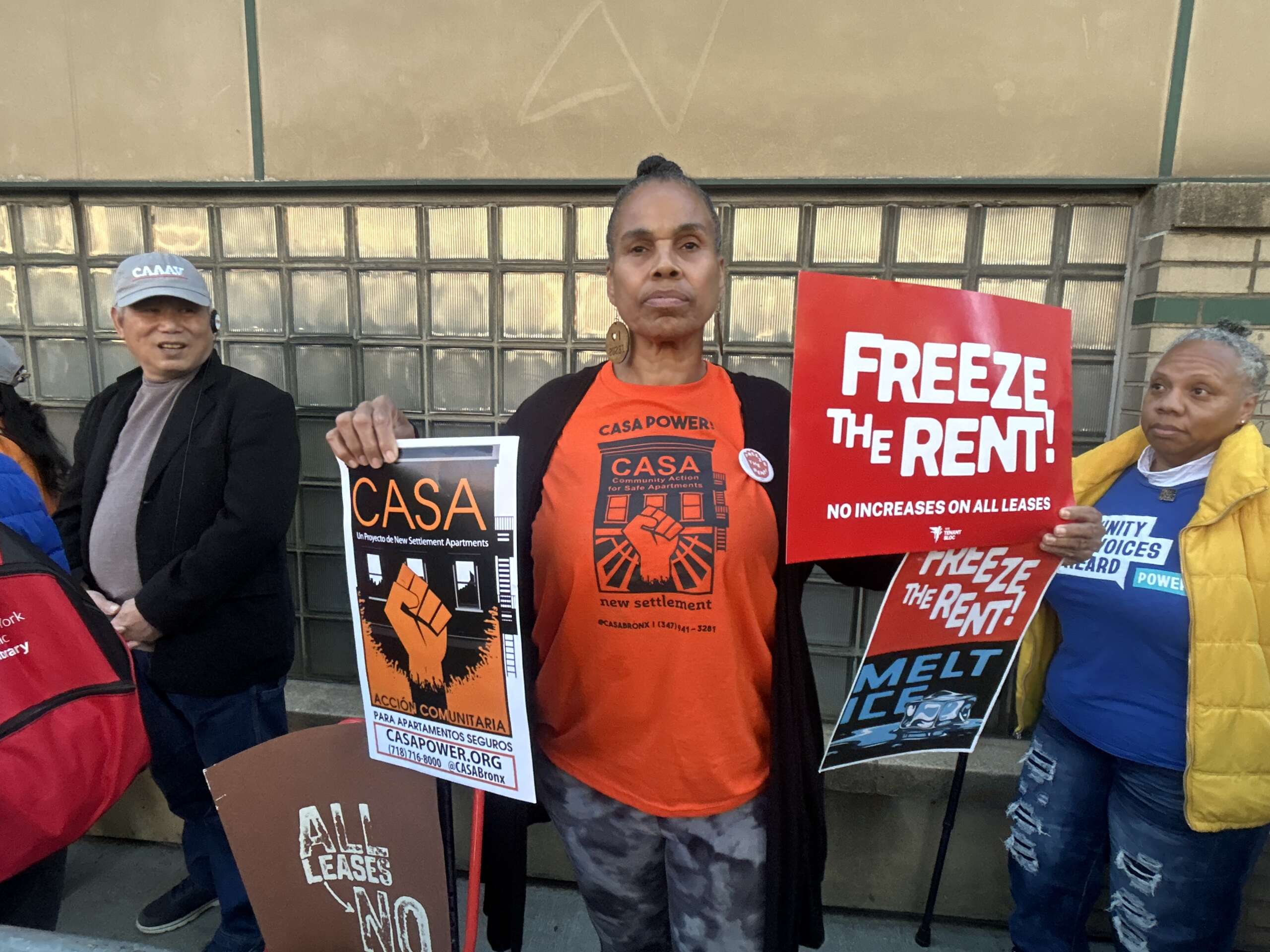
The magic number is “zero” for supporters of a rent freeze.
Zohran Mamdani’s promise of a rent freeze passed a major milestone Thursday evening, as the Rent Guidelines Board voted to advance a preliminary range of adjustments that included no rent increase for rent stabilized apartments.
In a brief meeting, the board voted to advance rent adjustments of 0 to 2 percent for one-year leases and 0 to 4 percent for two-year leases. Rent-stabilized tenants have the option of one- or two-year renewals.
The board will vote in June on a final rent level that will affect lease renewals signed starting in October. The board usually approves a final rent level that is within the preliminary range, but they’re not required to.
Outside Thursday’s hearing, tenant groups called on the board to freeze the rent, pointing to the city’s cost of living crisis and the risk of displacement for households living on the edge of affordability.
“[To me it means] extra money to pay for my medicine, to live a more affordable life, to pay for bills,” said Sarah Delany, a rent stabilized tenant from Highbridge, Bronx. “Cost of living is rising but our money is not.”
The Rent Guidelines Board, which is made up of nine members—two representing tenants, two representing landlords, four public members, and a board chair—froze the rent three times under Mayor Bill de Blasio but has never enacted a rent freeze on two-year leases, something this board will consider.
Elisa Martinez, a member of the New York State Tenant Bloc, said a two-year freeze would give rent stabilized tenants like her father more security.
“My father’s about to retire… and he doesn’t want the risk of signing a one-year lease,” said Martinez.
Thursday night, tenant members of the board proposed a range that included rolling back the rent, setting the range from -3 to 0 percent for one-year leases. But the motion did not receive the necessary five votes to advance.
The mood inside the LaGuardia community college auditorium was tamer than past years, when tenants had demanded a freeze to no avail. Rents went up 12 percent over four years under former Mayor Eric Adams, according to a report from the Community Service Society.
But the crowd of tenants did erupt into chants of “rent rollback” as it became clear the board would consider leveling off, but not decreasing, rents.
Since taking office, the Mamdani administration has toned down its overt advocacy for a rent freeze, perhaps concerned about legal challenges—even as the administration mobilizes its Office of Mass Engagement to encourage New Yorkers to testify at the board’s public hearings.
The RGBis an independent board that’s required to consider economic data when setting rent levels for the city’s 1 million rent stabilized apartments. But Mayor Mamdani, who campaigned on a promise to freeze the rent, appointed six of the board’s members—a majority with some cushion.

Nevertheless, the decision about rents is ultimately up to the board.
Whether the economic data does indeed support the freeze is a debated question. The net operating income for rent stabilized buildings grew by 6 percent last year, according to anRGB report released last month. Last year, net operating income went up by 12 percent and the board still voted to increase rents.
Tenant advocates say that the economic data justifies the freeze.
“In working class immigrant communities, rent is our biggest bill every month. At the same time, landlords have grown their net operating income by 30 percent over the past three years,” said Shelby Chen, a youth leader with CAAAV, a group that organizes Asian communities in New York City.
But landlords and some policy groups have said that the net operating income statistic captures buildings that also have market rate units and masks some distress in the housing stock.
RGB data shows that buildings with mostly or entirely rent stabilized apartments were on more precarious financial footing than their peers that also have market rate units.
“If RGB members concede to the politics of a rent freeze or insignificant rent increase, they will be following a path of defunding rent-stabilized housing,” said Ann Korchak, president of the board of the Small Property Owners of New York, in a statement.
Costs for landlords have also gone up, the board’s data found, with some asking the government to tackle rising costs like property taxes and insurance.
A report from the nonprofit Community Preservation Coalition found that expenses in rent stabilized buildings rose 27 percent while rents rose just 11 percent, with one in three buildings in their sample unable to cover the costs of their outstanding debt.
Last month the Mamdani administration announced a new program to provide a publicly backed insurance option for some affordable housing that would cover 100,000 units by 2030. And while property tax reform does not appear to be on the table this year, the Mamdani administration has suggested that it will take a look at the issue down the line.
Thursday’s vote lays out a path to advancing the rent freeze next month, with seven members of the nine-person board voting to advance the rent ranges that include zero. One landlord member, Maksim Wynn, a Mamdani appointee, abstained.
The mayor is one step closer to his campaign promise.
“New Yorkers from every borough should make their voices heard and speak directly to what this housing crisis looks like in their lives. I’m confident the Board will weigh those perspectives carefully and arrive at a decision later this summer that reflects the urgency of this moment,” he said in a statement.
To reach the reporter behind this story, contact [email protected]. To reach the editor, contact [email protected]
Want to republish this story? Find City Limits’ reprint policy here.