


Share This Article
The city’s “AC for All” initiative, launched in 2017, aimed to bring air conditioning to every public school classroom. But the policy doesn’t require the city to verify whether the units are functioning properly, or to extend cooling to common spaces.
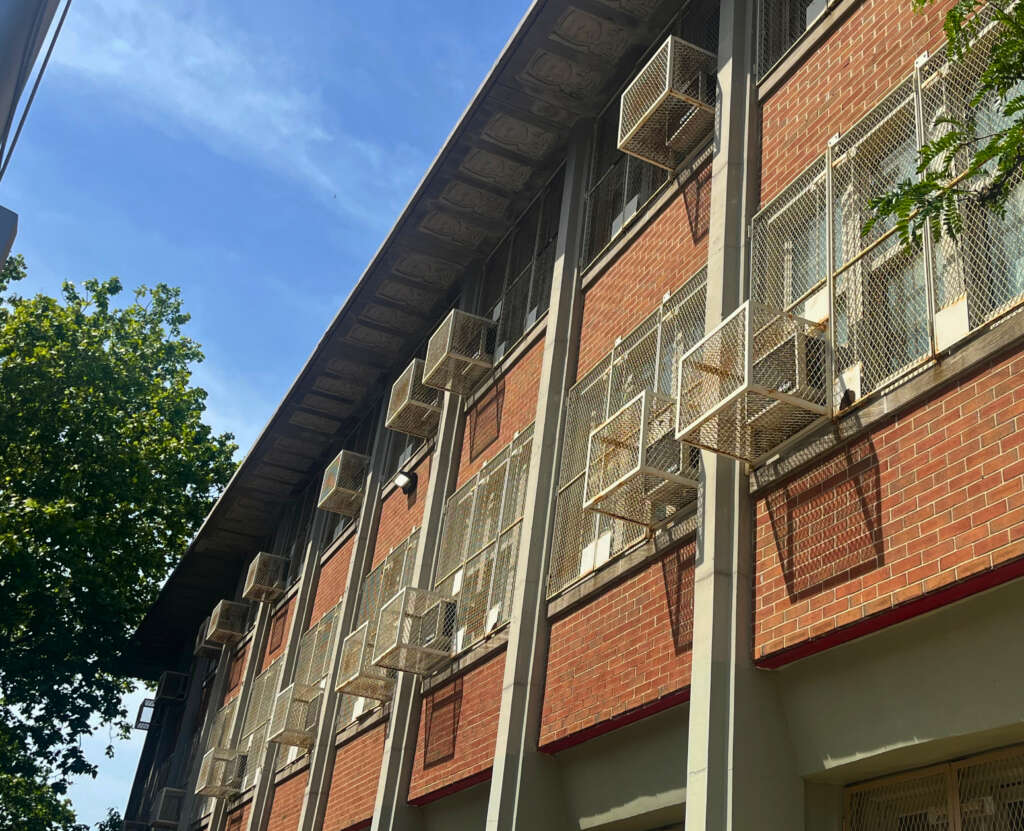
As summer approaches and temperatures begin to rise, many New York City public school students are still without air conditioning in shared spaces such as gyms, cafeterias, and auditoriums.
While some schools report fully air-conditioned buildings, others continue to lack cooling in key areas, raising concerns about equity across the public school system, according to local education advocates.
“It’s so sweaty and sticky, and I can feel it and visualize it. It’s frankly gross and uncomfortable,” said Kristen Berger, co-chair of the Youth, Education, and Libraries Committee of Community Board 7 on the Upper West Side.
The city’s “AC for All” initiative, launched in 2017, aimed to bring air conditioning to every public school classroom. However, the policy does not require the New York City Department of Education (DOE) to verify whether the units are functioning properly or to extend cooling to common spaces.
“It had this initial kind of checkbox to be like, yes, we saw a physical air conditioner in each of these classrooms,” said Berger. “It does not appear to have the maintenance and support that those ACs need, so now, many of them are physically there in the classroom and not working.”
She’s working with Jessie Nieves, district manager of Community Board 7 on the Upper West Side and a mother of three children at the Joan of Arc School Complex, to push for expanded air conditioning there, in part because of the site’s accessibility for students with disabilities.
The Joan of Arc Complex hosts the Manhattan School for Children, Lafayette Academy, and the Community Action School. Located on 93rd Street between Amsterdam and Columbus avenues, the DOE lists each school as fully accessible.
According to DOE building ventilation reports, Manhattan School for Children, which hosts grades K-8, has no air conditioning in its auditorium, gyms, or cafeteria.
Additionally, a mechanical inspection from 2025 revealed that the building’s central climate control system was operating in only 20 percent of the building, leaving the majority of the complex unable to properly regulate heating, ventilation, and air conditioning. The report also found damage to basic temperature infrastructure throughout the complex, including broken thermostats, defective valves that control the flow of heat and cooling into rooms, and broken vent flaps that physically block fresh air from circulating.
While picking up her son, Nieves recently saw a wheelchair-using student leaving the school who wasn’t wearing shoes, presumably due to the high temperatures inside the building. It prompted her to consider how much more difficult it would be for students with disabilities to find comfort in the heat.
“I don’t find it humane or equitable. It just doesn’t sit right with me, whether it’s my child or someone else’s child,” Nieves said. “Every student and every educator should be in a comfortable environment to give our kids the best.”
Other city schools share similar issues. According to DOE’s building ventilation report, Fred R Moore Academy, a public school in Harlem serving grades PK-5, also has no AC in its auditorium, gym, or cafeteria. P.S. 79, another school in Harlem that serves grades PK-12, has no AC in its auditorium, while P.S. 452, an elementary school on the Upper West Side, has no AC in its gym.
“Our facilities teams and Custodian Engineers across the city have worked to ensure every classroom’s temperature supports learning, especially during the warmer months. While many of our buildings are older and present unique challenges, we’ve made meaningful progress upgrading systems and improving climate control in shared spaces, too,” DOE spokesperson Isla Gething said in a statement. “This effort is ongoing, and we remain committed to investing in improvements that provide the best possible learning conditions for our students.”
Common spaces like gymnasiums and auditoriums can play critical roles during the warmer spring and summer months, hosting graduations, standardized testing, and summer learning initiatives.
“More and more auditoriums are being used for testing, they’re used for congregating, they’re used for graduations,” said Councilmember Eric Dinowitz, who chairs the City Council’s Education Committee. “It’s just healthy to have air conditioning, particularly as we have summer rising and summer school, we need it in all of the spaces.”
“At this point, it’s a generally accepted matter of student and occupational health and safety,” said David Bloomfield, an education and law professor at Brooklyn College and CUNY Graduate Center. School resources are often prioritized based on political pressure and private fundraising, he noted, meaning schools in wealthier neighborhoods with affluent Parent Teacher Associations (PTAs) are often better equipped to prioritize issues like air conditioning.
“Air conditioning is not a luxury; it’s a necessity, and necessities should not be parceled out based on favoritism,” he said.
Indeed, not every public school faces these challenges. The Spruce Street School, a public school in the Financial District serving grades PK-8, reports that all of its AC systems are operational. East Side Elementary School, a school in the Lenox Hill neighborhood, and P.S. 290, an elementary school on the Upper East Side, also report no problems, according to the DOE’s ventilation reports.
Dinowitz said air conditioners in common spaces “would sure help out,” especially in his home borough of the Bronx, which has the “highest rate of asthma, anywhere.”
“Every kid should be in a healthy space,” the lawmaker said.
Nieves and Berger are encouraging schools to apply for what’s known as “Reso A” funding—discretionary grants doled out by coucilmembers and borough presidents—and showing them how to do so, often connecting them to elected officials. Bloomfield believes responsibility falls on the city.
“The mayor and the chancellor are responsible for the school budget and the physical condition of our schools,” he said. “As per the city requirement, we’ve already said it’s a necessity. The fact that there may have been a drafting oversight that didn’t include school common areas needs to be corrected.”
Dinowitz agrees with Bloomfield regarding the DOE budget. “Centrally, there should be a better system to just make sure the schools are getting the resources they need.”
City officials said that all public schools undergo routine building condition assessments, and campus custodian engineers are equipped with indoor air quality meters for real-time temperature monitoring.
In response to questions about the funding and infrastructure of shared spaces, a City Hall spokesperson emphasized the administration’s focus on classrooms while noting that work on cooling common areas is an ongoing effort.
“We understand that comfortable learning environments are essential to student success, and air conditioning plays a key role in helping students stay focused and engaged,” the spokesperson said.
To reach the editor, contact [email protected]
Want to republish this story? Find City Limits’ reprint policy here.