


Share This Article
The Mamdani administration claimed a partial victory when it got the new owner of 5,000 rent stabilized units to promise repairs and clear housing code violations. It looks like those efforts might be falling short, though tenants say the city’s support helped them negotiate rent debt forgiveness.
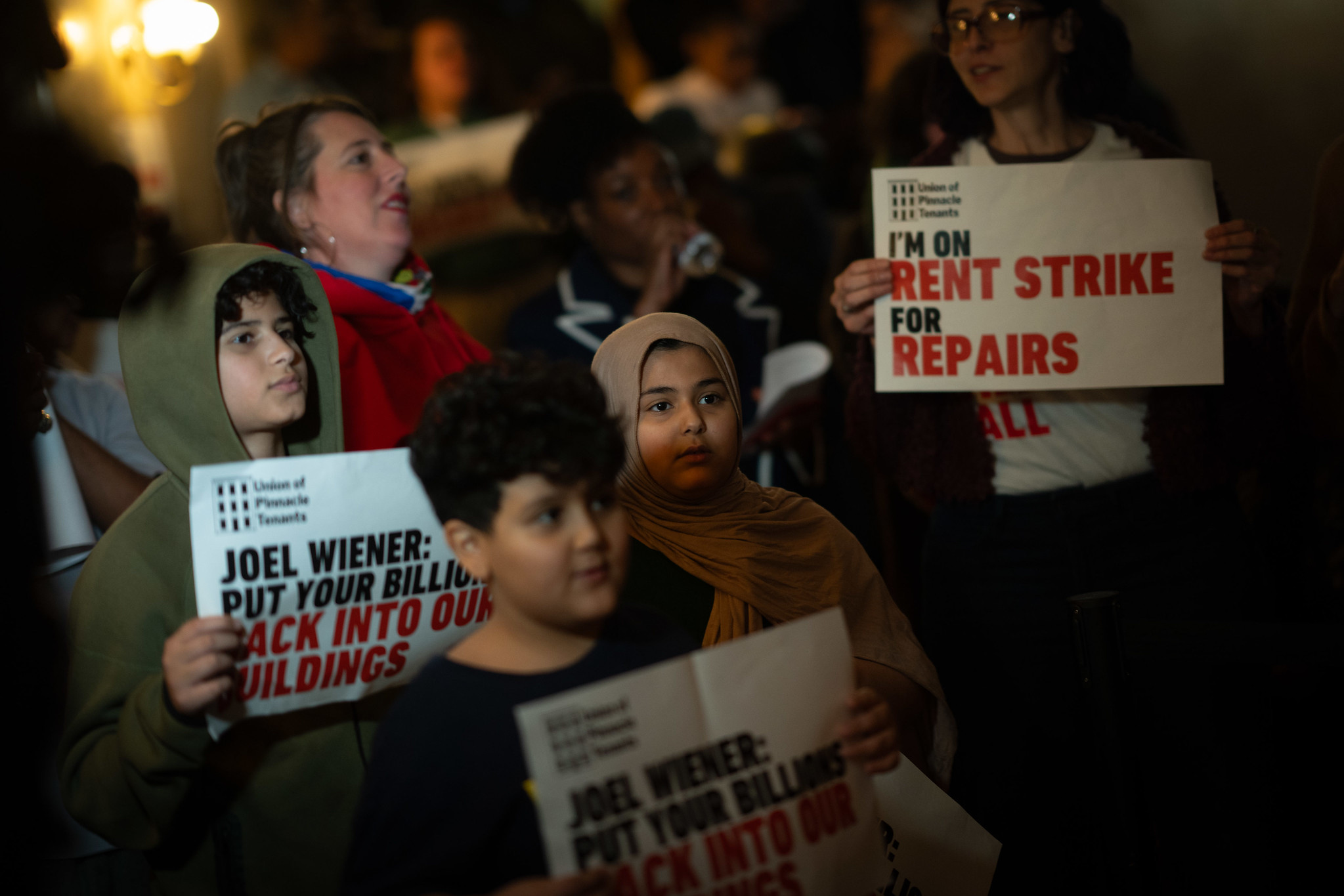
What’s a promise worth?
When a bankruptcy judge approved the controversial sale of over 5,000 rent stabilized apartments from the troubled Pinnacle Realty in January, the buyer, Summit Gold Inc., promised to cure half of the buildings’ nearly 6,500 housing code violations.
At the time, Mayor Zohran Mamdani’s administration claimed a partial victory. While City Hall had intervened late to try and steer the sale of the deteriorating portfolio to a preservation owner at bankruptcy auction, officials weren’t able to stop the transaction.
Instead, they say they secured a multimillion dollar promise from the new buyer to fix half of housing code violations by June 1—signs, tenants said, that the administration’s support had worked.
But it was never clear just how enforceable that promise, made in bankruptcy court, would be. And now whether that it has been fulfilled is in dispute. Two months after the sale, it appears Summit may be falling short of its goal—depending on how you count its buildings’ violation numbers.
But tenants are still hopeful they can leverage the developer’s promise, and help from city housing officials, into gains. In one early win, Summit said that they agreed to forgive tenants’ rent debts accumulated prior to their takeover two months ago, as long as residents stay current with their payments under new ownership.
“I was proud of what we accomplished. I was proud of the fact that our organizing led to Summit having to make those promises,” said Josie Wells, a tenant organizer who lives in a Summit building in Flatbush. “They were expecting for this to be business as usual.”
Tenants formed the Union of Pinnacle Tenants, or UPT, and the union has forged a one-of-a-kind partnership with the city government.
The newly relaunched Mayor’s Office to Protect Tenants created a website with resources for tenants of the portfolio. And government representatives from City Hall and the city’s Department of Housing, Preservation and Development (HPD) have been present at meetings between tenant leaders and Summit, according to multiple sources.
Tenants say the city’s support has sent a message that Summit needs to get serious about repairs. Summit had promised to cure half of housing code violations within the first two months of ownership, with a focus on the most serious, health impairing conditions.
According to an analysis of housing code violations shared with City Limits, there were 6,488 open violations in the Pinnacle portfolio when Summit won the buildings in bankruptcy auction on Jan. 13. The owners have since resolved 2,780 of them.
After the sale went through, however, it took another two months for the deal to close and Summit to take over the 93 buildings, which are spread across four boroughs. HPD inspectors found an additional 6,028 violations in the months since the Jan. 13 purchase date, including those identified after tenants lodged a 311 campaign to file their repair complaints with the city en masse. As of June 8, 5,330 violations remain open.
What exactly that means for a promise made to a bankruptcy court judge is not clear.
Tenants told City Limits they consider it a breach. Even if you counted only violations open on Jan. 13, Summit would have closed just 43 percent of them based on HPD’s analysis, not half, as the new owners promised.
“I’m not surprised,” said Vivian Kuo, a tenant in one of the former Pinnacle buildings in Hamilton Heights. “Summit doesn’t have a great reputation,” she said, pointing to poor conditions in a separate portfolio of buildings partially owned by Summit.
But representatives for Summit said they have met their obligations. A spokesperson for the company said they promised to “cure” violations, relying on internal repairs tracking rather than HPD’s violation system, which they claimed won’t always reflect the current conditions. The result is disparate accountings of maintenance issues across the 93 buildings.
“Over the past two months, Summit has invested significant resources in repairs, staffing, building operations, and capital improvements across a long-neglected portfolio. Our focus has been on apartment repairs and common areas—nearly every lobby has been painted, and hundreds of apartments have been repaired and remediated,” wrote a spokesperson for the company in response to questions from City Limits. “We have met our commitment: more than half of the 6,300 violations that existed at the bankruptcy hearing have been cured.”
They also appointed two new management companies to oversee the portfolio, the spokesperson noted.

Residents were encouraged to see some repairs getting done, but felt as though Summit was going after low-hanging fruit.
“It’s questionable if it’s gotten better. I think there’s a hope that it’s getting better, but it’s hard to say yet,” said Kuo. The building adjacent with hers in Hamilton Heights has been without gas for weeks, she said.
Kuo said some of the initial challenges have been managerial: tracking down existing paperwork, leases, and rent rolls from the previous ownership.
“It’s right now very cosmetic, they’re painting, they’re putting up signage for their new management,” said Kuo. “That’s good, but there’s also major problems that we’ve all had to deal with right now, from my perspective, and anecdotally… it’s really not happening at a scale that seems to me that they can reach their commitments on time.”
The overt support for tenant unions from the mayor’s office is a new phenomenon in a city with historically entrenched real estate interests.
“From our first day in office, the Mamdani administration has stood firmly with tenants across New York City. We took a historic step to intervene on behalf of Pinnacle tenants and secured important commitments from Summit, and we continue to coordinate with UPT to ensure that tenants see the improvements they were promised,” said Cea Weaver, director of the Mayor’s Office to Protect Tenants, in a statement.
The city has aligned itself with tenants in the past, particularly to steward distressed properties like those in the formerly Pinnacle (now Summit) portfolio to new ownership, according to Samuel Stein, a housing policy analyst at the Community Service Society (Note: CSS is a City Limits funder).
The new mayor’s efforts to partner with tenants, he said, are “precedented, but at an unprecedented scale.”
“It’s different for the Mamdani administration to say to tenants: [get organized] and we’ll help you,” said Stein.
Tenants say that the administration’s presence, along with the threat of housing code enforcement, have forced Summit to the table, where the union says they’ve made important gains, like excusing the rent debt accumulated under the previous ownership (terms of such an agreement have not been finalized, the union said in a statement).
“Tenants and the city, if they are aligned, that’s pretty powerful,” said Stein.
The administration’s persistent presence hasn’t bothered Summit, according to spokesperson Jordan Barowitz. “It is helpful to have the City attend the meetings. There are many issues that require City’s engagement to resolve and having a direct line to them can help untangle the bureaucracy,” he told City Limits in a statement. “We are all partners. Improving the buildings is in everyone’s best interests.”
The Pinnacle Tenants Union hopes that their efforts, and that of city leaders, will support a freshly-empowered tenants movement in the city.
“I’m so proud to be part of that movement in a city that I love, and in a city that has this profound history and is crucial right to what’s happening in the nation. I think it’s dope,” said Wells.
Residents in the buildings, which have faced years of deferred maintenance, hope that it eventually leads to improved material conditions. Representatives for the union said that members are still dealing with broken windows, blocked fire escapes, and damaged floors and walls, among other issues.
“There are pockets of glimmers of hope. Some have positive reports that you know certain buildings are getting the repairs or they’re just starting now,” said Kuo. “We’re not holding our breath either.”
Another test of Summit’s promises is fast-approaching. In January, Summit promised to fully cure their violations portfolio-wide by Oct. 1.
To reach the editor, contact [email protected]
Want to republish this story? Find City Limits’ reprint policy here.