


Share This Article
Advocates and a Brooklyn City Council member are asking the city to create a set of guidelines for how schools should respond to the presence of ICE agents nearby, and to set up a system for alerting families and students.
Lea la versión en español aquí.
For U.S. Immigration and Customs Enforcement (ICE) agents to enter a school in New York City, they’re required to show a judge-signed judicial warrant, according to the city’s standard procedures.
But what happens if federal agents loiter around schools when families are dropping off or picking up their children?
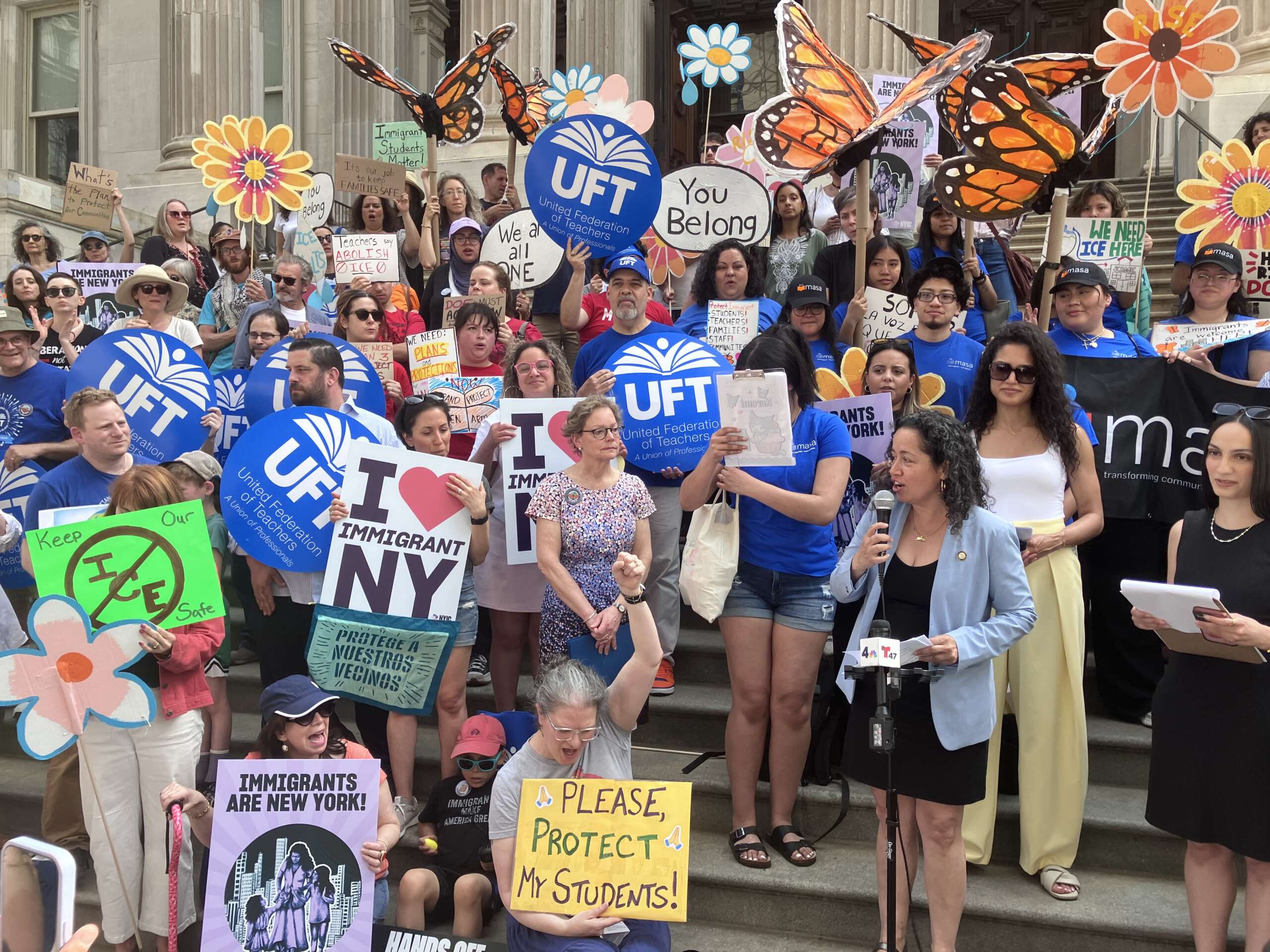
That’s what has been happening in neighborhoods with significant Latino communities, such as Corona in Queens and Sunset Park in Brooklyn, according to reports from advocates and educators during a rally Thursday afternoon. They’re calling for the city to establish official protocols around what local schools should do in such incidents.
“We shouldn’t have to go to school, afraid or on edge, just to think that something’s going to happen to our family. That shouldn’t be the case, especially in New York City,” a 16-year-old student said during the rally.
ICE has not entered any city schools, a spokesperson for New York City Public Schools (NYPS) stated, though the agency did not elaborate or respond to questions about agents’ presence near school buildings. But local lawmakers and educators said it’s been an issue, as the Trump administration continues its mass deportation campaign.
“There were months where it was daily activity, and then it’s kinda a little quiet,” Councilwoman Alexa Avilés, who represents the predominantly Latino neighborhood of Sunset Park, told City Limits. “Even if there’s spaces [in time] between the actual arrests, people are still very unnerved. So you know, it goes in waves.”
On Monday, Tom Homan, Trump’s border czar, threatened to deploy “more ICE agents than you’ve ever seen in New York City,” days after Gov. Kathy Hochul passed legislation prohibiting local police from striking cooperation agreements with ICE.
Last year, the Trump administration rescinded a policy passed under former President Joe Biden that prohibited immigration enforcement in “sensitive” locations, like churches and schools. The Department of Homeland Security last fall said the change “gives our law enforcement the ability to do their jobs,” but said ICE agents weren’t specifically targeting schools for enforcement and that such instances would be “extremely rare.”
Since October, Latinos have accounted for the vast majority of ICE arrests in the city, far exceeding their percentage in the general population. Street arrests by ICE in New York sometimes go unnoticed by residents or activists, who show up after the agents’ presence is reported. The increase in these types of low-profile arrests has made many residents in Latino neighborhoods across the city uneasy.
“Back in February, two mornings in a row, right before school arrival began, suspicious occupied cars were spotted next to elementary schools and a middle school, and no staff at the schools knew what to do,” Julia Garland, an elementary school teacher in Sunset Park, Brooklyn, said at last week’s rally.
“The cars drove away just to begin repeatedly circling the blocks the schools were on for two hours, and still no staff at the schools knew what to do. I was one of the community responders. It was scary. Parents were walking their children into school, knowing ICE was right there,” she added.
An estimated 267,000 New York City children live in “mixed-status” households, meaning at least one family member is undocumented, according to the Center for Migration Studies.
During the rally, teachers, students, advocates, and Councilwoman Avilés urged NYPS to consider a plan to alert families and students of ICE presence in areas surrounding schools. Advocates handed a package containing the petition and collected signatures to a NYPS representative.
“We want to see your continued advocacy, and we welcome that you continue to push us to do more and to support our students and families,” said Flavia Puello-Perdomo, deputy chancellor of the division of family partnership and community support, minutes before the petition was handed to her.
“We’re actively working to strengthen our protocols, particularly as they relate to interactions with non-local law enforcement—ICE,” Puello-Perdomo added.
The petition, with over 2,100 signatures as of June 5, asks the city to create a set of guidelines for how schools should respond to ICE’s presence, both inside and outside school buildings, so staff and families know what to do. It calls for creating a “safe passage” program for students, especially young adults and teens who often travel alone to and from school.
Advocates are also pushing for the city to offer parents and caregivers shelter or a safe waiting space until immigration enforcement leaves, and establish a rapid family-notification procedure to quickly inform families when confirmed enforcement activity near the school is happening.
“NYCPS remains steadfast in its commitment to supporting every student and family, regardless of immigration status,” an education department spokesperson said in a statement. “NYCPS firmly believes that every New Yorker, whether newly arrived or born and raised, is entitled to a rigorous, safe and supportive education.”
NYPS said they’ve updated their training guidance related to field trips, arrival, and dismissal, and encouraged schools to contact their borough safety director for guidance on safe passage protocols, “an initiative that harnesses the strength of communities to ensure safe journeys to and from school,” a spokesperson said.
Some schools in Sunset Park have deployed staff to wait outside during arrival and dismissal times to essentially stand guard, something the petition calls to be implemented system-wide.
A standardized procedure around ICE sightings would ensure students at every school building feel protected, Avilés said.
“This sickens me to my core. And I know you all share that feeling, because that’s why we are here, out here again; just as with any public educational resource, it should not be determined by zip code,” Avilés chanted. “Your rights should not be determined by your zip code or whether an educator is in political alignment with you.”
To reach the reporter behind this story, contact [email protected]. To reach the editor, contact [email protected]
Want to republish this story? Find City Limits’ reprint policy here.
1 Comment