


Share This Article
“It is far too difficult to get a street tree planted in the five boroughs. The Urban Forest Plan must reverse this paradigm; if the goal of growing the city’s tree canopy to 30 percent coverage is as worthy as we say it is, let’s pull out the stops.”
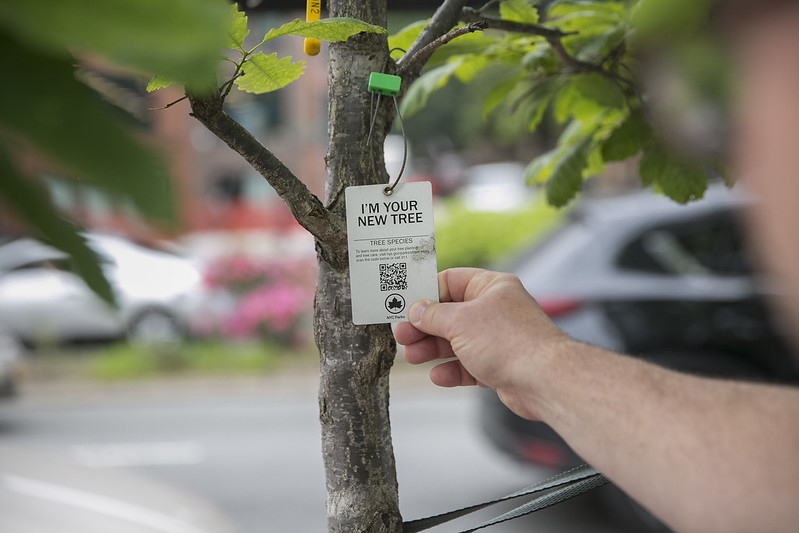

As New York City develops its new Urban Forest Plan, I couldn’t be more excited. Given the urban heat island effect, cloudburst flood events, air pollution, and climate change, we need trees more than ever. As this past Saturday, Oct. 4, marked City of Forest Day, it’s worth asking: to be effective, what should this new Plan emphasize?
First and foremost: get more trees in the ground
As I know from experience, it is far too difficult to get a street tree planted in the five boroughs. The Urban Forest Plan must reverse this paradigm; if the goal of growing the city’s tree canopy to 30 percent coverage is as worthy as we say it is, let’s pull out the stops.
The city’s new Urban Forest Plan needs to reduce hurdles to getting new trees in the ground – and it needs to let everyday New Yorkers help in real ways to make that happen, even if it means city agencies accepting more informality and imperfection than usual.
Flipping the constrained street tree script
Here’s how we change the way we think about planting street trees:
- The city should not prioritize jackhammering new tree pits into sidewalks given the number of existing open tree pits; focus on the extant low hanging fruit first.
- The city should conduct a lightning survey of all existing open street tree beds for actual underground pipes or cables (a typical Digger’s Hotline review, not the inscrutable “conflicts with surrounding infrastructure” analysis used in the city’s now-defunct 311 request-a-street-tree option).
- The city should eliminate its tree planting permit requirements (financial and paperwork).
- The city should publish a map showing all of the eligible tree pits open for planting.
- The city should encourage anyone (individuals, families, community groups, local businesses) to plant a tree in any of the eligible tree pits so long as it is at least four feet tall and staked. Non-profit partners can continue—and expand—their free tree giveaways.
And then the city government should stand back after a bit of promotion of this new paradigm, and let New Yorkers of all kinds plant the saplings of their own collective future.
Will this approach be less than perfect? Yes. Should it be done alongside city contractor tree planting? Yes. Will some new trees die? Yes. But will it lead to an overall greater number of trees planted and growing by 2030 than the city will otherwise be able to muster, even in partnership with large non-profit partners, by that date if it keeps current strictures in place? When the soil clods settle, I know we’ll see the answer is a resounding yes.
Today, open tree pits sit empty for years despite requests by neighbors and owners. Some individuals have even resorted to making donations of over $1,500 to a city-preferred non-profit to get a tree planted, if they’re lucky. It’s emblematic of just how wrong the default is: the switch is flipped to a presumption of “do not plant” instead of “yes, plant.” If the Urban Forest Plan is going to ramp up tree planting in a profound way, it needs to revamp the city’s calcified, overly cautious presumptions.
Will existing contractor requirements for tree size, watering, staking, and maintenance be sacrificed for trees planted by the community under the new paradigm? In some cases, yes, though some of those things may well be replaced by community and individual efforts. At any rate, those considerations should be secondary to actually getting new trees in the ground, many of which will persist even with minimal amounts of care. But critically, the cost to get a given tree in the ground will be so much less than the current $3,000 per tree that it is worth the experiment on a large scale. I’ve seen a grassroots planting “pilot” prove as much.
Prioritize biodiversity, adaptation, species realities
Along with this fundamental shift in approach to help reach our tree planting goal, the Urban Forest Plan must also change other presumptions. For one, the existing limited list of permitted street tree species must be jettisoned to allow greater biodiversity and prevent single-species Dutch Elm Disease-style catastrophe.
Species that traditionally hail from farther south, like water tupelo (nyssa aquatica), should be tried out as the city’s climate zone shifts (Green-Wood Cemetery has been experimenting with this species, and we have seen similar “unlikely” species like bald cypresses succeed as street trees).
Additionally, while native tree species should be foregrounded, the Urban Forest Plan must not be too precious. If arrived species are most likely to succeed in disturbed areas, we should accept their erosion control, flood mitigation, carbon sequestration, shade, oxygen production, habitat benefits, and higher growth rates in some cases in service of the overall canopy coverage target.
The script should be flipped here, too: instead of limiting what types of trees can be planted to a dozen or so, only a handful of the most noxious should be outright discouraged. I’ve long wondered why so many species of fruit- and nut-bearing trees are not on the permitted street tree list when there are several species listed that make just as much of a mess on the sidewalks and vehicles (gingko, Kentucky coffee, and sweetgum, I’m looking at you).
Looking at the big picture
Taken together, these proposed fundamental shifts from the existing street tree-planting paradigm in New York City give us a real chance of achieving —and exceeding—the stated Urban Forest Plan canopy cover goal. It also gives everyday New Yorkers a meaningful role in a truly exciting citywide effort while building a corps of grassroots stewards deeply entwined with their curbside charges.
Brad Vogel is a resident of Gowanus, Brooklyn. He has volunteered with and helped lead groups planting trees in multiple boroughs over the past decade. Vogel has long found inspiration in the legacy of the late Hattie Carthan, the Tree Lady of Brooklyn.
2 Comments
Anon
I am curious what experience this writer has with tree planting in the city, but I would encourage them to read the parks website or any literature from NAC. Most of what is being suggested here is either already done, unfeasible or already available to homeowners. Any abundance based approach to running city government should be looked at skeptically.
Let’s go through the 5 points that would “Change the way we plant trees”
1. The city already prioritizes replanting in empty tree pits, during one of the past city hall hearings, it was mentioned more money was being put towards stump removals to then replant. Where the city had an empty pit they cannot plant it is due to other restrictions.
2. It is required to call for utility mark-outs for any excavation near utilities. There is also no such thing as a “lightning survey” with how massive this city is. Parks also just switched over to a “Block planting” strategy where they do exactly this and look for every possible planting spot on a street. This is on their website.
3. Planting permits are almost exclusively used by developers, and those requirements ensure they actually fulfill their street tree planting requirements. Go to any 1960s-90s development in the outer boroughs where there are monocultures of Norway maple and Bradford pears, and the writer can see what developers did before there were real regulations.
4. City already has a tree map, and all planting sites are also available on opendata.cityofnewyork.us
5. If you are just a regular homeowner and want to plant a young sapling or other landscaping in a tree pit, you are allowed to. Anyone can sign up for the tree giveaways and plant a sapling in their empty pit, but keeping it alive requires constant care for the first few years. There are also groups that do guerrilla plantings the writer could get involved with.
Additionally, arguing to reduce “Contractor requirements for tree size, watering, staking, and maintenance” is ridiculous when those requirements are what give the tree the best chance at survival to establish. NYC streets are far from the ideal place to grow, and if everything is not done to get those trees established, the city is just burning money.
On species selection, the city already plants many southern species, like Kentucky coffee tree and tupelos, as they have said in city council hearings, they are often limited by what nurseries grow. They do not plant trees that drop nuisance fruit anymore, like the female ginkgos. The myth that the city could plant apple orchards on the streets for human consumption is laughable.
It seems they have missed the forest for the trees in that they completely omit maintaining our existing canopy. Maintenance is not sexy, but ensuring established trees can continue to grow will get us to 30% much quicker than planting a bunch of saplings that will die. The writer should maybe read up on past plans, current community initiatives like the tree census, or just wait until the urban forest plan comes out before prescribing solutions
lengzai
if the city spent time trying to find and plant every existing tree bed in the city without at the same time looking for places for new tree beds it would get nothing done. if you want something planted do it yourself it’s not like the tree police are going to arrest you