


Share This Article
“The approval of 144 St. Felix signals something important: preservation and growth are not opposing forces. New York does not have to choose between protecting its past and building for its future.”
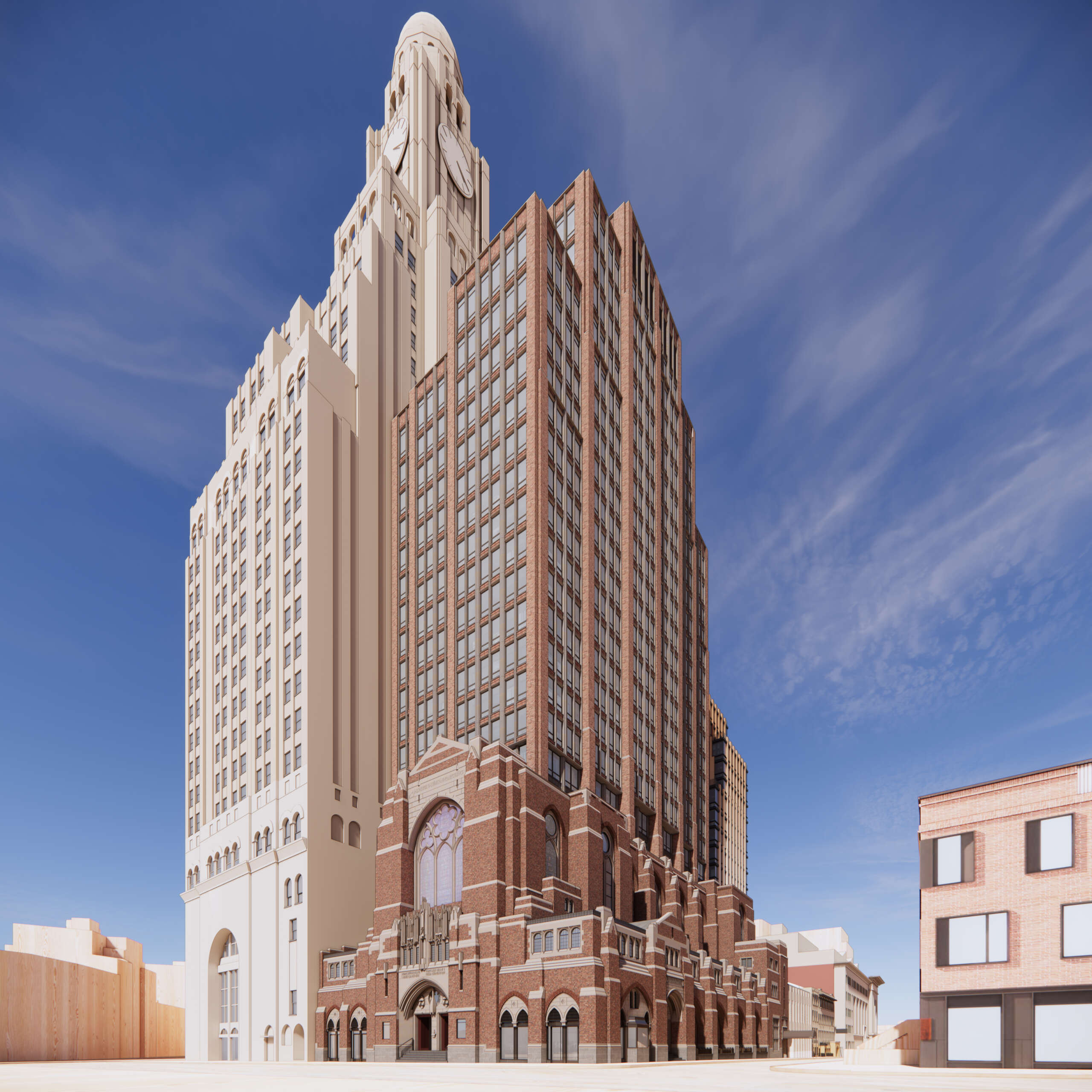

Walk around any New York neighborhood, and you’ll find them: Gothic stone facades with plywood in the windows, padlocked doors beneath carved inscriptions, scaffolding that has been up so long it’s become invisible. These are the city’s failing churches, and it feels like there are more of them every year.
Last month, the New York City Landmarks Preservation Commission unanimously approved the adaptive reuse and expansion of one such building: a century-old church at 144 St. Felix St. that has sat vacant since 2019, its interior deteriorating and future uncertain. On its face, this is a local project. In reality, it points to a citywide—and increasingly urgent—opportunity. While the vote was about one project, it pointed to a citywide crisis that deserves a citywide response.
Across New York, religious institutions that once anchored community life are struggling to survive. Congregations are shrinking, maintenance costs are rising, and buildings designed for another era sit underutilized and deteriorating, at risk of being lost altogether. When they go, they take something with them: not just architectural heritage but memory, identity, and the texture of everyday life. Too many have already been demolished, and too many others are facing the same fate.
The typical responses are inadequate. Preservation alone, without a viable long-term use, often leads to slow decline. Demolition, meanwhile, erases memory, identity, and continuity. New York needs a better approach, one that treats these properties as opportunities rather than frozen artifacts or blank sites for redevelopment.
At 144 St. Felix, that better approach required four things.
First, love the existing building. Not sentimentally, but rigorously. The historic structure is the foundation, not an obstacle—its form, materiality, and presence define the project. Preservation here is not a constraint, but a source of value.
Second, build carefully. The addition is not a mimic, nor is it indifferent to its context. It is intentionally contemporary—clearly of its time—yet calibrated in scale, proportion, and expression to defer to the historic base. This is not contrast for its own sake, but dialogue: old and new in a mutually reinforcing relationship. The goal is for the two to strengthen each other rather than compete.
Third, introduce a use that ensures long-term viability. In this case, mixed-income housing, targeting 72 permanently affordable units, on a site steps from Atlantic Terminal. Too often, preservation and growth are framed as opposing values. They aren’t. A thoughtfully designed addition enables the restoration of a landmark, while the restored landmark gives identity and civic permanence to new housing. Each makes the other possible.
Fourth, recognize that reuse is itself a sustainability strategy. The greenest building is the one already built. Retaining the existing structure preserves embodied carbon that demolition would destroy. Pairing it with energy-efficient new construction amplifies that benefit. If New York is serious about reducing emissions while accommodating growth, adaptive reuse deserves to be central to that effort, not a footnote.
None of this emerged easily. The design was shaped through multiple rounds of engagement with the LPC and the larger community. What felt like friction became a catalyst, with each iteration clarifying the relationship between old and new, sharpening proportions, and strengthening the project’s contribution to the BAM Historic District.
The design that received unanimous approval is better for that scrutiny.
New York is filled with beloved but vulnerable religious buildings. With thoughtful design and the right regulatory framework, these sites can evolve—accommodating housing, community space, and new forms of shared life—while retaining the character that makes them meaningful.
The approval of 144 St. Felix signals something important: preservation and growth are not opposing forces. New York does not have to choose between protecting its past and building for its future.
The question now is whether the city treats this as a one-off success or as a precedent.
Dan Kaplan, FAIA, is a senior partner at FXCollaborative Architects
1 Comment
Lana
What about the residents next door who will be blocked? I agree the housing crisis needs addressing but the residents blocked by this building will suffer I imagine.