


Share This Article
Voters recently gave the City Planning Commission new powers to fast track some affordable housing proposals; these nominees could get a say over what projects go through.
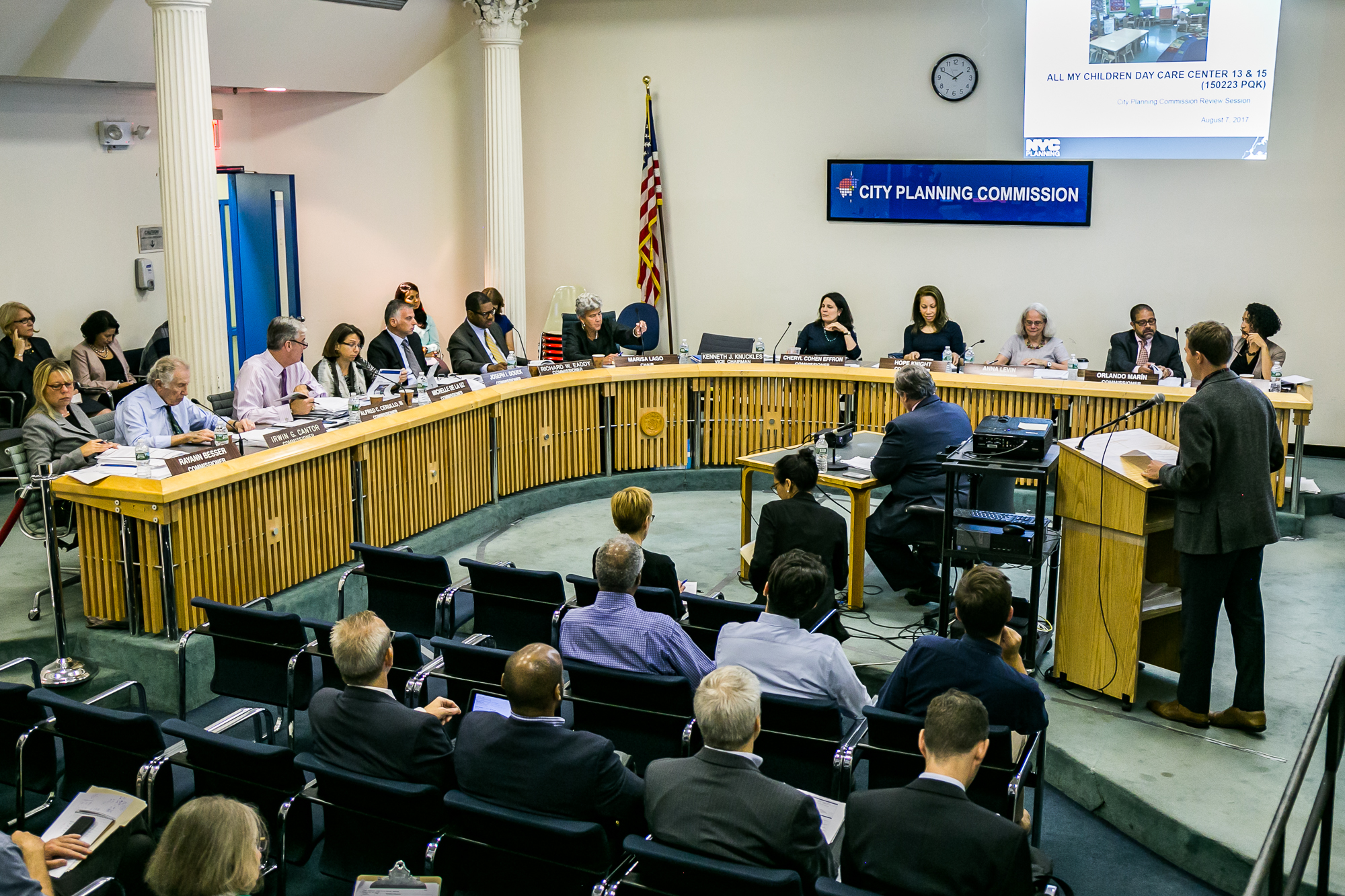
The City Planning Commission, already getting some new powers, is also getting some new faces—if the City Council approves.
Mayor Zohran Mamdani nominated three new City Planning commissioners Wednesday morning and renominated two more, appointing a mix of law, planning, and real estate experts.
The commission recently gained new powers over housing approvals in some parts of the city at the expense of the City Council—which now must approve or reject the mayor’s nominees.
“Zoning and land use decisions shape whether New Yorkers can afford to live in their neighborhoods and whether our city is built to serve the people who call it home,” said Mayor Zohran Mamdani in a statement to City Limits. “I look forward to working with [the nominees] to build a city where every New Yorker can live with dignity.”
The mayor appoints seven of 13 board members. He chose Margaret Anadu, who leads affordable housing investing organization One Weaver; Julie Stein, of the Union Square Partnership; and Meenakshi Srinivasan, former chair of the Landmarks Commission and Board of Standards and Appeals.
He renominated current commissioners Kenneth Knuckles, CEO of the Upper Manhattan Empowerment Zone Development Corporation and Anthony Crowell, dean and president of New York Law School. Rasmia Kirmani-Frye, who ran the nonprofit Hester Street, is in the middle of her term, and Mamdani appointed Chair Sideya Sherman in February.
The commission, which oversees land use and zoning changes in New York City, will have new powers starting in January, thanks to voter-approved ballot measures aimed at accelerating affordable housing production.
Under the changes, the board now gets final approval on affordable housing projects in 12 communities—from the Upper East and West sides, to Eastern Queens, and much of Staten Island—that have built the least affordable housing in recent years, as well as some modest infrastructure and resiliency projects.
“We know that there’s a housing crisis,” nominee Srinivasan told City Limits.
“The commission has a role regarding land use applications and proposals,” Srinivasan added. “But there are other arms of government as well, and the mayor, this administration—they’re all engaging in trying to meet the demands of New York City residents and to provide the affordable housing that’s needed for the city.”
Traditionally, the board advanced land use changes, including both site specific and neighborhood rezonings, to the City Council for a vote, where members had virtual veto power over projects in their district.
But under the new rules, projects in those 12 districts with a minimum level of affordable housing will skirt Council review, much to the consternation of many local councilmembers, who said it will hurt their ability to secure promises for their district, like more affordable housing or infrastructure investments.
As a result, the bureaucratic body might attract more intrigue than it has in recent years.
“City Planning Commission is now going to become somewhat more public facing,” said Councilmember Kayla Santosuosso in late September.
Santosuosso, who is advancing her own rezoning proposal in response to the ballot measure changes, said she still plans to use her pulpit to shape projects in her Bay Ridge district.
“That’s going to be a real interesting role change, and it’s going to be fascinating to see what plays out there,” Santosuosso said.
Srinivasan did not say how she hoped to engage with councilmembers or use the board’s new fast track powers.
“I look forward to going before the City Council and understanding their views. But I think whichever case it may be, I think I would like to bring a level of rigor, fairness, and integrity to that process,” said Srinivasan.
The ballot measures moved powers from the City Council to mayorally-appointed boards—on the City Planning Commission, the mayor appoints six members and the chair, while each borough president and the public advocate also appoint a member.
Leah Goodridge, appointed by Public Advocate Jumaane Williams in 2021, said the board rarely voted down projects during her tenure; she expects fast track projects to move forward with ease.
“Beforehand, City Council members would negotiate with the developer applicant to modify projects,” said Goodridge. “I’m eager to see how that may work when commissioners signal a project may need more affordable units.”
Last month, the mayor’s nomination for an obscure but important post leading the Board of Standards and Appeals—another panel charged with interpreting the city’s zoning rules and reviewing developers’ variance requests, which also gained new powers after the ballot measures—inflamed tensions about Council land use powers. Lawmakers approved Mamdani’s pick, despite some councilmembers’ “reservations.”
In addition to the new fast track, the Planning Commission will also consider large neighborhood rezonings advanced by City Hall, one for the area south of Brooklyn’s Prospect Park and another along an Eastern Bronx Metro North Corridor.
Attempts to reach Mamdani’s other nominees before press time were unsuccessful.
The City Council will have 30 days to take up the nominations after the mayor officially submits them, likely at Thursday’s stated City Council meeting.
To reach the reporter behind this story, contact [email protected]. To reach the editor, contact [email protected]
Want to republish this story? Find City Limits’ reprint policy here.