


Share This Article
Despite the Mamdani administration’s efforts to avoid the auction block, a large portfolio of former Emerald Equities’ buildings went up for sale—but failed to attract any bids at foreclosure auction, throwing tenants into an uncertain future and raising alarm about the health of the city’s rent-stabilized housing stock.
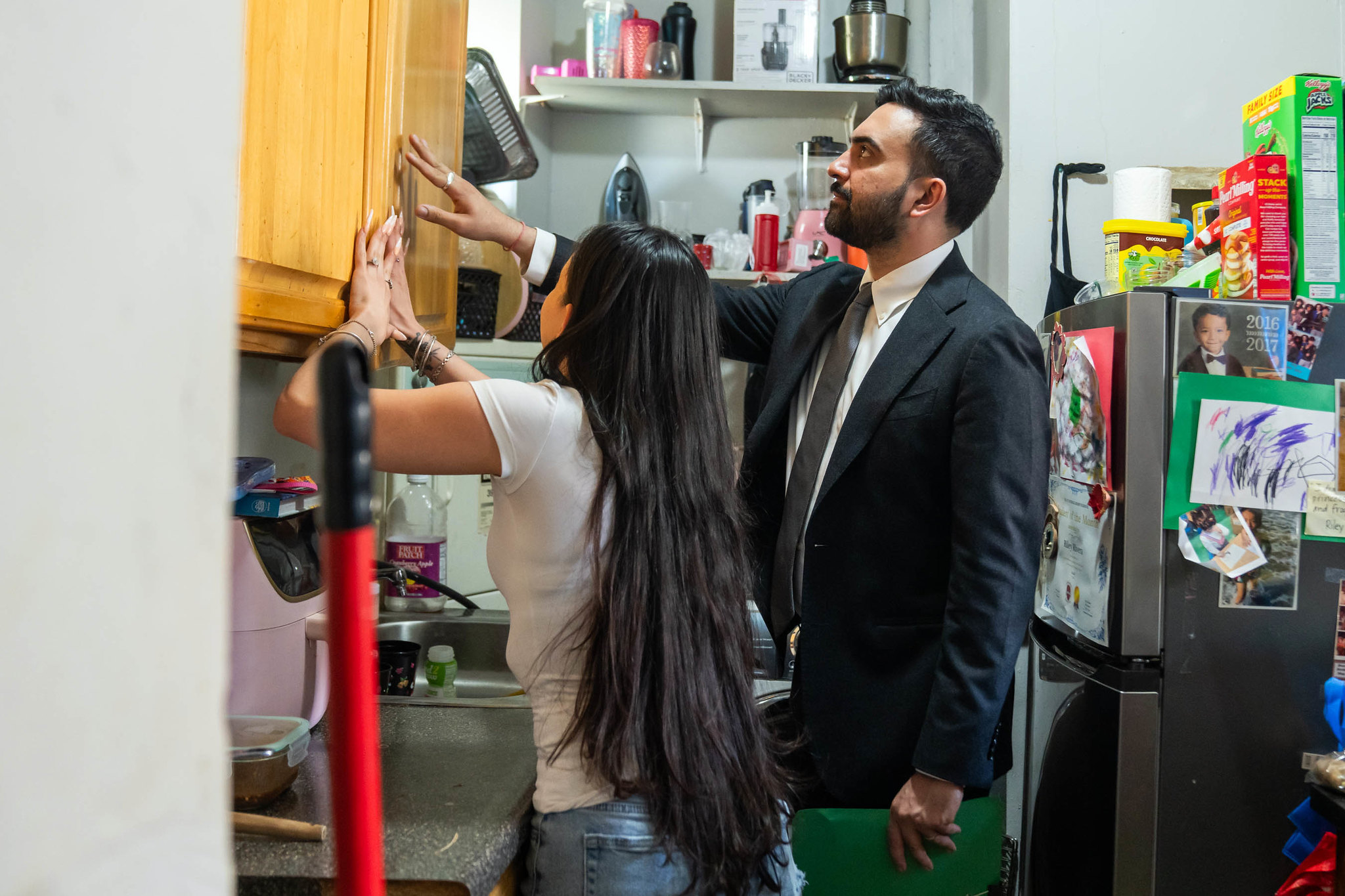
Ideally, “we shouldn’t even be going to an auction,” organizer Sergio Sorza lamented.
Tenant leaders, community organizers, and members of the East Harlem Community Land Trust were huddled in the hallway outside a Manhattan courtroom, still abuzz with the frenzy of a dozen foreclosure auctions that concluded in rapid succession last Tuesday.
They were a bit shell-shocked.
“I’m pissed,” said Vic Washington, a tenant of a building on East 103rd Street included in the auction.
It’s part of a nearly 900-unit portfolio of 39 mostly rent-stabilized buildings, once owned by Emerald Equities’ Isaac Kassirer, many of which went up for foreclosure sale last week, despite the efforts of Washington, her tenant union, and Mayor Zohran Mamdani’s administration.
Of the 27 buildings in the portfolio up for auction over the past two weeks, 26 attracted no bids. One building on East 114th Street sold for $826,000, splitting the tenants and throwing their plans—to steer the properties to their preferred buyers, who could work to preserve the apartments—into uncertainty.
It’s another twist in the Mamdani administration’s efforts to intervene in the sales of distressed affordable housing.
“It makes it more challenging, but we’re up for the challenge,” said Washington, who also works at the El Barrio Community Land Trust.
Tenants in five Emerald Equities buildings on East 103rd Street won a rent strike in 2025 before expanding their organizing across the rest of the real estate group’s portfolio and starting a “buyer beware” campaign.
Tenants called for a responsible owner—preferably a nonprofit that would help them turn some of the apartments into affordable coops—to take over. The city took notice, and backed a bid from preservation buyer Spatial Equity.
But the city’s efforts to push for a sale failed, as the creditor, Sabal Investment Holdings, rejected Spatial Equity’s offers of $68 and $110 million in July and October, according to reporting by both City Limits and Gothamist.
If banks holding the roughly $250 million in debt on the properties hoped for a better deal at auction, it didn’t materialize Tuesday. Instead, tenants are back to the drawing board, trying to get repairs on their neglected buildings.
“We are disappointed that one of these buildings was apparently purchased by a third party, assuming this sale goes through,” said Matt Latterner, a staff attorney at Legal Services NYC working with the tenants. “We do have a tenant’s association in this building and we are prepared to stand by those tenants as they seek to get repairs and fight the illegal overcharges.”

‘Going once, going twice… back to the plaintiff.’
At foreclosure auctions, investors can bid for buildings on the cheap, looking for financial upside.
But one after the other, as Emerald Equities’ buildings were announced on consecutive Tuesdays this month, auctions closed without a bid, sending them back to the bank for just $500 apiece.
At auction, bids must clear the “upset price”—a figure that matches the size of the judgement the bank holds. Only one building, 417 East 114th St., a skinny three story walk-up that looks out over Thomas Jefferson park, sold at auction, for $1,000 above the upset price of $826,000.
It was sold to a bidder, “Matt,” who, according to court papers, bid on behalf of 135th Place LLC, a group linked to Isaac Badalov, who owns one other building in Rockaway, according to Who Owns What. Attempts to reach representatives from LLCs associated with Badalov and his business address were unsuccessful.
While the tenants hope the scarce interest from buyers leaves the door open for nonprofit ownership, it alarmed landlords.
The prices of heavily rent-stabilized buildings like those in the Emerald Equities portfolio are flagging. “Nobody wants to own these buildings,” said Kenny Burgos, CEO of the New York Apartment Association.
Burgos’s group says that New York’s rent stabilization policies, including 2019 changes to state law that made it harder for owners to deregulate buildings, have limited landlords’ ability to increase rent to keep pace with expenses and repairs.
Banks are not in the business of operating housing, Burgos said, and are looking for the best deal—but don’t realize just how little interest owners have in these buildings. “The banks are still in this disbelief stage that the values have fallen so drastically,” he said.
But tenants say it’s because Emerald Equities neglected the buildings, destroying their value. They complain about pests, mold, heat outages, and unsafe conditions across the portfolio, which had 2,300 open housing code violations as of this summer.
“I think what we’re looking at is an unprecedented reckoning for how these buildings have been managed,” said Cami Dominguez, a staff organizer with Community Voices Heard.
Washington said that Emerald Equities and the banks have no one but themselves to blame, taking out an irresponsible level of debt, hoping to be able to take some of the units out of rent stabilization—until reforms in 2019 that closed rent-raising loopholes foiled their plans.
“These banks overleveraged their hand. They over-lent to a clearly irresponsible landlord who wasn’t able to properly steward these buildings, and now the tenants are facing the brunt of that,” said Washington.
Nonprofit owners may face some of the same challenges as their for profit peers, with rising maintenance and insurance costs.
“Purchasing or rehabbing rent stabilization is hard. The amount of money in it is really hard,” said Brian Peters, executive director of the El Barrio Community Land Trust. “So anybody who’s going to commit to it, it’s got to make financial sense. And clearly, for a for-profit entity, it’s not making sense—99 percent of people [are] saying this doesn’t make sense to buy at these prices.”
The mayor’s original plan makes sense to Peters—have a preservation buyer come in, with city support, and spin off some of the buildings on East 103rd Street for a community land trust, which would own the land and govern it through a resident board, managed by El Barrio.
Putting distressed rentals in the hands of community groups and trusted nonprofits is a pillar of Mamdani’s housing plan—and he just signed a bill, the Community Opportunity to Purchase Act, that may open up more opportunities for groups like Peters’ to buy.
“The goals are different. The money is different,” said Peters. “For non-profits, it’s just used to maintain the building. It’s not going anywhere.”
But groups like his need financial support from the city to be able to afford the high costs of preserving housing.
The mayor’s office has intervened strategically to try and push vulnerable portfolios of housing to preferred buyers, as they tried earlier this year with more than 5,000 rent-stabilized apartments formerly owned by Pinnacle Realty.
Those efforts have seen mixed results. Even when sales don’t go their way—as was the case with the Pinnacle units—tenant unions say their organizing helped them extract key concessions from new ownership.
But the scale of the problem in rent-stabilized housing, according to Burgos, outpaces the city’s resources to preserve them.
“Lost in all of this is that tenants get stuck in limbo,” said Burgos.
“Policy after policy ignores the underlying math,” he added. “[The mayor] will not be able to intervene and scale to every building…that is a futile effort.”
What’s next for tenants?
Going to auction throws tenants into another round of uncertainty, and each day in ownership limbo is another lived in poor conditions.
With most of the buildings back in the bank’s hands, tenants hope to resurrect their vision of a preservation buyer and a community land trust. A court-appointed receiver currently manages the buildings.
“We might not today have the power to influence the sale, but the majority of tenants coming together to understand the conditions and chart their own path forward, that’s what the tenant union is doing,” said Dominguez.
With little to show from the foreclosure, tenants are hoping that Spatial Equity’s $110 million offer now looks more appealing to the banks.
“It’s just adding extra steps, but the fight is still one and the same,” said Sorza, who works for the nonprofit Community Voices Heard.
For tenants in 417 East 114th St., the lone property that sold, the uncertainty is compounded by their uncoupling from the rest of the portfolio.
“We said ‘buyer beware’… we’re going to be on their necks,” said Washington. “Whoever buys these buildings is going to inherit a lot of violations, a lot of work that they’re going to be doing, and a whole lot of organizing that’s been behind each and every tenant in this building.”
Where the Mamdani administration and Spatial Equity want to go from here remains to be seen. Spatial Equity head Teg Sethi did not respond to requests for comment.
“The Mayor’s Office is proud to support the tenants of the East Harlem Tenants Union as they organize for better living conditions and more control over the future of their homes,” said Mayor’s Office to Protect Tenants’ leader Cea Weaver in a statement.
With Pinnacle’s portfolio now in private hands and Emerald Equities’ buildings up for grabs, it’s not yet clear if the administration’s plans to steer more affordable housing into community hands will work.
“They’re developing a strategy. It’s in progress,” said Dominguez.
When new owners Summit, who bought the Pinnacle portfolio, agreed to make repairs in bankruptcy court, the Mamdani administration claimed a partial victory.
Washington said she isn’t ready to call that a win.
“Let’s get the show on the road. Let’s get these buildings fixed,” she said.
“The amount of concessions that some of my neighbors have had to make is more than enough,” Washington added. “Some of us, some of my neighbors, don’t have doors. They don’t have ceilings that are working properly. Their apartments are not comfortable. They don’t have cooking gas. They don’t have heat. I think we’ve made enough concessions.”
To reach the reporter behind this story, contact [email protected]. To reach the editor, contact [email protected]
Want to republish this story? Find City Limits’ reprint policy here.