


Share This Article
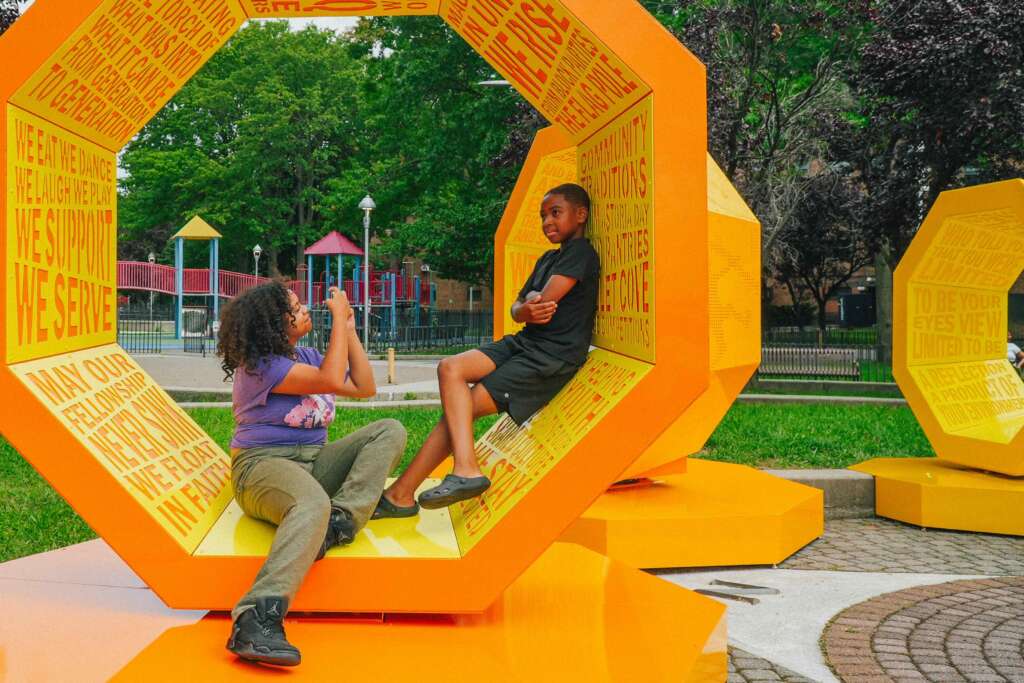
Tamra Cosby, 28, said it was “very humbling” to hear her Astoria Houses neighbors—some of whom she’s known for over a decade—speak candidly about personal doubts and worries. Her new sculptures have fellow residents’ words etched into them.
Tamra Cosby, a 28-year-old poet and resident of Astoria Houses, led poetry workshops for her neighbors for more than a year and a half, with a goal to get residents involved in the design of their new outdoor gathering area.
Cosby, who’s lived there since she was 6, took on the role after being accepted into the program From Roots to Arts, funded by the Public Housing Community Fund (PHCF), which supports a 20-month residency for five artists—one in each borough—and includes funding to construct a physical space determined by resident feedback.
Cosby said she was surprised when she was accepted, and spent the next year and half getting to know her neighbors—from children to adults she’s known for decades—through poetry prompts and emotional conversations, an experience she described as “a blessing.”
“One of the ladies used to do my hair when I was younger,” Cosby explained. “To be able to get to know her on a different level, and see her creativity blossom on another level, was amazing.”
After beginning her fellowship in September 2024, Cosby hosted dozens of poetry workshops, offering at least one each week, and community events, like open mics and Father’s Day brunches.
From those, she created a record of poems, thoughts and experiences residents shared to form the brainchild for Astoria Houses’ new outdoor sculptures.
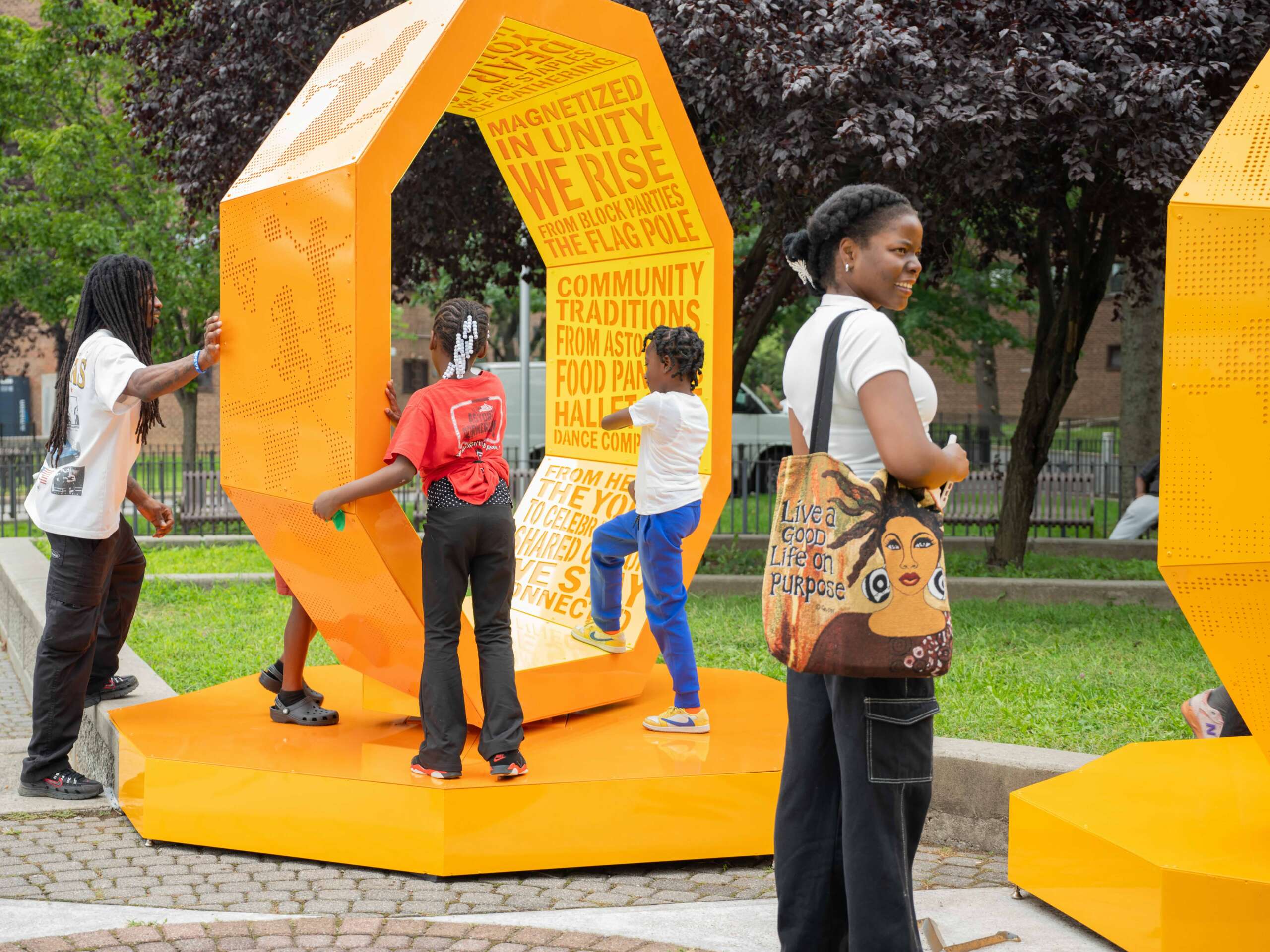
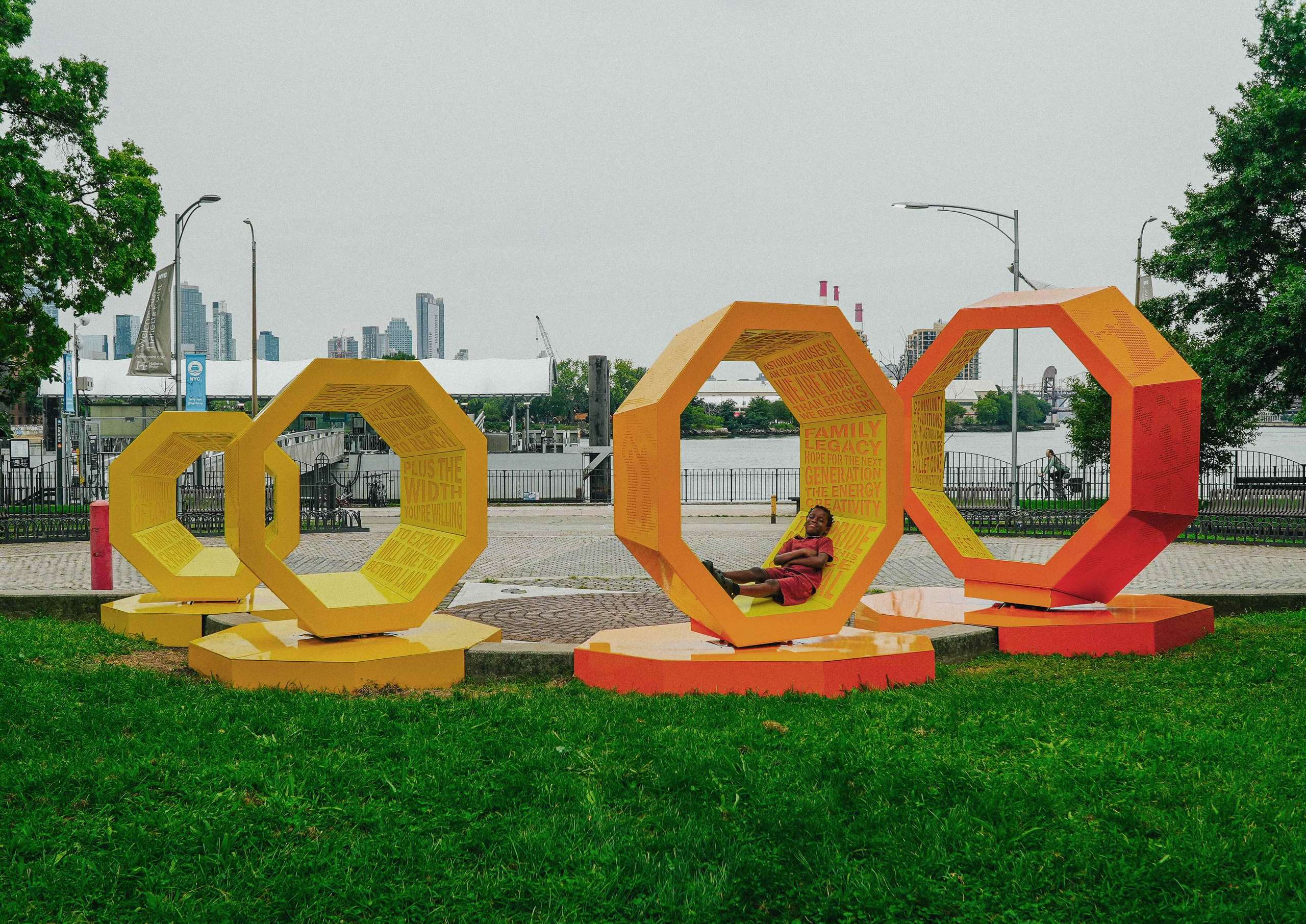
Collectively called “Revolving Voices,” the art installation was unveiled in September, and includes a series of rotating, megaphone-inspired sculptures that serve as gathering, performance and play areas, with stories residents shared etched into the metal.
Funded by a $3 million grant from the Mellon Foundation, the artist residency is a first of its kind from the PHCF, a nonprofit that was created by New York City Housing Authority (NYCHA) in 2016 to bring together design and construction groups for public projects that are funded by private donors.
In the program, artists complete a 20-month paid residency at a NYCHA campus in each borough, and are tasked with creating an artistic vision for a physical space project that integrates input from residents.
The residency required weekly workshops with public housing residents—and as a poet, Cosby said she most often talked through literary devices and used poetry prompts to help groups feel more comfortable sharing their thoughts on themes like gratitude and hardship. She said many conversations she had surprised her.
“Hearing mothers talk about feeling like they didn’t do enough, or being a single mother helped me get to know people in my community more,” Cosby explained, “and it was very humbling.”
“They shocked me with how personal they got, because I know y’all outside here and I know you’re not that vulnerable,” Cosby said. “I was able to ask them about motherhood and womanhood, there was a lot of healing and it was insightful for me too.”
With the children, she said, she focused on literary devices that were easier to visualize. She used prompts like “emotion mapping” or asking kids to write poems based on what they think emotions like anxiety, joy, or anger look and sound like.
Beyond the residency requirements to host workshops and facilitate designs, Cosby said she curated events that brought dozens of people out, which she credits for boosting interest and enthusiasm for the project.
“The first one was an open mic, and one of the ladies free-styled,” Cosby said. Another event she held was a Father’s Day brunch, where she “invited poets who are dads to share poems while the other dads were treated to brunch.”
One resident who attended the events, Cheryl Seaton, told City Limits that her experiences at the workshops, which included jumping “double dutch and straight rope,” and playing “kickball, handball and dodgeball,” were potent reminders that she was “blessed as a kid growing up in Astoria Houses.”
“I am so grateful that I was part of the design process,” Seaton said, adding that she’s noticed “the community sits and reads the words inside the artwork.”
“When people read the words, they will see we are a community that loves one another,” she said.
“It was beautiful to hear people pour back love to themselves through the writing,” Cosby said.
Kemi Karim,senior manager of art and culture at PHCF, said she believes art can help create a space where people can share emotional burdens, and that public housing residents don’t always have those spaces.
Karim, who grew up in Bushwick Houses, described part of her experience as a public housing resident as feeling “sometimes forced to be emotionally hardened.”
“When you are living in an apartment and your ceiling is chipping away, and your bathroom has mold, and you have roaches crawling in and out of the crevices in the house, and your elevator may or may not be working,” she described, “sometimes you harden yourself in order to handle your environment, and there’s no time to think about your feelings and emotions.”
Some people, Karim said, don’t have the language to express their feelings but can find it easier to identify and become aware of their thoughts through creative expressions, like poetry or painting.
“Seeing the light come back to people’s eyes from day one to day 60 is a powerful thing,” Karim said. “Part of what vulnerability means is coming to terms with how much you’ve held onto and not expressed, and part of the art is understanding how you’re feeling even if you don’t have the language for it.”
Part of Karim’s job also includes connecting resident artists with design groups, and for the Astoria Houses project, PHCF and Cosby worked with The Urban Conga, a design studio based in Bushwick that’s focused on social activities and urban play structures.
By the time The Urban Conga team joined the project in September 2025, around a year after Cosby’s residency started, conversations shifted from sentiments collected in poetry workshops and events to developing a design to encompass it all.
Ryan Swanson, the principal of The Urban Conga, explained that with many of Cosby’s workshops already done, “our lives were made so much easier coming in and collaborating because she had that relationship, and community members walked through the door easier.”
From there, he told City Limits, options on how the space would function and look were whittled down over about seven large meetings with residents, plus several smaller ones.
Collecting thorough input from residents, he said, is also a priority for his group. With Cosby, the group hosted crafts events, like making postcards, recording audio messages, taking photos around themes like choosing leaders in the community, to create an archive of ideas.
The symbology of the megaphone, Cosby explained, comes from a shared value amongst the residents’ to encourage each other “to speak out against anything that they may face, whether that’s personally or collectively as a community.”
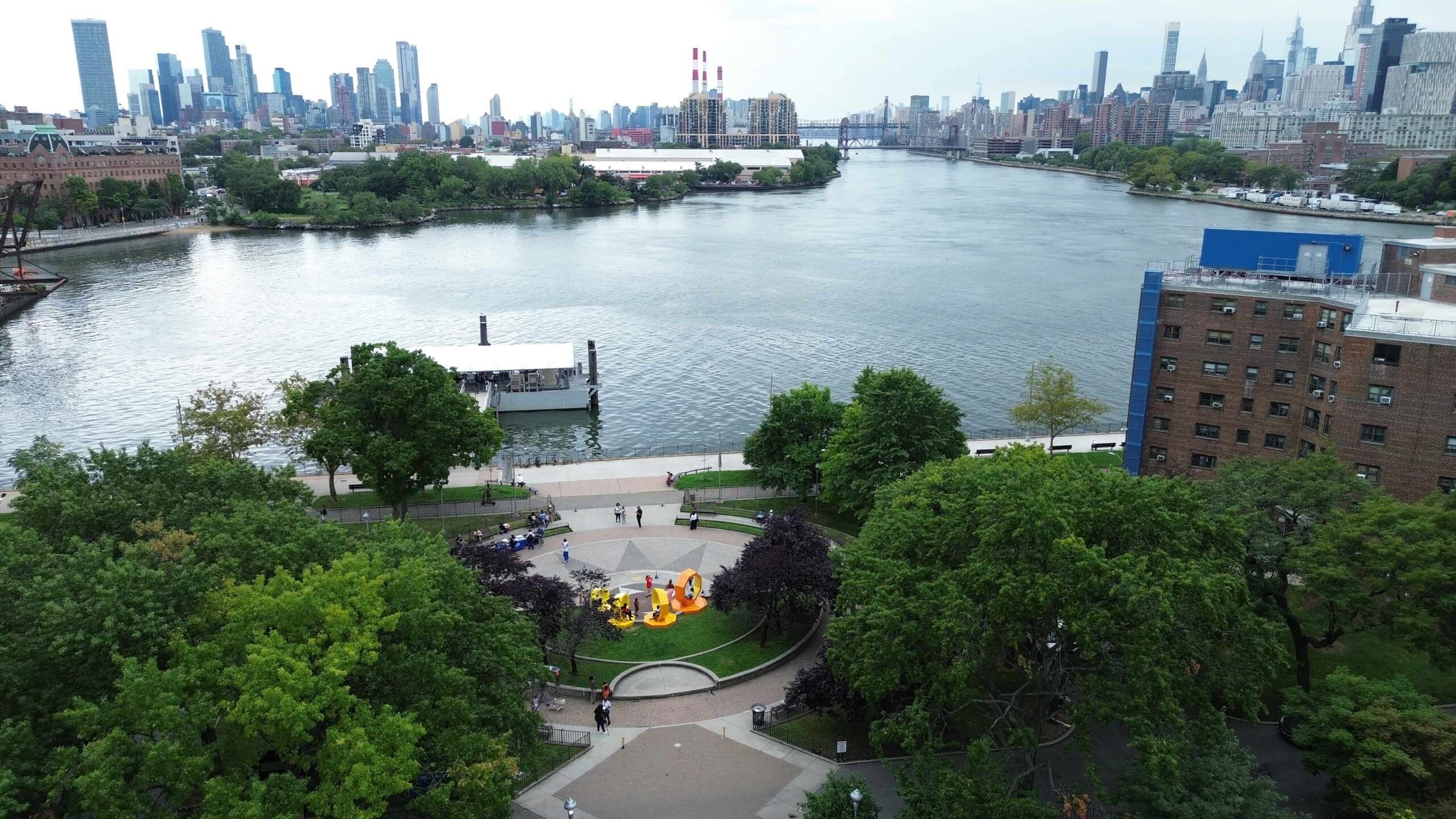
The neighborhood surrounding the Astoria Houses has changed dramatically in recent years, with the addition of a NYC Ferry landing in 2017 and a flurry of new development along the Halletts Point waterfront.
“The ferry stop is right there, and people would kind of wander into the community not knowing that people lived there,” Swanson said.
“There’s no sign to tell people to sit or touch it,” he said of the art installation. “People who are visiting ask those questions, and it creates a connection to the space which I find quite beautiful.”
Challenges of the project were few, he said, and namely included finalizing the technical concepts of the rotating sculptures while ensuring safety and durability.
“NYCHA was really willing to work back and forth with us to make it work, which was great,” Swanson said. “They were very open and wanted the process to stay true to the design the community wanted as much as possible.”
The Urban Conga has completed about seven projects with NYCHA so far, Swanson said, adding, “this was our first full collaboration with another artist, and the magic can be seen in what was created.”
To reach the reporter behind this story, contact [email protected]. To reach the editor, contact [email protected]
Want to republish this story? Find City Limits’ reprint policy here.