


Share This Article
“A group of radical activists took over a tiny park near Wall Street and did the seemingly impossible: They got thousands of disaffected, cynical, frustrated people—including me—to believe that a better world was possible.”
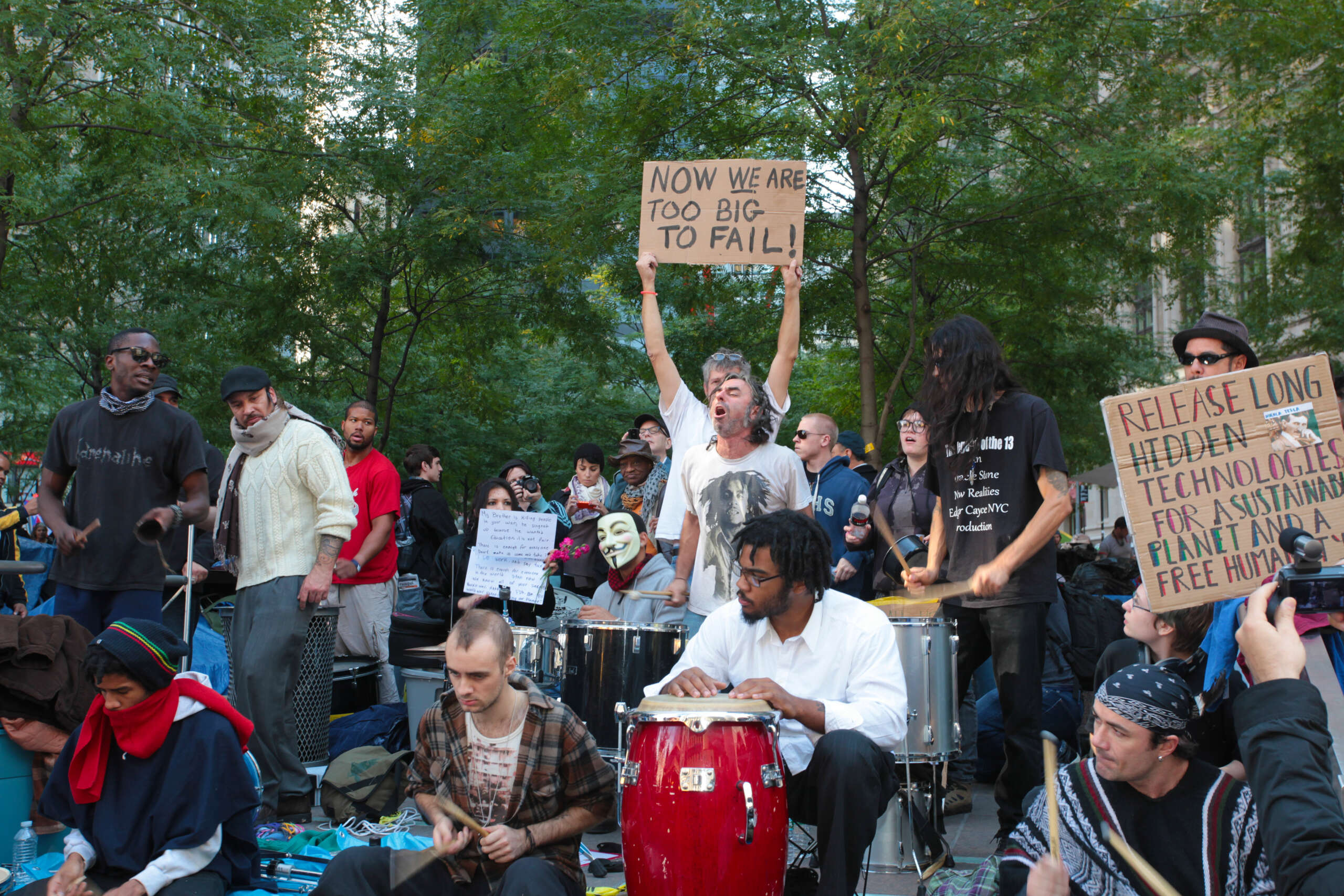

I’ve spent the last year reporting on a movement that most people, if they even remember it, consider a failure: Occupy Wall Street. It was, as many occupiers I spoke to agreed, a hot mess. But it was also the most inspirational event in many of our lives.
To tell the story of the Occupy movement, which began 15 years ago Thursday, we have to go back a little further. In 2008, Wall Street’s short-sighted bets on subprime mortgages caused a global financial meltdown.
The Democratic president who had promised hope and change handed out a $700 billion bailout to the banks that caused the crash. Those same institutions paid their top earners enormous bonuses while millions of ordinary people lost their jobs, homes, and retirement savings. My partner and I were both laid off. We put ourselves on an austerity budget to make unemployment checks stretch and asked our landlord to reduce the rent. He declined.
Thankfully, I found a (lower-paying) job within a few months, and my partner’s involuntary transition into the gig economy worked out. We recovered financially, but I was left deeply cynical about the Democratic establishment. Prominent Democrats gave endless speeches about punishing Wall Street greed and helping working families, but seemed unable or unwilling to make structural changes to an economic system clearly stacked against most of us.
The Right had its Tea Party movement, shaking up the Republican Party. The Left remained mostly quietly angry. Complacent. Until Occupy Wall Street.
In 2011, three years after the crash, a group of radical activists took over a tiny park near Wall Street and did the seemingly impossible: They got thousands of disaffected, cynical, frustrated people—including me—to believe that a better world was possible.
The activists arrived at Zuccotti Park on September 17 with sleeping bags and an attitude that felt revelatory: Don’t ask permission. Take up space. Don’t wait for someone to save us. Imagine the world we want and start building it ourselves.
They also brought a different way of organizing. There was no charismatic leader, just facilitators running twice-daily general assemblies where anyone could speak. Without permits for amplified sound, speakers used the “people’s mic,” with the crowd repeating each sentence so everyone could hear. Decisions were made by consensus, using hand signals to indicate agreement or disagreement.
Protesters marched through Manhattan chanting, “Banks got bailed out, we got sold out!” But it was what happened inside the park that inspired people to leave the comfort of home and sleep on concrete for weeks. There were small group discussions where people from different backgrounds commiserated over their struggles, discussed ideas, and brainstormed solutions. They were learning about mutual aid and putting it in action. Creating community and learning how to organize themselves. And all of it was happening in a little anti-capitalist village that occupiers were building themselves.
There was a kitchen serving free meals, a library that amassed 5,000 books, a medical tent, sanitation and security crews, and a free store where people could get sleeping bags or clothes. Volunteers ran everything, with supplies paid for by individual donations.
For many of us who grew up with the bootstrap individualism of white America, this was the first time we had participated in a collective. And it was inspiring. I pedaled the stationary bike that powered their generator and brought food to the kitchen. The vibrant, sometimes goofy atmosphere in Zuccotti Park felt like a reprieve from the punitive world outside of it.
Quickly, Occupy Wall Street became a worldwide movement. Copycat occupations sprang up across the country and around the world. At first, many Democratic politicians seemed mystified. There were jokes about Occupy having no demands and no leaders. Hecklers yelled, “Get a job!” and pundits questioned what occupiers were hoping to accomplish by living in a park.
But Occupy did accomplish something extraordinary: It changed how Americans talked about capitalism and class. “The 99 percent versus the 1 percent” transformed the usual left-versus-right political frame into one focused on economic power. Occupy exposed structural inequality and punctured the myth that financial security is simply the result of individual choices—that wealth is always the reward for hard work and poverty a personal failure.
There were, of course, problems. Radical inclusivity also meant infiltrators were welcomed in. Meetings could be unwieldy and endless. There was infighting over tactics. Things sometimes turned violent, mostly at the hands of police but also between occupiers. After 59 days, police forcefully cleared the park in the middle of the night, arresting 200 people in the process.
The conventional wisdom is that Occupy failed. It did not dismantle capitalism or produce a lasting political organization. But it prompted a political shift that would have been difficult to imagine before the movement. Politicians who challenged corporate power, such as Bernie Sanders and Elizabeth Warren, moved into the mainstream. Ideas once considered marginal, including student debt relief, became national talking points. Support for unions started to grow.
Although it didn’t change much structurally, Occupy made dissent more common and motivated thousands of people into action—which is why I think it’s important to remember Occupy on its 15th anniversary. We desperately need a reminder of what hope feels like—and a reminder that we, as a collective, don’t have to wait for our leaders to solve the nation’s problems.
Now, economic inequality is even more pronounced. At the same time, President Donald Trump and his administration are attacking democratic institutions and making America feel unsafe for many people because of where they were born, the color of their skin, or their gender.
The response from many universities, media companies, and corporations has been acquiescence: Make deals, self-censor, quietly discontinue programs that might upset those in power. Meanwhile, the Democratic Party continues to stumble and get stuck in internal debates.
It’s unclear what, if anything, will stop the trajectory we’re on. Maybe the Democrats, despite being disorganized and outspent, will sweep the midterms and finally have enough muscle to block some of Trump’s most inhumane policies. Maybe the MAGA movement will collapse in on itself.
However, I don’t think we can count on the electoral process or traditional protest, like the No Kings marches, to turn the tide. We need something that, like Occupy, will awaken a cynical and disengaged populace, bring us together in a way that feels powerful, and force the world to pay attention. We’ve seen that Occupy spirit in Minneapolis’s response to ICE; we need to expand that level of fierce, creative, decentralized dissent into something national.
We need something that brings thousands of ordinary people together to imagine a different future. Something that moves people from helplessness to action, from isolation to community, from cynicism to hope.
Occupy proved that it can happen. And if it happened once, it can happen again.
Maria Luisa Tucker is an award-winning investigative journalist and producer of the podcast series Occupy! An Unfinished Uprising.