


Share This Article
“There’s no money exchanged,” said 39-year-old Regina Carter, who sources furniture and home goods otherwise destined for a landfill, and donates them to fellow New Yorkers. “We’re just placing things in communities of need.”
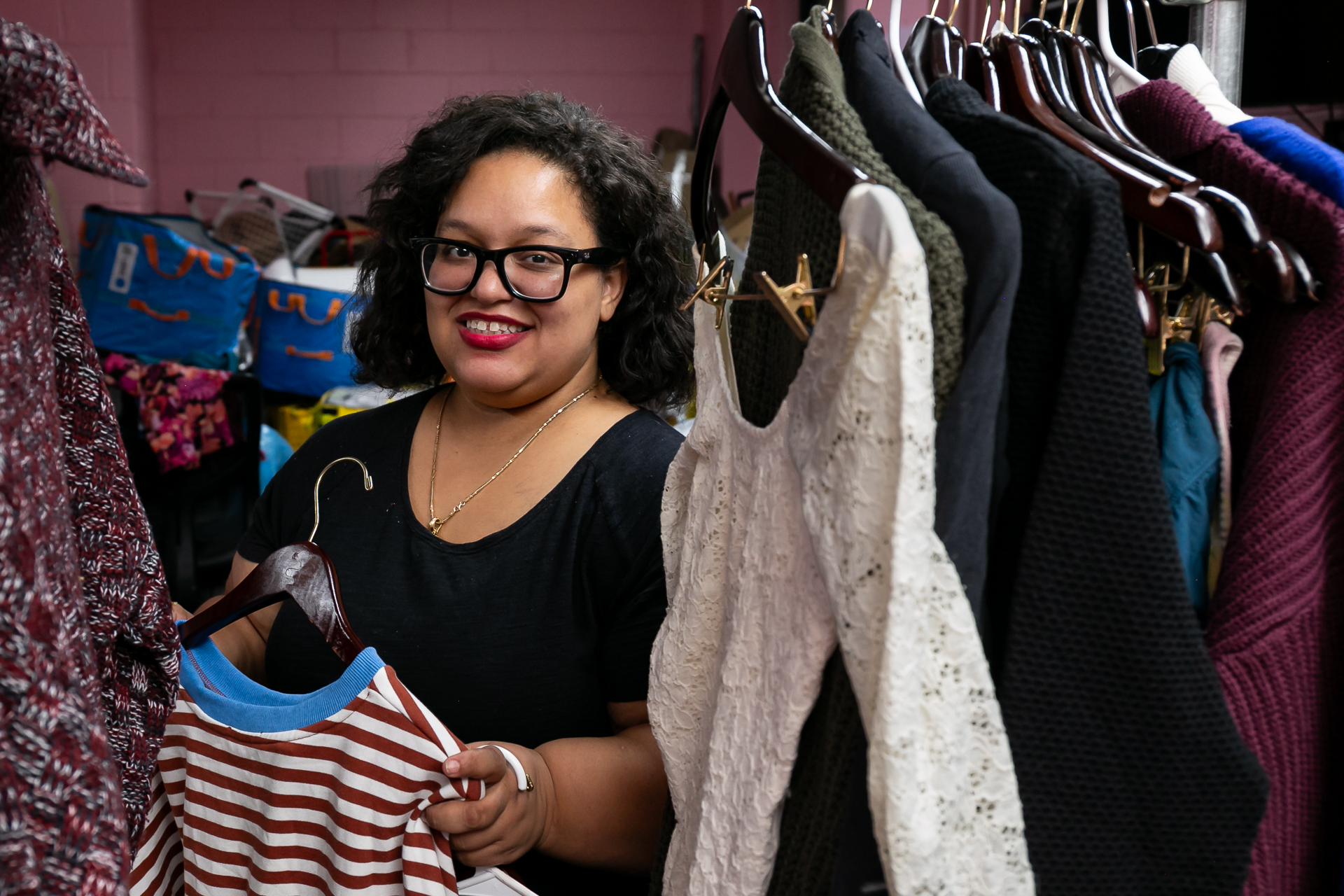
Regina Carter, a 39-year-old resident of NYCHA’s Morris Houses in the South Bronx, won a $200,000 prize on Tuesday—with no strings attached—recognizing her yearslong efforts to organize furniture giveaways for anyone in need.
Morris Houses became Carter’s first home after aging out of the city’s foster care system, she said, and she’s lived there for the last 18 years. Those experiences, she told City Limits, convinced her that “when your home is not in order, you’re not in order.”
She said she recognized many public housing residents’ need for functional furniture, and how they often lacked the time or money to secure it, something she’d experienced herself.
“When I aged out of the foster care system at 21, I had a 6-year-old and a 4-year-old, and I needed resources that weren’t readily available to me,” she told City Limits. A self-described “serial thrifter,” she said she “furnished the apartment, got the kids what they needed, all while navigating systems that were new.”
“I came to the realization that I wasn’t the only person who had those issues, but I was one of the people who was able to figure it out,” she said. “Some people just don’t have that in them, and I wanted to help people get those resources.”
Carter, now recognized by her neighbors as the “Furniture Queen,” runs Repurposed Life, a nonprofit that works with thrift stores, moving companies, and an extensive word-of-mouth system to collect home goods like desks, chairs, sofas, computers and televisions. She then hosts free pop-ups where anyone can claim the items—otherwise destined for landfills, and often in excellent condition—to New Yorkers in need on a first-come, first-serve basis.

It has earned her the recognition of The David Prize, which annually awards five New Yorkers each with $200,000—with no regulations on how that money is spent—for work that “invests in New Yorkers, and specifically, their potential.”
Past winners have included a barber in Brooklyn, a jailhouse lawyer in Queens and a hip hop therapy high school teacher in the Bronx.
“We believe that New Yorkers have the answers to improving the city,” said a spokesperson for The David Prize, which is funded by the Walentas Family Foundation, a private, family-funded organization.
Carter said her time working as a community associate at NYCHA’s social service department and volunteering with the Clay Avenue tenants’ association, which represents part of Claremont Houses in the South Bronx, helped her realize how many people were in need of furniture and home goods. And she realized she had a knack for acquiring those items.
“I was able to source from a company in Canada that is the middleman between people getting rid of stuff and nonprofits, and that’s where the furniture came in,” she said.
She started by sourcing furniture her friends or neighbors mentioned they were looking for, who would then tell others. “It created this trickle down effect, and I realized everyone needs these things and the resources are there,” Carter said. “But there’s no one connecting people to them.”
By 2022, she got a new job with the city’s Human Resources Administration, and also widened her volunteer ambitions on finding furniture for city residents, registering her nonprofit in 2024.
A few key milestones propelled its growth, she said, including working with Donate NYC in 2021, which Carter describes as like “Facebook Marketplace, but run by the city.” Through that work, she connected with Remix Market, a thrift store in Long Island City.
Left: Kaleb Spencer, 20, unloading a van filled with donated clothing and other soft goods at the Morris Houses in the Bronx in September. Right: Staff pick up a donated television. (Adi Talwar/City Limits)
“I’ve been able to furnish quite a few homes off the stuff from Remix Market alone,” Carter explained. “They get a lot of things through junk luggers, but some things don’t necessarily fit their aesthetic, or would just be better to give to a nonprofit.”
In 2022, her group contracted with Green Standards, a Canadian company that donates, resells and relocates office furniture to over 25,000 nonprofit and charitable organizations.
Carter said other sources of furniture include people who call her directly, including property managers and people who are moving, or who want to recycle furniture without fronting an expensive clean up bill.
Others, Carter said, “are just fed up with the normal donation routes,” and “like the message behind what we do.”
“There’s no money exchanged,” Carter said. “We’re just placing things in communities of need, and they enjoy that.”
On top of private donations, Carter said she’s been working more frequently with moving companies, like Eagle Transfer, which have resulted in some big recent hauls, including 150 desk chairs given in March to residents at Morrisania Air Rights, a public housing complex in the Bronx, and 55 big screen televisions she distributed outside Morris Houses.
To date, Carter has rehomed nearly half a million pounds of reused materials since launching her nonprofit—all without paying a cent for storage space. “We have people who can temporarily hold things for 48 hours,” Carter said, “but the need is so high that the stuff just goes.”
“We get items delivered to us twice a month, and we go out on a weekly basis to pick things up,” she said of her process. Then, she chooses an area that’s open to the public city to host a free pop-up to distribute the thrifted finds; past locations have included basketball courts, parking lots, or curbside setups. She aims to hold at least one pop-up each month, and hosted about 12 so far this year.
Carter said that word travels fast once she opens a pop-up. She uses her group’s social media accounts to livestream volunteers unloading items, and reaches out to people who have left their contact information with her in the past.
“The resources are never the problem,” Carter added, “but funding is always a challenge.” She estimates that each weekly pick-up costs about $500, namely spent on the truck rental, gas, and small stipends she likes to pay the volunteers who help drive and unload.
“It’s not a terribly large number, but it’s also not sustainable for a single mom who works two jobs, does the kids, and never stops,” Carter said.
With her newfound prize money, Carter told City Limits she’s relieved she won’t be “scrambling to find funds,” but is more excited about the chance to spread the word about her work since being named a winner.
“The money is one thing, but the notoriety of the prize itself is so amazing,” she said. “People who want to spread the message of what it is I do, why I do it and how.”
The feedback she’s gotten on her work, she said, hasn’t always been positive. “I’ve had so many people tell me, ‘People don’t actually need the things you’re giving them, you’re enabling them.'”
“But I remember being 21 and needing these things,” she said. “These things were going in the garbage anyway. We’re helping people, and we’re helping the environment. Is it really that bad of a thing?”
To reach the reporter behind this story, contact [email protected]. To reach the editor, contact [email protected]
Want to republish this story? Find City Limits’ reprint policy here.