


Share This Article
“An indirect source rule (ISR) would be a win-win for the people of New York, especially for environmental justice communities that have been overburdened by the unregulated surge of mega-warehouses.”
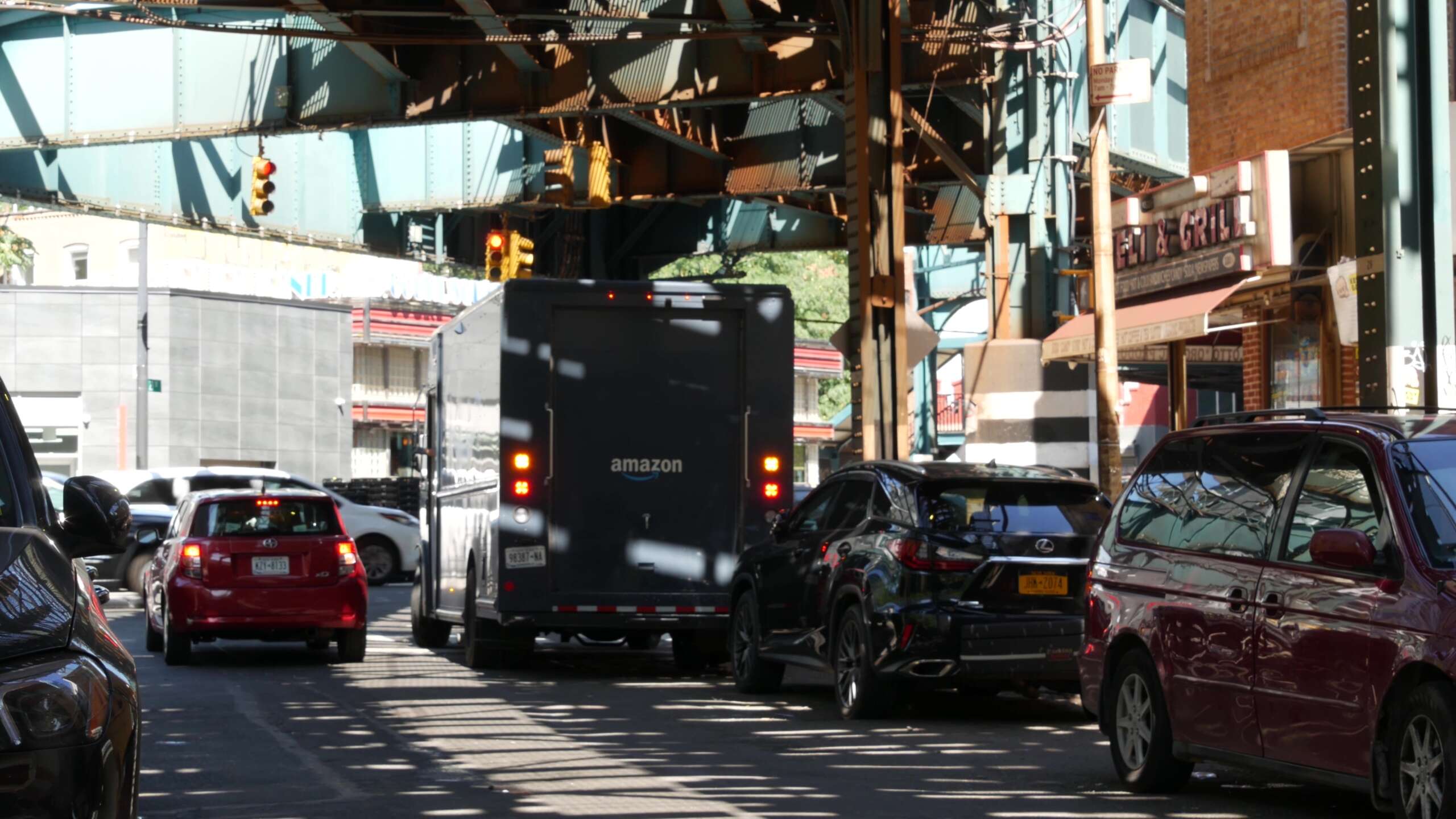

The Mamdani Administration’s backing of the Delivery Protection Act has put e-commerce giants like Amazon back in the spotlight. After a summer of New Yorkers having their plans upended by dangerous air quality alerts and extreme heat, the urgency to address the impact of distribution centers, mega-warehouses, and their associated truck traffic has never been clearer.
The New York City Environmental Justice Alliance (NYC-EJA, a citywide coalition of environmentally over-burdened communities) supports the Delivery Protection Act, and believes the city must go further to ensure clean air for all New Yorkers by adopting an indirect source rule (ISR).
NYC-EJA and the Last-Mile Coalition have advocated since 2021 for an indirect source rule to hold facility operators, such as large warehouses, accountable for reducing air pollution generated by the heavy truck traffic they attract into surrounding neighborhoods.
“[The warehouses and truck traffic] just kind of appeared out of nowhere,” says Tevina Williams of Red Hook Initiative in Red Hook, Brooklyn.
The e-commerce boom has concentrated mega-warehouses and distribution centers in low-income neighborhoods and communities of color already overburdened by heavy traffic, noise, and toxic emissions. The resulting air pollution increases long-term health risks, including asthma and heart disease.
This year, the City Council reintroduced a bill, Intro. 0053-2026, directing the Department of Environmental Protection (DEP) to create an ISR, and just recently DEP announced that, as part of its environmental review process, it will hold two information sessions on Sept. 15 and 16 for the public to learn more about the proposed Warehouse Indirect Source Emissions Reduction, or WISER, program.
Modeled after Southern California’s successful Warehouse Actions and Improvements to Reduce Emissions (WAIRE) program, the proposed policy assigns facilities over 50,000 square feet a “points obligation” based on the number and type of vehicle trips to and from the facility. Operators fulfill this obligation by selecting from a menu of clean-air investments, with each option assigned a points value based upon the cost of the investment and/or its air quality impact.
For example, under the proposed rule, warehouse and other large facility operators could meet their obligations by:
- Transitioning to zero-emission vehicles, cargo bikes, zero-emission yard trucks, and EV charging infrastructure, or installing anti-idling technology
- Incentivizing employee use of public transit or alternative commute options
- Participating in municipal traffic-reduction initiatives.
Under such a system, New Yorkers will keep fast delivery services while warehouse operators invest in cleaner operations.
NYC-EJA and the Last-Mile Coalition are pushing for a strong rule that reduces emissions below pre-e-commerce boom levels and incorporates air quality monitoring for dangerous pollutants like NOx and particulate matter. This approach safeguards public health, the jobs of delivery workers, and community air quality.
“That is going to make a huge difference for the communities and for their health outcomes as well. We have to prioritize people over profit, and we have to prioritize our health and where we live and how we live over businesses being able to set up shop in our neighborhoods,” says Dariella Rodriguez of The Point CDC in the South Bronx.
As the federal government weakens environmental protections, states and cities need to step up to protect their communities. An indirect source rule (ISR) would be a win-win for the people of New York, especially for environmental justice communities that have been overburdened by the unregulated surge of mega-warehouses. New Yorkers’ health and wellbeing must be prioritized over corporate greed. Enacting a robust indirect source rule will ensure that fast delivery doesn’t come at the expense of public health or quality of life.
Eddie Bautista is the executive director at New York City Environmental Justice Alliance ( NYC-EJA). Paul Jones III is a transportation planner at NYC-EJA. The Last-Mile Coalition is a citywide group of environmental justice and public health advocates fighting to regulate polluting e-commerce or “last mile” facilities in New York City.