


Share This Article
What the 2026 Democratic primary reveals about demographic change, coalition politics, and unequal political participation.
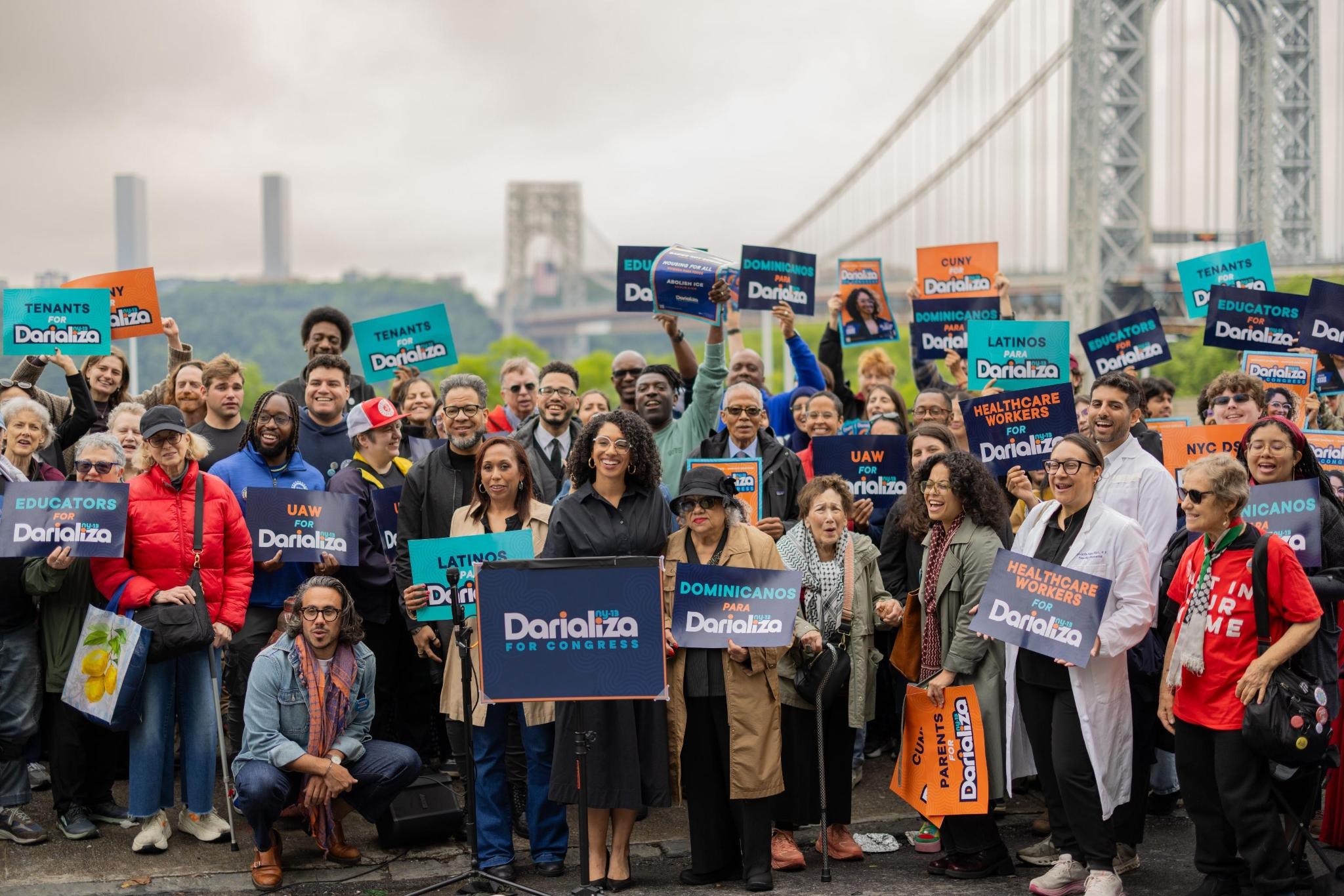

Writing in 1994, in the aftermath of the contentious congressional contest between Charles Rangel and Adam Clayton Powell IV in New York’s then-15th Congressional District, Manning Marable offered observations that would prove remarkably prophetic.
Marable, the late Black historian and public intellectual, recognized that any future contender for the seat would need to account for the district’s rapidly growing Latino population. He understood that the district of 1994 differed significantly from the one Rangel first won in 1970, when he defeated Adam Clayton Powell Jr. (the father of Adam Clayton Powell IV). It was no longer only the long-established Puerto Rican community in East Harlem whose political preferences would shape congressional elections; the voice of the rapidly expanding Dominican community would also become an increasingly influential force.
Marable called this change the “wild card in Harlem’s political future.” What perhaps Marable could not see in 1994 (though he surely did after) was the gentrification Harlem would experience in subsequent decades. This brought about a drastic increase in the white population in what was and continues to be considered the mecca of Black cultural life in New York City. Recent data indicates that white residents now comprise over 17 percent of Central Harlem’s overall population.
The effects of this gentrification notwithstanding, Marable was right about the district: 22 years after that 1994 essay, Adriano Espaillat would become the first Dominican congressional representative in the nation’s history, defeating Keith Wright, the Manhattan Democratic Party chair, who sought to succeed one of his mentors, Charles Rangel, in Congress.
Thus, the 13th Congressional District—as it is now—would again become a seat of “firsts.” Remember, this was the congressional seat that would make Adam Clayton Powell, Jr. the first Black member of Congress in New York history. Rangel then held the seat for almost half a century. As Christina Greer has written, “For more than seven decades, Powell and Rangel made the district synonymous with Black political power.”
But the demographic change Marable foresaw, spurred by the growth of the (mostly Dominican) Latino population and coupled with a rise in the white population in Harlem, would drastically shift the political dynamics of the district.
The political earthquake felt even beyond the 13th Congressional District last month is yet another manifestation of what Marable envisioned over 30 years ago. Espaillat, who had made history just a decade ago, was dethroned by Darializa Avila Chevalier, a Democratic Socialist of Dominican descent.
What is emerging is what Marable hoped—a truly multiracial and multicultural district where the needs of the most vulnerable may be met through a bottom-up approach to organizing and community-building. (This much was made clear not only through the organizing efforts of the Avila Chevalier campaign but the massive ground operation put together by UAW Region 9A on her behalf.)
My analysis of the recent 13th Congressional District race reveals several elements that are noteworthy: While Espaillat won the bulk of Latino-heavy election districts (EDs), and overwhelmingly so in some of them, Avila Chevalier won the Black-majority EDs, majority-white EDs, and racially-mixed EDs (i.e., EDs that share almost equal representation of Latino, Black and white voters).
Young voters, whom I have classified as 18-34 years of age, comprised 20 percent of the overall vote. This was more than double the typical turnout in this age group, nearly equaling the turnout by this demographic in last year’s mayoral primary, when Zohran Mamdani managed to draw out these typically disengaged voters.
The demographic make-up of this young adult age group is fascinating. More than half of its members reside in the 70th and 71st Assembly Districts. Interestingly enough, within the 13th Congressional District, these two Assembly districts have experienced significant gentrification over the last 20 years.
The 13th Congressional District also includes Columbia University, where many voters tend to skew whiter and younger. Nevertheless, it is equally important to note that almost half of the voters in this younger age group were Black and Latino. It is also important to note that Avila Chevalier defeated Espaillat in these areas.
Also of note here is where the youth vote lagged. For that we must turn our gaze to the Bronx. Only 8 percent of the overall vote in the Bronx portion of the 13th Congressional District was in the 18-34 age group. To be sure, the lack of young adult voter participation in the Bronx is not a “youth problem”: The Bronx as a whole has long experienced a serious lag in voting participation. In relation to this particular congressional race, the data reveals the following:
- 22 percent of all registered voters in the 13th Congressional District reside in the Bronx. Yet they accounted for only 12 percent of all votes cast in the election.
- Only 8.42 percent of all eligible voters in the Bronx portion of the district participated in the election. Put differently, 91.58 percent of eligible Bronx voters did not vote.
- In contrast, 17 percent of eligible voters in the Manhattan portion of the district participated. While that level of turnout is hardly impressive, it is nonetheless more than double the participation rate in the Bronx.
This pattern repeats itself election cycle after election cycle. Is it merely coincidental that the borough with the city’s highest poverty rates, among the highest crime rates, lower educational outcomes, and lower levels of college attainment, is also New York City’s only Latino-majority borough? These correlations warrant serious attention and raise important questions about the structural barriers that may be contributing to chronically low voter participation.
Unfortunately, despite years of hard data pointing in the same direction, these realities too often fail to generate the sustained public discussion or policy response they deserve.
Much has been said lately about the potential erosion of identity politics within New York City elections. However, as long as these economic, educational, and crime-related disparities exist between the Bronx and the other boroughs, identity politics will continue to shape how campaigns are run, how resources are allocated, and ultimately, how communities are represented.
It is difficult to argue that identity no longer matters when one of the city’s largest groups—the Latino community—continues to experience such profound disparities in civic participation. Until the structural conditions that suppress political engagement are addressed, identity will remain not simply a matter of electoral strategy, but a reflection of unequal political power.
To be sure, this is not only a “Latino” problem. Black voters also continue to experience the harsh consequences that unjust structures create. Which brings us back to Marable. Similar struggles should not lead to isolated attempts at ameliorating sociocultural ills and civic engagement. Isolation inhibits an effective politics of coalition building.
The results of the 13th Congressional District point to the possibilities of a political future that attends to the particularities of the struggles of the most dispossessed, while combating the causes of the struggles through real coalition building—on the streets and in the voting booth.
As Manning Marable said: “What is desperately required is a breakthrough of political imagination, of a social vision of democratic empowerment liberating the energies, talents and abilities of the most oppressed and alienated members of society.”
Eli Valentin is an assistant dean at Virginia Union University’s Graduate Center in Harlem and the author of “Politicking in the Barrio: Essays on Latino Politics in New York.“